Leave Your Vacation Rental Management to Us
Free Online ConsultationGuest Trouble Prevention and Insurance: Set Them Up Before You Start Operating
Deciding how to handle guest trouble and which insurance to choose is a business decision you need to make before you ever list your property — not after something goes wrong. Whether you’re operating under the Minpaku Business Act (the “new minpaku law”) or the Hotel Business Act, guest-related issues are simply inevitable. At Stay Buddy, we manage multiple properties on a day-to-day basis, and we can tell you from experience: the gap between owners who “figure it out after it happens” and owners who “prepare before it happens” is enormous — both in financial losses and in peace of mind. In this article, we break down 10 real-world categories of guest trouble and share our approach to rule-setting and insurance planning.
10 Types of Guest Trouble We See on the Ground
1. Damaged Furniture or Fixtures (Unreported)
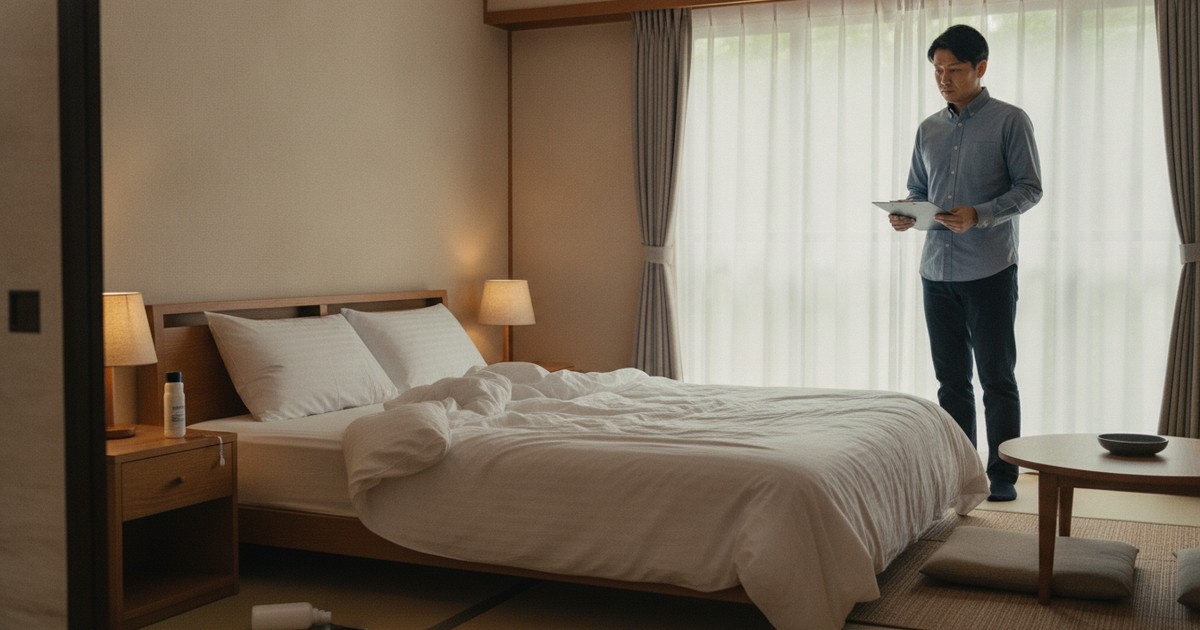
Discovering a scratched table or a stained sofa during post-checkout cleaning is one of the most common issues you’ll encounter. Since guests often check out without saying a word, there’s no way to pinpoint who’s responsible without photographic evidence. Simply making photo documentation at check-in and check-out a standard rule dramatically strengthens your position when it comes time to make a claim.
2. Noise and Late-Night Parties
Complaints from neighbors sometimes reach owners through property management companies or local authorities. In one property Stay Buddy manages, a neighbor called our emergency line directly late at night, and our on-site staff responded in person at 11 PM. Proactively informing guests in advance, along with a house rule stating “please keep indoor conversation at normal volume after 10 PM,” has proven to be an effective deterrent.
3. Exceeding the Guest Limit
This is when more guests stay than were booked. Beyond the practical inconvenience, exceeding occupancy limits also carries legal risk, since it can violate fire code capacity limits as well as the conditions of your permit under the Minpaku Business Act or Hotel Business Act. Properties that can verify the number of people entering — through smart lock logs or cameras — tend to see fewer incidents of this kind.
4. Garbage Disposal Rule Violations
Neighbors file complaints when guests don’t follow local rules for sorting trash or collection days. Including a garbage disposal guide in multiple languages in your welcome book goes a long way toward reducing complaints. Translation services can often handle this for just a few thousand yen, so the cost barrier is low.
5. Smoking in Non-Smoking Areas
Removing smoke odor requires more than a standard cleaning, and if it can’t be resolved before the next guest’s check-in, you may be forced to cancel a reservation. The basic safeguard is to clearly state your no-smoking policy in three places: the property description on your booking platform (OTA), the house rules, and the welcome book.
6. Key and Smart Lock Issues
A guest who can’t get the door code to work, or finds the lock battery dead at check-in, starts their stay with a terrible first impression. The realistic fix is to set a regular battery-replacement schedule and establish a clear backup communication flow for when things go wrong.
7. Unauthorized Subletting or Commercial Use
Sometimes a property gets used not for lodging but as a photo studio or meeting space. Using a permitted property outside the scope of its approved purpose can be a problem under both the Minpaku Business Act and the Hotel Business Act. Properties that make a habit of confirming the purpose of stay through OTA messaging tend to catch this type of issue earlier.
8. Payment Disputes and Chargebacks
Credit card chargebacks — where a guest disputes a charge with their card company and demands a refund — can occur even on bookings made through an OTA. It’s important to confirm in advance what’s covered under the platform’s host guarantee program, including its payout limits, and to have a response plan ready for cases that fall outside that coverage.
9. Boundary Disputes with Neighbors
This covers cases where guests trespass on or cause a nuisance in shared hallways, parking areas, or neighboring property. Clearly stating the “scope of shared-area use” in your property guide both informs guests up front and gives you something to point to if a dispute arises.
10. Complaints Over Lost or Missing Valuables
A guest claiming “my item went missing” can quickly turn into suspicion directed at your cleaning staff. Recording video before and after cleaning staff enter the unit, along with a documented process for handling lost items, gives you a reliable way to verify what actually happened.
How to Build Rules That Prevent Trouble Before It Starts
A house rules document that’s just a list of “don’ts” doesn’t actually work. Pairing each prohibition with its reasoning — and with the consequence of violating it, such as additional charges or being asked to leave — gives guests a reason to buy in, which makes the rule far more effective as a deterrent. Most OTAs allow hosts to set their own house rules that guests must agree to, but rules that contradict the platform’s own cancellation policy or terms of service simply won’t hold up. So it’s essential to check that your house rules align with each platform’s terms.
More and more properties are automating check-in communication, but skipping rule explanations entirely can actually raise your risk of trouble. The practical approach is to include the key points of your house rules directly in your message templates, so guests have an easy way to review them.
How to Think About Insurance as Part of Guest Trouble Prevention
Under the Minpaku Business Act (the “new minpaku law”), operators of registered properties are effectively required to carry liability insurance (see the registration requirements under Article 5 of the Act and the Ministry of Land, Infrastructure, Transport and Tourism’s interpretive guidance). For facilities licensed under the Hotel Business Act as well, carrying facility liability insurance is a basic part of sound risk management.
When choosing a policy, the key things to check are: the coverage limits for bodily injury and property damage liability, whether guests’ personal belongings are covered, and the scope of coverage for damage to the building and furnishings (i.e., protection for the host’s own property). Host guarantee programs offered by OTAs (such as the damage protection programs some platforms provide for hosts) are not the same as insurance — they come with detailed conditions and exclusions. The standard approach to risk management is to carry a separate insurance policy rather than relying on these programs alone.
Premiums vary widely depending on the size of the property, its location, and the scope of coverage, so there’s no simple answer like “expect to pay X per year.” The right first step is to get quotes from multiple insurers or agencies and make sure there are no gaps in your coverage.
Free Consultation and Inquiries with Stay Buddy Inc.
As a company specializing in vacation rental and hotel business management, Stay Buddy takes on the operational burden for owners — from handling guest trouble on the ground, to setting up house rules, to advising on insurance choices. You’re welcome to reach out even if you don’t own a property yet and simply want to talk things through before you get started.</p
We tailor our management services flexibly to fit your property’s size, location, and business format — from a full-package solution covering cleaning coordination, guest communication, pricing management, and neighbor relations, all the way down to partial support for specific tasks only.
In your first free consultation, we’ll listen to your current situation and concerns, then walk you through the operational risk points and how to address them. We’ll also share our on-the-ground perspective on choosing insurance and aligning your rules with OTA requirements. Feel free to reach out anytime through our contact form to get started.