Leave Your Vacation Rental Management to the Experts
Free Online ConsultationThe Problem With Being 10,000 Kilometres Away
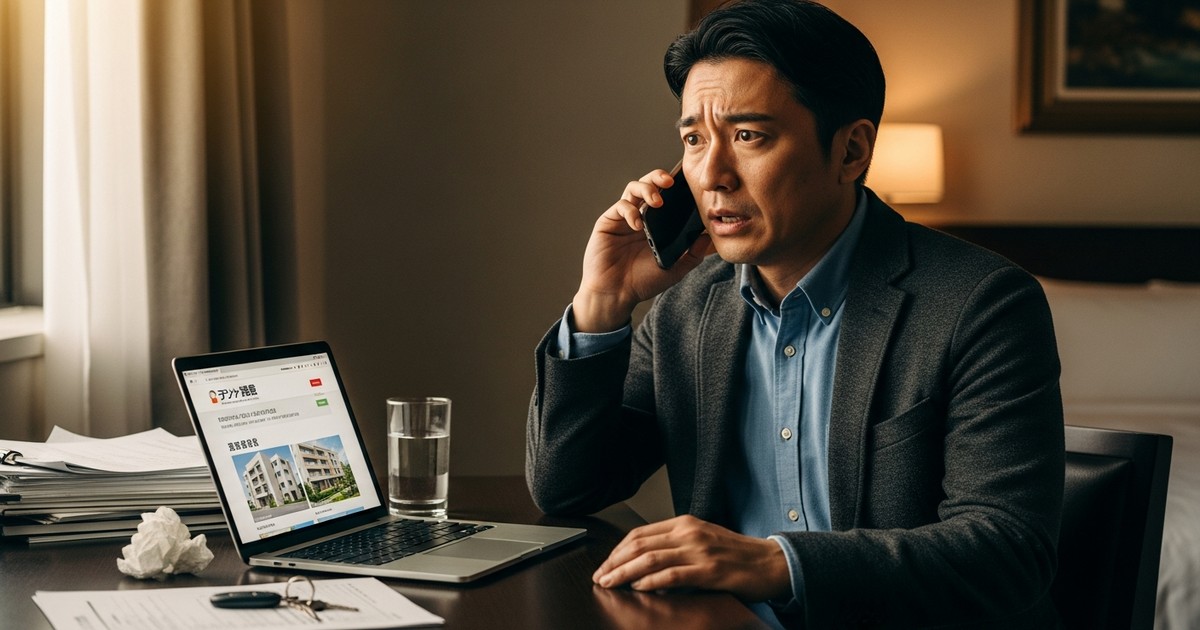
Owning a short-term rental or ryokan in Japan while living abroad is entirely workable — thousands of overseas landlords do it successfully — but it does create one genuinely awkward situation: something breaks at two in the afternoon local time, your guests are checking in at four, and you are asleep on the other side of the world. A pipe joint fails under the kitchen sink. The air-conditioning unit trips a breaker and refuses to restart. A sliding shoji frame splinters and the door no longer closes. None of these are catastrophic, but all of them require a decision — and money — within hours, not days.
How that decision gets made, who authorises the spending, and how you find out afterwards is not a minor administrative detail. It sits at the centre of whether your management arrangement genuinely protects you or simply creates the appearance of oversight while leaving you exposed to surprise invoices, guest refund claims, or — in the worst case — a compliance incident that threatens your operating licence.
This article walks through the practical and legal landscape of emergency repairs in a Japan rental property, written specifically for owners who cannot physically be present. By the end, you should know exactly what questions to ask any management company before you sign, and what a robust repair-authorisation system actually looks like in practice.
Why Japan’s Licensing Framework Makes This More Consequential Than You Might Think
Before getting into the mechanics of repairs, it is worth understanding why property compliance sits at a higher level of scrutiny in Japan than in many other markets. Short-term rental operations fall under one of three main frameworks, and each carries specific obligations that an emergency repair can inadvertently touch.
Minpaku Law (Housing Accommodation Business Act) Properties
If your property operates under the national Minpaku Law — formally the Housing Accommodation Business Act, enacted in 2018 — you are capped at 180 operating nights per calendar year. More importantly, you are required to notify the relevant prefectural or municipal authority of your management arrangements and maintain certain safety standards as a condition of registration. Structural elements, fire-detection equipment, and emergency egress routes all fall within the scope of what inspectors look at. A repair that is done cheaply and quickly but not to code can create a compliance problem that surfaces at the next inspection — at which point your registration is at risk, not just your plumbing.
Ryokan Business Licences
Properties operating under a ryokan licence (旅館業法) face stricter structural and hygiene standards from the outset. The licence is tied to the physical premises and to specific conditions — room dimensions, ventilation rates, fire-safety provisions — and local public health offices can inspect on a complaint-triggered basis. An emergency repair that alters a ventilated bathroom arrangement, changes the configuration of a smoke alarm, or involves a room that is temporarily taken out of service can require a notification to the licensing authority. Your management company needs to understand this; a contractor who simply fixes the visible problem without flagging potential compliance implications is not sufficient.
Special Zone (Tokku Minpaku) Variations
Some areas — notably parts of Osaka, Chiba and certain other designated zones — operate under National Strategic Special Zone (tokku) rules that permit more flexible operation, including the ability to exceed the 180-day national cap. The trade-off is that special zone licences involve their own conditions, sometimes tied to specific property characteristics. If you own in one of these zones, the management company’s authorisation to spend on repairs should be explicitly understood in the context of whether any work affects those licence conditions.
Municipal Variation Adds Complexity
Beyond the national framework, individual wards and municipalities have layered their own restrictions on top. Kyoto has imposed some of the most restrictive rules in Japan, limiting minpaku operations to certain time periods. In parts of Tokyo, individual wards have prohibited short-term rentals in residential zones entirely. What this means practically is that if your property is temporarily taken offline for repairs — even for a day — the way that absence is recorded can matter. A management company operating properly will know how to handle this; one that does not may inadvertently create a gap in your records that becomes a compliance headache.
The Two Types of Emergency: Urgent and True Emergency
When discussing repair authorisation with any management company, one of the first things to establish is how they categorise the severity of a problem. There is a practical and financial difference between something that must be fixed in the next two hours and something that is genuinely disruptive but can wait until the next business day.
True Emergencies (Immediate Action Required)
- Water leaks that risk structural damage or are actively flooding a room
- Loss of hot water with guests in residence
- Total loss of air conditioning or heating in extreme seasonal temperatures (Japan’s summers can be dangerously hot; its winters in mountain regions genuinely cold)
- Fire safety equipment failure — smoke alarms, emergency lighting
- Security failures — locks that will not engage, external doors that will not close
- Gas leaks or suspected gas leaks (these require immediate evacuation and utility contact)
Urgent But Not Immediate
- Appliance failure where a substitute can be arranged (portable fans while awaiting an AC repair, for instance)
- Internet outage — disruptive and review-damaging, but manageable if guests are communicated with promptly
- Minor water ingress through a window seal
- Toilet or sink functionality partially impaired but not fully blocked
- Damage to finishes — torn screens, scuffed floors — that affects aesthetics but not safety
The reason this distinction matters financially is that emergency contractors in Japan, as in most countries, charge a significant premium for out-of-hours callouts. A licensed plumber called to a property at ten in the evening will typically cost substantially more than the same plumber arriving the following morning. A management company that treats every problem as a true emergency — and spends accordingly — will erode your returns; one that is too slow to act will generate guest refund claims that erode them differently.
Authorisation: The Core Question
Here is the central issue for overseas owners. When a contractor needs to be dispatched and paid, somebody has to say yes. In a well-structured management arrangement, that decision should never be undefined. There are broadly three models in use across the Japan rental market:
Model 1: Owner Approval Required Every Time
In this model, the management company contacts the owner for authorisation before spending anything above a nominal amount — typically in the range of a few thousand yen. This sounds safe, but it creates a practical problem: reaching an owner across time zones during a genuine emergency may be impossible within the window available. Guests waiting for a hot water repair at nine in the morning Japan time are waiting for a call to be returned from Europe at two in the morning. The result is either a delayed repair, a frustrated management company that acts anyway and is then uncertain about its authority, or an owner who loses sleep on a routine issue.
Model 2: Blanket Spend Authority Up to a Set Threshold
The more functional model gives the management company authority to approve spending up to a defined threshold without prior contact — typically somewhere in the range of tens of thousands of yen, though the exact figure should be negotiated and written into your contract. Above that threshold, the management company must contact the owner before proceeding. True emergencies (gas, flood, fire safety) are typically carved out with authority to spend whatever is necessary and notify rather than seek prior approval.
Model 3: Pre-Approved Vendor Network Only
Some operators maintain a network of contractors with whom they have standing rate agreements, and the authorisation framework applies only to use within that network. This can be efficient and keeps costs predictable, but you should ask whether the network genuinely covers all emergency categories, including after-hours callouts.
The table below summarises the practical implications of each model for overseas owners:
| Model | Speed of Response | Owner Control | Risk of Over-Spending | Risk of Under-Spending | Best Suited To |
|---|---|---|---|---|---|
| Owner Approval Required Every Time | Slow — depends on contact success | High | Low | High (delays in emergencies) | Owners with very flexible availability and in close time zones |
| Blanket Threshold Authority | Fast for routine issues; escalated for large spend | Moderate | Moderate — threshold sets a ceiling | Low | Most overseas owners; the most common functional arrangement |
| Pre-Approved Vendor Network | Fast within the network | Low to moderate | Low — rates are known in advance | Low if network is comprehensive | Owners prioritising cost predictability over granular control |
Financial Flows: What Actually Happens to the Money
Repair costs in Japan do not exist in isolation from the broader financial structure of your rental income. Understanding how they interact is important, particularly for non-resident owners who face specific tax treatment.
Non-Resident Withholding Tax
If you are a non-resident individual owner receiving rental income from Japan, the person or company paying you — including a management company remitting your net income — is technically required to withhold twenty per cent of the gross rental income at source and pay it to the Japanese tax authorities on your behalf. This applies to individuals; corporate structures are treated differently. Repair costs reduce the gross income figure before this withholding calculation is applied, which means that how repair costs are invoiced and recorded genuinely affects your net tax position. A management company that handles this properly will provide itemised monthly statements that clearly separate income, management fees, OTA platform commissions, cleaning charges, and repair expenditure.
OTA and Cleaning Fee Structures
Most short-term rentals in Japan distribute through one or more online travel agencies. The major platforms typically charge the property owner a commission in the range of fifteen to twenty per cent of accommodation revenue, though the exact structure varies by platform and by whether you operate under a model where the guest is charged a separate service fee. Cleaning fees are often passed through to guests but are not always pure profit — you are paying the cleaning staff or cleaning company from those fees, and the margin on cleaning can be thin.
Emergency repairs that cause a same-day cancellation or require you to relocate a guest will typically trigger a full refund through the OTA, and those refunds will not return the OTA commission to you. The real cost of a mishandled emergency is therefore not just the repair invoice — it is the repair invoice plus the refunded booking revenue, plus any compensation you offer the guest, minus the commission you have already lost.
Consumption Tax
Contractors in Japan will typically invoice including consumption tax, currently at ten per cent. If your operation is registered as a business for consumption tax purposes — which becomes relevant if your taxable sales exceed a certain annual threshold — you may be able to offset this against your own consumption tax liability. If you are not registered, the tax is simply a cost. Your management company should be able to clarify which category applies to your situation, though the definitive answer requires an accountant familiar with both Japanese tax law and the treatment of non-resident landlords.
What Good Reporting Looks Like
For an overseas owner, the repair event itself is less visible than the reporting that follows it. A management company that acts well in an emergency but reports poorly leaves you managing a black box — you know money went out, but you cannot verify whether it was appropriately spent, properly coded, or compliant with your contractual authority thresholds.
A properly structured repair report should include:
- A description of the fault as first reported — ideally with photographs
- The time of first notification and the time the contractor was dispatched
- The name and licence category of the contractor used (for structural or gas work, this matters from a compliance perspective)
- Whether the repair was within or above your pre-agreed threshold, and if above, confirmation of how owner approval was sought or why emergency authority was invoked
- A copy of the contractor’s invoice, in full
- The outcome for the guest — whether they were relocated, compensated, or simply had the issue resolved without disruption
- Any compliance implications — for example, whether a fire alarm was temporarily disabled and subsequently retested, or whether any structural work requires notification to the licensing authority
If any of these items is routinely absent from reporting, that is a gap worth raising explicitly. Good management is not just operational; it is documentary.
Questions to Ask Before You Sign a Management Agreement
If you are evaluating a management company for a Japan property — or reviewing your existing arrangement — the following questions specifically address the emergency repair dimension. They are written to be asked directly, and a serious operator should have clear answers to all of them.
- What is your defined threshold for spending without prior owner approval, and how is a true emergency handled differently from a routine urgent repair?
- Do you maintain relationships with licensed contractors for each repair category — plumbing, electrical, gas, structural — and can you confirm they operate under the relevant professional certifications?
- How do you handle the situation where a repair cannot be completed before a guest’s check-in? What is your relocation protocol and who bears the cost?
- What documentation do I receive for every repair, and how quickly after the repair is that documentation provided to me?
- If a repair touches anything related to our fire safety provisions, smoke detection, or emergency egress — all of which are conditions of our operating licence — what is your notification protocol to the relevant authority?
- How do repair costs appear in the monthly income statement, and are they itemised sufficiently for me to share with my accountant in my home country?
- Under what circumstances would you take a room out of active availability without informing me, and how is this reconciled against our operating day records under the Minpaku Law framework or our ryokan licence conditions?
The Operator Difference
There is a meaningful difference between a property management company that acts as an agent — placing bookings, passing instructions to contractors, forwarding invoices — and one that operates your property as a principal. An agent’s liability for a poorly managed repair is limited; it acted on your behalf and the outcome is largely your problem. An operator who takes genuine responsibility for the property’s performance has different incentives: a poorly handled emergency damages their reputation with guests and OTA platforms, not just yours.
This distinction matters most when you cannot be present. An operator with skin in the game will have pre-agreed contractor relationships, a tested emergency protocol, clear internal authority levels, and the institutional knowledge to know when a repair creates a compliance implication that needs escalating. They will also be honest about what went wrong — because covering up a problem that later surfaces is a worse outcome for everyone.
When evaluating any management arrangement for a Japan property, look not just at the management fee percentage, but at whether the company can describe their emergency repair process clearly, completely and without hesitation. If they cannot — or if the answer is essentially “we call you and wait” — that is important information about how your property will be managed at two in the afternoon on a Thursday, when you are asleep and a guest is standing in a flooded bathroom.
A Final Word on Reserve Funds
One practical measure that overseas owners often overlook is establishing a small operational reserve — held in a Japanese yen account accessible to the management company — specifically for repairs. Rather than having the management company front repair costs and recover them from your next remittance, a standing reserve of a defined amount ensures that emergency work can be commissioned immediately, without any delay related to fund availability. It also simplifies the reconciliation process: the reserve is drawn on, rebuilt from the next income remittance, and the movement appears clearly in your monthly statement.
The appropriate level for such a reserve depends on the property type, age and location, but the principle is sound for any property where the owner is abroad and response time matters. It is a small administrative step that removes one more potential friction point from an already time-pressured situation — and in the context of Japanese rental operations, where guest experience expectations are high and review visibility is significant, removing that friction is worth the modest effort.