Leave Your Minpaku Management to Us
100% Free Online ConsultationTurning a minpaku property into a rental space is an extremely effective way to diversify your revenue streams. By renting out your property as a photo studio, party venue, or meeting room during weekday daytime hours or off-peak seasons when guest demand dips, you can boost both occupancy and overall sales. In fact, many operators running minpaku and rental space businesses side by side have seen monthly revenue increase by 1.5 times or more.
That said, combining a minpaku property with rental space use requires a different approach than standard accommodation management—covering legal considerations, property suitability, pricing strategy, and neighbor relations. This article walks through the fundamentals of using a minpaku property as a photo studio or rental space, backed by concrete figures and real-world examples.
Benefits of Using a Minpaku Property as a Rental Space
Boosting Revenue by Monetizing Downtime
Since minpaku properties primarily generate revenue from overnight stays, they sit idle—and earn nothing—during daytime hours between checkout and check-in, or on weekdays with no guests booked. For properties registered under the Private Lodging Business Act, the annual operating cap of 180 days means the remaining 185 days can’t generate any accommodation income at all. Renting out this unused time as a rental space allows you to maximize revenue throughout the year.
For example, if you rent the space at 3,000 yen per hour with an average of four hours of use per day, operating 20 days a month would generate an additional 240,000 yen. If your monthly minpaku revenue is around 300,000 yen, the combined total would reach 540,000 yen—roughly a 1.8x increase in earnings.
Risk Diversification Through a Broader Guest Base
Overnight stay demand is heavily influenced by inbound travel trends and seasonal fluctuations. Rental space users, on the other hand, are a completely different crowd—corporate photo shoot coordinators, freelance photographers, YouTubers, and seminar organizers. Building multiple revenue pillars like this creates a structure where a dip in one area can be offset by stability in another.
Some operators have reported that even when accommodation sales dropped 30% year-over-year, stable rental space income kept overall losses to just 10%. Maintaining multiple revenue channels is a key strategy for strengthening the stability of your minpaku business.
What Makes a Property Well-Suited for Photo Studio Use
Natural Light and Ceiling Height
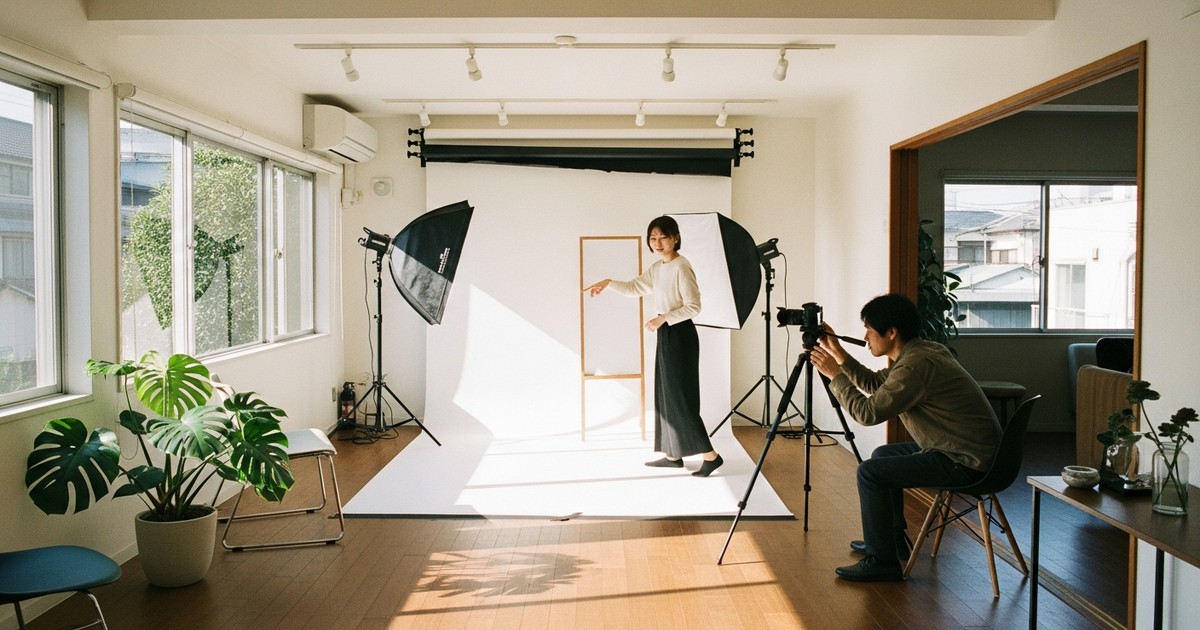
The single most important factor for a rental space used as a photo studio is ample natural light. Properties with large south-facing windows are highly sought after for portrait photography and apparel product shoots. A ceiling height of at least 2.4 meters—ideally 2.7 meters or more—makes it easier to set up lighting equipment and use flash units, which renters appreciate.
Older single-family homes or renovated warehouses often combine a distinctive atmosphere with generous space, making them especially popular as photo studios. Conversely, small studio apartments with few windows or north-facing units aren’t well suited for photography, so it’s more realistic to position them for other uses like parties or meetings.
Interior Design and Background Variety
What matters most to photography clients is a space that “photographs well.” Simple white-walled spaces offer high versatility, working for everything from cosmetics and accessory product shots to portraits. On the other hand, spaces with distinctive touches—vintage furniture, dried flowers, exposed brick—can attract individual clients chasing Instagram-worthy shots or music video shoots.
If your minpaku property’s existing interior can double as a photo studio setup, you’ll need little to no additional investment. Even a design-forward minpaku property can meet photography demand with just 30,000 to 50,000 yen in added props (floor lamps, drape curtains, potted plants, etc.), keeping upfront costs low while opening up a new revenue stream.
Legal Considerations and Required Procedures
Whether Change of Use Is Required and Fire Code Compliance
Whether renting out your minpaku property as a rental space requires a change-of-use application under the Building Standards Act depends on the type of use and the total floor area. If the space is deemed an “assembly hall” used by unspecified members of the public, properties exceeding 200㎡ may need to file a change-of-use confirmation application. It’s advisable to consult with your local building guidance division in advance.
Under fire safety regulations, if the rental space is classified as a facility “used by an unspecified number of people,” you may be required to install fire extinguishers or additional emergency exit lighting. A fire extinguisher costs roughly 5,000 to 8,000 yen each, and exit lighting runs about 20,000 to 30,000 yen per unit—an essential investment for safety. Check with your local fire department to confirm what equipment is required.
Owner Approval and Insurance for Leased Properties
If you’re operating a leased property as a minpaku, you’ll also need approval from the property owner or management company before adding rental space use. Even if you’ve already obtained sublease approval for minpaku operations, that approval doesn’t necessarily extend to rental space use. It’s essential to secure written agreement covering issues like common-area use during equipment load-in and building management risks tied to unspecified visitor traffic.
You should also confirm with your insurance provider whether your minpaku facility liability insurance covers accidents that occur during rental space use. If it doesn’t, you’ll need to take out separate rental space liability coverage (typically 10,000 to 30,000 yen per year in premiums). Protecting against scenarios like a renter knocking over equipment and damaging a wall, or a visitor falling and getting injured, is essential for sustainable operations.
Pricing Strategy and Choosing a Booking Platform
Setting Prices Based on Local Market Rates
Rental space pricing varies widely based on location, size, and amenities, but urban photo studio rentals typically run 2,000 to 8,000 yen per hour. Party rentals generally fall in the 1,500 to 5,000 yen per hour range, while meeting room rentals cluster around 1,000 to 3,000 yen per hour. A practical approach is to survey 5 to 10 comparable listings on booking platforms and set your initial rate within ±10% of the median.
When operating alongside minpaku, a “time-of-day pricing” model works well—setting lower rates on weekday daytimes to prioritize occupancy, and premium rates for popular slots like weekends, holidays, and evenings. For example, a two-tier structure of 2,500 yen per hour on weekdays from 10am to 5pm and 4,000 yen per hour on weekends and holidays can raise your average rate while still keeping weekday bookings coming in.
Comparing the Major Booking Platforms
Two platforms dominate the rental space booking market: Space Market and Instabase. Space Market has a large monthly user base and covers a wide range of uses—photography, parties, meetings—with commission fees around 30% of sales. Instabase specializes in photography and workshop bookings, with commissions ranging from 20% to 35% depending on the plan.
A practical starting point is to list on both platforms for about three months, then compare booking volume and post-commission profit margins before settling on a primary platform. In addition, building a direct booking channel through your own Instagram account or Google Business Profile can reduce platform fees and help build repeat customers. Securing five or more direct bookings a month can save you 20,000 to 30,000 yen monthly in commission costs alone.
Operational Considerations and Preventing Trouble
Neighbor Relations and Noise Control
The most common issue in rental space operations is noise complaints from neighbors caused by renters. This is especially true for party use, where loud music or late-night chatter can quickly become a problem—so it’s important to spell out rules in your terms of use, such as capping usage hours at 10pm and prohibiting outside speakers. Even for photography use, be mindful of large group shoots or outdoor voice work.
Proactively informing neighbors that “the space will be rented out during the day” can help prevent sudden complaints. Doing an introductory round of visits before launch and leaving your emergency contact information goes a long way toward building trust. It’s also worth setting up a system to quickly notify renters if a complaint comes in—such as SMS alerts or entry management linked to a smart lock.
Establishing Rules for Restoration and Equipment Management
Rental spaces often face a higher risk of damage or soiling than standard accommodation use. Common examples include floor scratches from large equipment being carried in, thumbtack holes in walls, and dirty kitchen fixtures. Be sure to state restoration obligations and penalties for violations (billing for actual repair costs) clearly in your terms of use, and build in a step where renters must agree to these terms at the time of booking.
Practical safeguards include installing networked cameras that automatically capture before-and-after photos of the room (roughly 10,000 to 20,000 yen per camera), or collecting a security deposit of 3,000 to 10,000 yen via credit card before use. Creating an equipment inventory list and checking quantities before and after each use also makes it easier to handle any missing items.
Managing Your Schedule When Running Both Minpaku and Rental Space
Calendar Integration to Prevent Double Bookings
When managing minpaku bookings and rental space bookings at the same time, the biggest risk is double booking. To keep overnight reservations from platforms like Airbnb from overlapping with rental bookings from platforms like Space Market, calendar integration through iCal sync or a channel manager (such as Beds24 or Chokuyoyaku.com) is essential. Manual management leaves plenty of room for human error, and even a single double booking per month can lead to reputation damage and refund costs running into the tens of thousands of yen.
A common approach is to open up the 4 to 5 hour window between guest checkout (typically 10–11am) and check-in (typically 3–4pm) as a rental slot. Setting aside 1 to 1.5 hours for cleaning and limiting rental use to a 3-hour window from 11am to 2pm minimizes any interference with your accommodation operations.
Streamlining Your Cleaning Operations
When cleaning is required twice—once between the rental and once between guest stays—cleaning costs can add up quickly. At 4,000 to 6,000 yen per cleaning session, 20 rental bookings a month would mean 80,000 to 120,000 yen in cleaning costs alone, eating into your profits. One effective solution is requiring renters to do light cleanup themselves (taking out trash, wiping tables, vacuuming) and having your team handle only a quick 15- to 30-minute cleaning pass (costing around 1,500 to 2,000 yen) afterward.
Spelling out cleaning rules in your terms of use and requiring renters to submit photos at checkout can boost self-cleaning compliance. This approach has helped some operators limit full cleanings to just 2 to 3 times a month, cutting total cleaning costs down to 30,000 to 40,000 yen monthly.
Considering Rental Space Use for Your Minpaku Property? Talk to Stay Buddy
Running a minpaku property alongside a photo studio or rental space business calls for expertise and hands-on experience across a wide range of areas—legal procedures, pricing design, schedule management, and trouble prevention. Handling all of this on your own can be a heavy burden, and a wrong move can end up hurting revenue or creating problems instead of solving them.
At Stay Buddy Co., Ltd., our minpaku management services go beyond simply running your accommodation business—we offer multi-angle proposals aimed at maximizing your property’s overall revenue potential. Backed by real-world experience, we can provide concrete support with everything from identifying properties well-suited for rental space use to selecting platforms and advising on pricing.
If you’re thinking, “I want to boost revenue from my existing minpaku property” or “I’d like to start renting out space but don’t know where to begin,” we’d love to hear from you. We’ll propose the optimal plan based on your property’s characteristics and current market conditions.