Leave Your Vacation Rental Management to Us
Free Online ConsultationSetting clear house rules on Airbnb is the most fundamental measure for preventing guest trouble and keeping your property in good condition for the long term. If you start operating with vague rules, unexpected problems will crop up one after another—noise complaints, damaged amenities, and grievances from neighbors, to name a few. In fact, data shows that around 40% of Airbnb hosts have experienced trouble caused by inadequate house rules, underscoring just how critical proper rule-setting really is.
This article offers a practical breakdown of exactly what to include in your Airbnb house rules and how to word them effectively. Whether you’re hosting for the first time or you’re already running a listing and feel it’s time to revisit your rules, you’ll find plenty of useful guidance here.
Why Airbnb House Rules Matter
House rules aren’t just polite requests—they also serve as important evidence when using Airbnb’s AirCover protection program. For example, if a guest damages your property while violating a prohibited action, having that rule clearly stated makes it much easier to have your compensation claim approved. Conversely, rules that were only communicated verbally may be judged as “not agreed to in advance,” resulting in denied claims.
House rules can also be reviewed by guests before booking, which creates a natural filtering effect: guests who can’t agree to your rules simply won’t book in the first place. This significantly reduces post-check-in disputes like “I wasn’t told that” or “I didn’t know that.” One host reported that after thoroughly refining their house rules, guest complaints dropped from an average of 3 per month to just 0.5.
Check-in and Check-out Rules
Specifying Check-in Time and Method
State the check-in window with concrete times, such as “3:00 PM–10:00 PM.” Even if you allow late-night arrivals, adding a condition like “Check-in after midnight requires prior notice” helps prevent unannounced late arrivals. If you use a smart lock, specify exactly when the access code will be sent—for example, “The door code will be sent via message at 12:00 PM on the day of check-in”—which also cuts down on guest inquiries.
Check-out Time and Departure Rules
Set your check-out time—such as “by 10:00 AM” or “by 11:00 AM”—based on your cleaning schedule. Be specific about what you expect guests to do before leaving. For example: “Gather used towels on the bathroom floor,” “Sort trash and place it in the kitchen bin,” “Turn off the air conditioner and lights,” and “Return the key to the lockbox.” Simply writing these out can shave 15–20 minutes off your cleaning crew’s turnaround time per stay.
Noise and Party Rules
Setting Quiet Hours
Noise is by far the most common cause of neighbor disputes. Be explicit: “Quiet hours are from 10:00 PM to 8:00 AM. Loud voices and music, indoors or outdoors, are prohibited during this time.” For condos or apartments, additional rules like “Please refrain from conversing in shared hallways or on balconies at all times” can also help. There have been real cases where noise complaints from neighbors to a building’s management association led to a complete ban on short-term rental operations at that property—which is exactly why clearly defining time windows and prohibited behavior is essential.
Prohibiting Parties and Events
Airbnb has officially banned parties platform-wide since 2022, but it’s still important to restate this in your own house rules. A statement like “Parties, gatherings, and events of any kind are strictly prohibited at this property. Violations will result in immediate eviction and an additional cleaning fee of up to ¥30,000” strengthens the deterrent effect by specifying an actual penalty amount.
Smoking Rules
Designated Smoking Areas and Violation Policy
If the entire unit is non-smoking, state clearly: “Smoking indoors, including e-cigarettes, is strictly prohibited.” Simply writing “no smoking” can leave some guests thinking heated tobacco products or e-cigarettes are exempt, so it’s important to define the scope explicitly. If smoking is allowed on a balcony or in a garden, specify the exact location and method: “Smoking is permitted only in the designated area (north side of the balcony). Please use a portable ashtray and dispose of butts in the provided can.”
Always spell out the penalty for violations as well. A statement such as “If indoor smoking is confirmed, a deodorizing and cleaning fee of ¥50,000 will be charged” gives you solid grounds for billing if it actually happens. Since professional odor-removal typically costs between ¥30,000 and ¥50,000, setting your fee within this range is realistic.
Occupancy and Visitor Rules
Enforcing Maximum Occupancy
Allowing more guests than the maximum occupancy stated in your listing can even raise fire code issues. Make it explicit: “The maximum occupancy is [X] guests. Hosting more guests than booked is prohibited under any circumstances, and infants count as one guest.” Also state how you’ll handle violations—for instance, “An additional fee of ¥3,000 per person, per night will be charged for any guest exceeding the booked headcount”—to discourage unauthorized extra guests.
Rules for Non-Staying Visitors
You should also set clear terms for visitors who aren’t staying overnight. Specify time limits and conditions, such as: “Non-staying visitors are permitted until 8:00 PM and must be reported to the host via message in advance,” or “Guests must accompany any visitor using shared spaces.” Noting that guests are responsible for any trouble caused by their visitors also encourages guests to keep their visitors in check.
Pet Rules
Setting Pet Policy and Conditions
If pets aren’t allowed, pair the reasoning with the penalty: “Pets of any kind are strictly prohibited. Out of consideration for future guests with allergies, a special cleaning fee of ¥20,000 will be charged if this rule is violated.” If you do allow pets, spell out detailed conditions, such as: “Up to one small dog; cats, reptiles, and birds are not permitted,” “Pets must not be allowed on beds or sofas,” “Guests must clean up after their pet immediately,” and “A pet fee of ¥2,000 per night applies.”
Pet-friendly properties often require special post-checkout cleaning for flea treatment and odor removal, adding ¥10,000–¥30,000 per stay. Set your pet fee with the length of stay and this cleaning cost in mind, so it adequately covers the expense.
Rules for Using Amenities and Equipment
Kitchen and Appliance Usage
If you provide a kitchen, be specific: “Please wash all dishes after use and return them to their original place,” “Turn off the IH cooktop after each use,” and “Do not pour oil down the drain.” For properties with a washing machine, adding a time limit and maintenance instructions—such as “Please finish laundry by 10:00 PM. Clean the dryer’s lint filter after each use”—helps prevent premature wear on your equipment.
Handling Keys and Security Devices
Losing a key typically costs ¥10,000–¥30,000 to re-key the lock. State clearly: “If the key is lost, a cylinder replacement fee of ¥25,000 will be charged.” For smart locks, provide specific guidance too, such as “Do not share the access code with anyone else” and “This property has an auto-lock feature, so please always carry your smartphone when going out.”
Trash Disposal and Cleaning Rules
Sorting and Disposing of Trash
Local trash-sorting rules can be confusing for guests, especially those visiting from overseas. Provide clear guidance, such as: “Please sort trash into four categories: burnable, non-burnable, PET bottles, and cans. Refer to the diagram posted in the kitchen for sorting instructions,” and back it up with a visual guide placed inside the property. If a trash collection day falls during the guest’s stay, specify the day and location: “Please place trash at the collection point in front of the entrance by 8:00 AM on Tuesdays and Fridays.” This is especially important for longer stays, since accumulated trash indoors can attract pests.
Expected Cleanliness Level at Checkout
Clarifying exactly what you expect—and don’t expect—reduces guest stress and helps protect your review scores. For example: “Professional cleaning is arranged after every stay, so there’s no need to clean before checkout. However, we do ask that you wash any dishes used and gather up the trash.” If you charge a separate cleaning fee, specify the cap on additional charges as well: “The ¥5,000 cleaning fee covers standard cleaning. In cases of significant mess or damage, an additional cleaning fee of up to ¥20,000 will be charged.”
How to Communicate Your House Rules Effectively
Registering Rules in Your Airbnb Listing Settings
Airbnb’s host dashboard includes a dedicated section for entering house rules. Rules registered here are shown to guests before booking, and booking is treated as agreement to those terms. Standard items like “No smoking,” “No parties,” and “No pets” can be selected via checkboxes, while additional custom rules can be entered in a free-text field. Since this field typically allows around 500 characters, prioritize your most important rules there.
Posting Rules On-Site and Including Them in a Welcome Guide
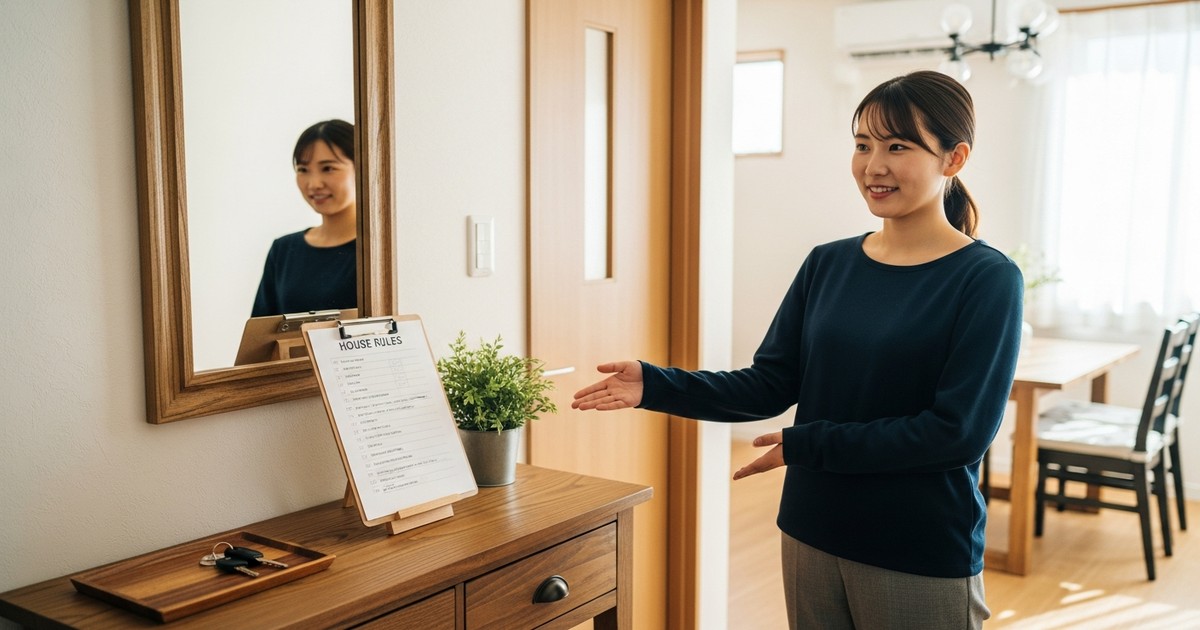
Plenty of guests check in without ever reading the rules in your listing. Post a laminated rules sheet somewhere prominent in the property—such as on the back of the front door or on the living room table. Preparing it in four languages (Japanese, English, Chinese, and Korean) also helps ensure smooth communication with international guests. Keep it to a bulleted list of 10 items or fewer that fits on a single A4 sheet. For more detailed information, compile a welcome guide (as a booklet or PDF) and send it to guests via message before check-in to make sure it actually reaches them.
Points to Watch When Creating House Rules
Avoid Discriminatory or Overly Restrictive Content
Airbnb’s Community Guidelines prohibit rules that discriminate based on race, nationality, gender, religion, or similar factors. Statements like “No guests from [country]” or “Same-sex couples not permitted” can result in account suspension. Overly restrictive rules—such as “No eating or drinking indoors under any circumstances” or “Showers limited to once per day”—can also hurt the guest experience and lead to poor reviews. It’s important to include only rules with a clear, reasonable justification.
Confirm Compliance with Applicable Laws
Japan’s Private Lodging Business Act (the “Minpaku Law”) caps annual operation at 180 days and requires hosts to maintain a guest registry. Including a line in your house rules such as “Please present your passport or a valid ID upon check-in” both fulfills this legal requirement and communicates it clearly to guests. Including evacuation routes and the location of fire extinguishers per fire safety regulations also demonstrates attentiveness to safety, which reassures guests as well.
Need Help Setting Your House Rules? Talk to Stay Buddy Inc.
The ideal house rules depend heavily on your property’s location, layout, and target guest demographic. There’s a lot to consider—condo buildings require alignment with building bylaws, whole-property rentals need attention to distance from neighbors, and properties targeting international guests need multilingual support, among other factors.
At Stay Buddy Inc., our vacation rental management service has supported countless properties with everything from drafting house rules and listings to handling guest communication. We can offer comprehensive advice covering your entire operation, including building response workflows for when trouble arises and designing guest communication strategies to boost your review scores.
If you’re unsure how detailed your rules should be, or if you’re already dealing with recurring issues and want to revisit your current rules, please feel free to reach out to Stay Buddy Inc. We offer complete support—from proposing house rules tailored to your property’s specific situation to full day-to-day management.