Why Wi-Fi Infrastructure Matters for Minpaku in Hokkaido
When running a minpaku (private lodging) business in Hokkaido, setting up a proper Wi-Fi environment is an unavoidable topic. Wi-Fi infrastructure for minpaku isn’t just an added bonus—it’s become a baseline requirement for inbound guests when choosing where to stay. According to surveys by the Japan Tourism Agency, “access to free Wi-Fi” has consistently ranked among the top complaints from foreign visitors traveling in Japan, and dissatisfaction with connectivity directly translates into lower review scores.
Hokkaido is home to numerous internationally popular destinations such as Niseko, Furano, and Sapporo, and guest expectations for accommodation facilities continue to rise each year. In particular, the Niseko area, world-renowned as a ski resort, attracts many long-term visitors from North America, Europe, and Australia who take for granted a connection quality capable of supporting remote work and video streaming. This article explains, for those operating minpaku or ryokan businesses in Hokkaido, the specific standards for Wi-Fi infrastructure, the connectivity quality inbound guests actually expect, and cost-effective ways to implement it.
Note that neither the Private Lodging Business Act (the “new minpaku law”) nor the Hotel Business Act explicitly mandates Wi-Fi installation when obtaining a license. However, local government guidelines and listing standards on booking platforms increasingly treat it as a de facto requirement. Understanding these standards correctly and making sound investment decisions is key to maintaining a stable occupancy rate.
Specific Speed Standards for Wi-Fi Infrastructure in Minpaku
The Minimum Connection Speed Benchmark
Aim for a measured download speed of at least 30 Mbps for the Wi-Fi you provide at your minpaku property. This figure allows two to three guests to comfortably stream 4K video (recommended 25 Mbps) or make video calls (recommended 10 Mbps) simultaneously. Airbnb’s host guidelines also recommend “an environment where guests can comfortably use the internet,” specifically noting that posting speed test results can help earn higher ratings.
In some rural areas of Hokkaido, fiber-optic service isn’t yet available. In such cases, home router-type mobile connections (such as WiMAX or SoftBank Air) become an option, but actual measured speeds can be as low as 10–20 Mbps in some cases, so be sure to check coverage and test speeds before signing a contract. In areas where fiber is available, even an individual-use plan costing around ¥4,000–6,000 per month can deliver measured download speeds of 200 Mbps or more, making it overwhelmingly cost-effective.
Simultaneous Connections and Choosing the Right Router
Even for a property with a capacity of four guests, each person is likely to bring multiple devices—smartphone, tablet, and laptop—so you should plan for at least 10 simultaneous connections. Inexpensive home routers (in the ¥3,000–5,000 range) show noticeable slowdowns with 10 simultaneous connections, so it’s more realistic to choose a business-grade or mid-range-and-above Wi-Fi 6 compatible router (in the ¥10,000–20,000 range).
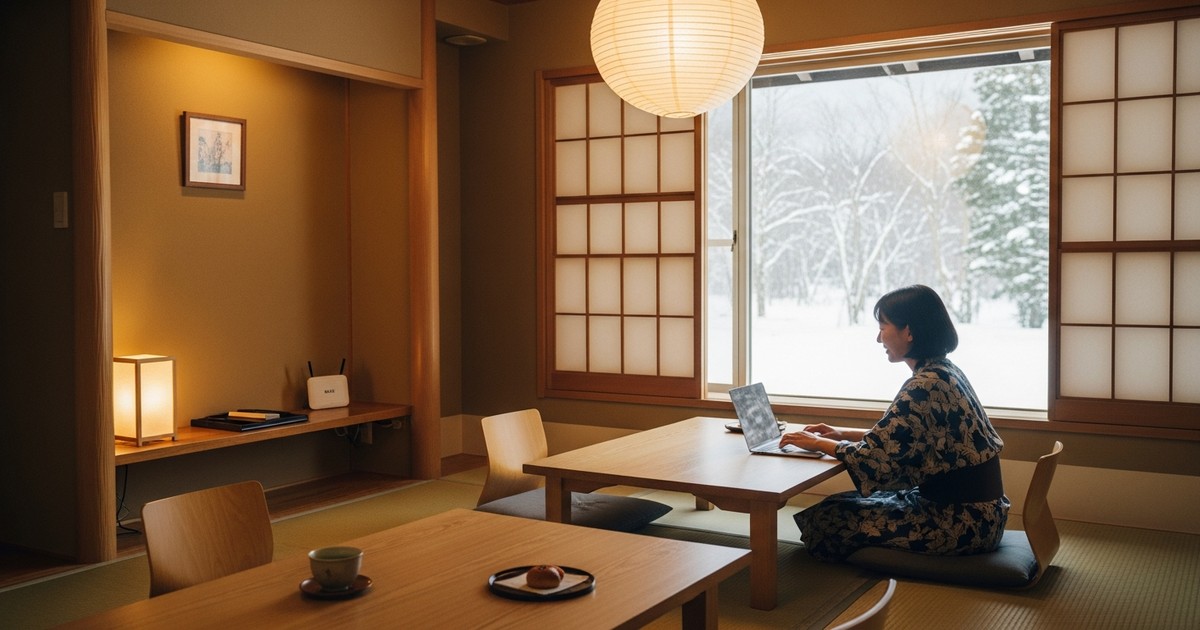
For whole-house rentals like traditional Japanese farmhouses or spacious log cabins—common property types in Hokkaido—a single router often can’t reach every room. In these cases, installing a mesh Wi-Fi system (roughly ¥15,000–30,000 for a two-unit set) allows for uniform coverage throughout the building. While this increases upfront investment, reviews complaining that “Wi-Fi doesn’t reach some rooms” can lead to one-star ratings, so it’s worth not skimping here—doing so ultimately protects your revenue.
What Inbound Guests Actually Expect from Wi-Fi
Balancing Easy Connectivity with Security
Guests arriving from overseas want to connect to Wi-Fi immediately after check-in so they can use map and translation apps. This makes it essential to keep the connection process as simple as possible. A practical approach is to print the SSID (network name) and password in English on a card and display it prominently at the entrance or in the living room. Printing a QR code also lets guests connect just by scanning it with their smartphone camera, avoiding typos and connection issues.
At the same time, security shouldn’t be overlooked. Separate guest and administrative networks (using a guest network feature) so that guests cannot access the network connected to IoT devices such as smart locks or security cameras. This setting is standard on most mid-range and higher routers and can be configured in just a few minutes from the admin panel.
VPN Access and Data Cap Considerations
Guests from mainland China often use VPNs (Virtual Private Networks) to access social media and messaging apps from their home country, and if your router settings block VPN connections, this can lead to significant dissatisfaction. Check whether VPN pass-through is enabled in your router’s firewall settings. Ideally, all major protocols—IPSec, L2TP, and OpenVPN—should be able to pass through.
Additionally, if you’re using a mobile connection with a data cap, speed throttling near the end of the month is a real risk. During Hokkaido’s ski season (December through March), long-term stays increase, and it’s not uncommon for a single group to consume more than 100GB of data per month. We strongly recommend choosing an unlimited data plan, or better yet, eliminating data caps entirely with a fiber-optic connection.
How Hokkaido’s Unique Environment Affects Wi-Fi Setup
Router Placement and Freezing Risk in Cold Climates
In winter, some areas of Hokkaido see outdoor temperatures drop below minus 20 degrees Celsius, and indoor temperatures can approach 0 degrees when heating is turned off. Since routers and ONUs (optical network units) are typically rated for operation between 0 and 40 degrees Celsius, completely turning off heating during extended periods when guests are absent significantly increases the risk of equipment failure. Consider keeping the room temperature above 5 degrees even when unoccupied, or placing routers in well-insulated locations as a precaution.
Power outages caused by lightning or blizzards are also common in Hokkaido. Connecting a UPS (uninterruptible power supply) to your router and ONU ensures connectivity isn’t interrupted during brief outages. Small UPS units can be purchased for around ¥5,000–10,000, making them a worthwhile investment as insurance. You can also avoid the common problem of routers failing to reconnect automatically after a power outage by choosing models with an auto-recovery feature.
Adapting to Large Properties and Unique Building Structures
Many minpaku properties in Hokkaido are whole-house rentals on lots exceeding 330 square meters, or cottage-style facilities spread across multiple buildings. For properties like these, a single indoor router isn’t enough coverage, so you’ll need to design a setup using outdoor-rated access points or repeaters placed in each building. Outdoor access points cost around ¥15,000–30,000 each, but offering Wi-Fi coverage anywhere on the property can be a powerful point of differentiation.
In older wooden buildings and log cabins, signal attenuation varies greatly depending on wall thickness and insulation material. A reliable approach is to use a smartphone app that measures actual signal strength (such as Wi-Fi Analyzer) before installation, identify dead zones, and then decide on access point placement based on that data.
Cost and ROI Considerations for Wi-Fi Setup
Sample Initial and Monthly Costs
For a typical 1LDK to 2LDK minpaku property, fiber installation fees run about ¥16,500–26,400 (sometimes waived through promotions), and a Wi-Fi 6 compatible router costs about ¥12,000–18,000, bringing total initial costs to roughly ¥30,000–45,000. Monthly line fees run about ¥4,000–6,000, for an annual cost of roughly ¥48,000–72,000.
Against this investment, it’s not uncommon for a well-set-up Wi-Fi environment to allow you to add ¥500–1,000 to your nightly rate. Assuming 20 occupied nights per month, that translates to an additional ¥120,000–240,000 in annual revenue. In other words, the initial cost pays for itself in three to four months, with the rest being pure profit gain going forward. Factoring in the increased occupancy that comes from improved reviews, investing in Wi-Fi infrastructure is arguably one of the highest-return equipment investments in minpaku operations.
Support Systems for Connectivity Issues
“The Wi-Fi isn’t working” is one of the most common complaints in minpaku operations. To handle this remotely, we recommend enabling your router’s remote management features. Routers from major manufacturers such as TP-Link, ASUS, and Buffalo come with smartphone app functions that allow you to restart the device or change settings remotely.
As a backup for cases that can’t be resolved remotely, it’s reassuring to keep a spare mobile router on-site. If it uses a prepaid SIM with no monthly contract, it costs nothing when not in use. Being able to immediately tell a guest, “We have backup Wi-Fi available” when trouble strikes can be the decisive factor in preventing a negative review.
Legal and Regulatory Points to Check Alongside Wi-Fi Setup
How Communication Equipment Is Treated Under the Private Lodging Business Act and Hotel Business Act
Under the Private Lodging Business Act (the “new minpaku law”), Wi-Fi installation is not a legally mandated requirement. However, given the law’s emphasis on “ensuring guest safety” and “accommodating foreign guests,” internet access has effectively become indispensable for multilingual guidance and as an online emergency communication tool. When filing notifications with regional bureaus in Hokkaido, application forms often include a field for indicating whether Wi-Fi is available as part of the facility description, and failure to provide it may result in guidance from the authorities.
Similarly, under the Hotel Business Act licensing process, Wi-Fi installation isn’t a legal requirement, but it may be checked during public health center inspections as “part of accommodating foreign guests.” In areas with especially high inbound demand, local governments sometimes recommend communication infrastructure setup through their own guidelines, so it’s wise to confirm with your local health center before applying.
Personal Data Protection and Managing Connection Logs
When providing Wi-Fi to guests, it’s important to understand how to handle connection log storage. Ministry of Internal Affairs and Communications guidelines recommend that businesses offering public wireless LAN retain connection logs for a certain period. While minpaku operations often don’t strictly qualify as public wireless LAN providers, if a guest were to use the Wi-Fi for illegal activity, having connection logs on hand makes it easier for the property to avoid liability.
Business-grade routers and some high-function home routers include automatic connection log storage at no extra cost. Additionally, presenting a simple terms-of-use notice at check-in (ideally in English, Chinese, and Japanese) can help reduce legal risk in the event of trouble.
Contact Stay Buddy Inc. for Your Minpaku Management Needs
From Wi-Fi setup to overall accommodation operations, running a minpaku or ryokan business requires a wide range of specialized knowledge. Especially in areas like Hokkaido with high inbound demand, even small equipment investment decisions can have a direct impact on guest satisfaction—and ultimately, revenue.
Stay Buddy Inc., a full-service minpaku management company, provides one-stop support covering everything from proposing the optimal equipment setup based on your property’s characteristics and local demand, to daily guest communication, cleaning arrangements, and pricing optimization. We can also advise on the ideal internet connection and router placement tailored to each property.
Whether you’re wondering “how do I choose the right Wi-Fi setup,” want to “strengthen your service for inbound guests,” or are looking to “outsource your entire operation,” please feel free to reach out with any questions. As your partner for successful minpaku management in Hokkaido, Stay Buddy Inc. is here to help.