Leave Your Minpaku Management to Us
Completely Free Online Consultation3 Key Moments to Consider Transitioning from Minpaku to a Ryokan Business License
If you’re running a minpaku property, the 180-day annual operating limit eventually becomes a hard ceiling on revenue. For owners looking to scale their business, transitioning from minpaku to a licensed ryokan operation is a topic you simply can’t avoid. However, since this transition comes with real costs and effort, identifying the right timing is the key to maximizing your returns.
This article walks through the criteria for deciding when to switch from operating under the Private Lodging Business Act (minpaku) to obtaining a Ryokan Business Act license, along with a concrete breakdown of the actual transition costs involved. If you’ve been vaguely thinking “maybe it’s time to go the ryokan route,” this piece is designed to give you the hard numbers you need to decide.
When Occupancy Exceeds 140 Days a Year
Under the Private Lodging Business Act, 180 days a year is the operating cap. Once your occupancy climbs past the 140-day mark, that’s a sign demand is starting to outpace supply. Assuming an average nightly rate of ¥15,000, hitting the 180-day cap would generate ¥2.7 million in annual revenue. If you obtained a ryokan license and operated 300 days a year at the same rate, that jumps to ¥4.5 million. The ¥1.8 million difference is enough to recoup your transition costs within one to two years.
That said, high occupancy alone doesn’t automatically mean you should transition right away. It matters whether that occupancy is concentrated in peak season or spread evenly across the year. If a property is consistently booking 140+ days year-round, transitioning to a ryokan license means you can likely capture the revenue currently lost on the remaining 185 days.
When the Property’s Zoning Meets Ryokan Licensing Requirements
Obtaining a ryokan business license requires that the property’s zoning designation meet certain conditions. As a rule, properties in residential-only zones cannot obtain a ryokan license. If your minpaku-registered property is located in a commercial, neighborhood commercial, or quasi-industrial zone, you’re already clear of one major hurdle on the zoning front.
On the flip side, if the zoning doesn’t qualify, no amount of occupancy will make a transition possible. As your first step in exploring a transition, check your property’s zoning designation on your local urban planning map. Most municipalities publish this information on their websites. Since this check costs nothing, it’s the first thing you should do.
When Local Ordinances Further Restrict Your Operating Days
While the Private Lodging Business Act sets a nationwide cap of 180 days annually, some municipalities impose their own supplementary ordinances that shrink this further. For example, in areas where ordinances only permit operation on certain days of the week or during certain periods, the actual number of usable operating days can drop to around 100. In these cases, the economic case for obtaining a ryokan license becomes even stronger.
At 100 operating days a year with an average rate of ¥15,000, revenue comes to ¥1.5 million. Transition to a ryokan license with 300 operating days, and that jumps to ¥4.5 million — a ¥3 million difference. The stricter the local ordinance restrictions, the more compelling the economic case for making the switch.
The Full Picture of Costs Involved in Transitioning to a Ryokan License
The cost of transitioning from minpaku to a ryokan license varies significantly depending on the size and condition of the property. That said, the categories of expense involved are fairly consistent. Here, we’ll walk through the major cost items and typical price ranges, using a standard studio-to-1LDK simple lodging facility (one of the operating categories under the Ryokan Business Act) as our reference point.
As a rough total, it’s realistic to budget ¥1 million to ¥3 million for a small property, and ¥3 million to ¥8 million or more for a mid-size or larger whole-building property. Let’s break down the individual cost items below.
Fees for Application Support from an Administrative Scrivener (Gyoseishoshi)
Applying for a ryokan business license involves numerous steps — from preliminary consultation with the public health center, to preparing documentation, coordinating with the fire department, and ultimately securing the license. If you outsource this process to an administrative scrivener, expect to pay somewhere between ¥200,000 and ¥500,000. The exact amount will vary based on the complexity of the property and procedural differences between municipalities.
If you handle the application yourself, you’ll only need to cover the application fee (typically around ¥20,000–¥30,000, though this varies by municipality). However, considering the time and effort involved in dealing with document rejections and back-and-forth with the health center, hiring a professional often turns out to be the more cost-effective route. For first-time applicants in particular, using an administrative scrivener can shorten the application timeline by one to two months.
Fire Safety Equipment Installation and Upgrade Costs
Obtaining a ryokan license requires meeting fire safety equipment standards set by fire service regulations. In most cases, this means installing an automatic fire alarm system, emergency exit lighting, and fire extinguishers. In some cases, equipment already installed for minpaku purposes can be reused, but ryokan operations are often held to stricter standards.
As a rough guide: newly installing an automatic fire alarm system costs ¥300,000–¥800,000, adding emergency exit lighting runs ¥50,000–¥150,000, and fire extinguishers cost anywhere from a few thousand to tens of thousands of yen. Whether your existing fire safety equipment can be reused is something you can confirm by consulting with your local fire department in advance. Since this consultation is free, it’s worth doing early in the planning process.
Building Code-Related Renovation Costs
Because ryokan facilities are classified as “special-use buildings” under the Building Standards Act, they’re subject to different requirements than ordinary residences. This can include standards around natural lighting and ventilation, hallway width, stairway construction, and emergency lighting. Depending on the structure and age of the property, this may require substantial renovation.
Renovation costs vary widely based on the property’s condition — minor renovations might run ¥100,000–¥300,000, while structural changes can cost ¥1,000,000–¥3,000,000 or more. In particular, if a change-of-use confirmation application is required (for example, if the total floor area exceeds 200 square meters), you’ll need to budget an additional ¥300,000–¥800,000 for a design firm’s fees.
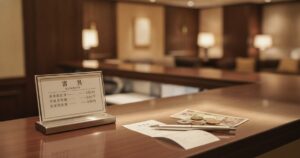
Front Desk / Reception Setup Costs
Under the Ryokan Business Act, guests are generally required to be identity-verified at a front desk (chōba). In recent years, a growing number of municipalities have begun accepting ICT-based alternatives — such as identity verification via video call on a tablet — but the specific requirements vary by municipality.
If you install a physical front desk, expect to spend roughly ¥200,000–¥500,000 on counter construction and interior work. If you opt for an ICT-based alternative, costs for a tablet, smart lock, and video call system typically run ¥50,000–¥200,000. Be sure to confirm with your local health center which method is permitted before proceeding.
Estimated Timeline for the Transition Process
Transitioning from minpaku to a ryokan license isn’t something that happens overnight once you decide to pursue it. Understanding the full timeline — from initial consultation through license approval — will help you plan around minimizing your downtime.
A typical schedule looks like this: 2–4 weeks for preliminary consultation, 1–3 months for design and renovation work, 2–4 weeks to prepare and submit application documents, and 2–4 weeks for the health center’s review and on-site inspection. All told, you should budget roughly 3 months if everything goes smoothly, or 5–6 months if renovation work is required. Whether you can continue operating as a minpaku during this period depends on your specific circumstances, so it’s wise to build your schedule in consultation with an administrative scrivener.
A Profit-and-Loss Simulation: Will the Transition Pay for Itself?
The most important question when deciding whether to make this transition is how quickly you can recoup your investment. Here’s a simplified simulation to illustrate the math.
Let’s say your total transition cost is ¥2,000,000, your annual revenue as a minpaku was ¥2,500,000 (170 days of occupancy at an average rate of roughly ¥15,000), and your projected annual revenue after transitioning to a ryokan license is ¥4,200,000 (280 days of occupancy at the same rate). That’s a revenue increase of ¥1,700,000 per year. Subtract the increase in cleaning supplies, consumables, and utility costs that come with more operating days (roughly ¥400,000–¥600,000 annually), and your net profit increase comes to ¥1,100,000–¥1,300,000 per year. At that rate, your ¥2,000,000 transition cost would be recouped in about one and a half to two years.
On the other hand, if your transition cost is ¥5,000,000 and your net profit increase is only around ¥800,000 a year, it would take more than six years to break even. For leased properties, where there’s always the risk of a lease not being renewed, you should think carefully if the payback period exceeds three years. For properties you own outright, there’s more room to factor in long-term asset value appreciation when making your decision.
Commonly Overlooked Pitfalls During the Transition
Explaining the Change to Neighbors and Securing Their Consent
Depending on the municipality, applying for a ryokan license may require you to explain the change to neighbors in advance or obtain their written consent. If there have been any complaints during your minpaku operation, neighborhood pushback can become a significant obstacle to your transition. Maintaining good relationships with neighbors on an ongoing basis is essentially an investment in a smoother future transition.
In practice, this means consistently enforcing trash disposal rules, managing noise, and providing multilingual guidance to guests on local etiquette. These efforts don’t just help with a future transition — they also directly improve how your current minpaku operation is perceived.
Checking Your Condominium’s Management Rules
If you’re operating a minpaku out of a unit in a condominium building, the building’s management rules may prohibit ryokan-style operations. Minpaku operates under a notification system, so it’s sometimes tacitly tolerated even when technically against the rules — but ryokan operation requires an actual license, and the health center may reach out to the management association to confirm compliance. Amending management rules typically requires approval from at least three-quarters of unit owners, which in practice can be a very high bar to clear.
Failing to check this in advance carries real risk — you might discover the transition is impossible only at the final application stage, after you’ve already spent money on an administrative scrivener and design work. Checking the management rules should be the very first step you take when considering a transition.
For Help with Minpaku Operations or Transitioning to a Ryokan License, Contact Stay Buddy Inc.
The right timing and cost structure for transitioning from minpaku to a ryokan license differs from property to property. Simply gathering the information you need to make a sound decision — analyzing occupancy data, checking zoning and fire safety requirements in advance, and building out a profit-and-loss simulation — takes a considerable amount of time and effort.
At Stay Buddy Inc., a minpaku property management company, we provide comprehensive support for maximizing owner returns — from optimizing your current minpaku operation to helping you decide whether transitioning to a ryokan license makes sense. Drawing on data from our operational track record, we can give you an objective basis for making that decision.
Even if you’re still at the stage of “I’m not sure if I should transition” or “I’m not sure the costs are worth it,” please feel free to reach out. After hearing about your property’s specific situation, we’ll provide advice grounded in concrete numbers.
For inquiries, feel free to contact us anytime through Stay Buddy Inc.’s official website. Your first consultation is completely free.