
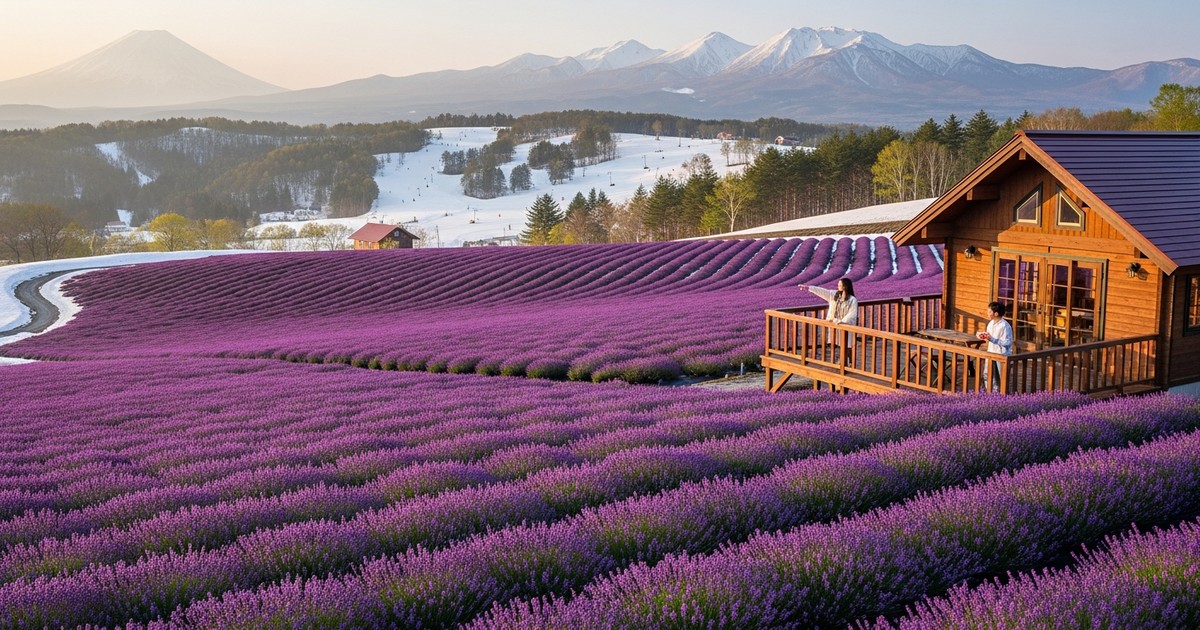
Why the Furano & Asahikawa Vacation Rental Market Is Drawing Attention
For owners looking to generate strong returns from a vacation rental in Furano, this area holds rare nationwide potential thanks to its two major peak seasons: the summer lavender season and the winter ski season. Within Hokkaido, the Furano-Asahikawa area attracts both domestic and international travelers year-round, and demand for vacation rentals continues to grow each year.
In reality, however, few people have a clear grasp of the specific occupancy rates or monthly revenue they can expect from operating a vacation rental in Furano or Asahikawa. This article breaks down concrete occupancy and revenue benchmarks for both the summer and winter seasons, giving you a realistic picture of what running a vacation rental in this area looks like across the full year.
Whether you’re considering investing in a vacation rental or already running one and looking to improve your returns, we hope you’ll find this information valuable. Please read on to the end.
Summer Season (Lavender Period) Occupancy Data That Drives Furano Rental Revenue
Summer Occupancy Rates Reach 70–90%
Furano’s summer season typically peaks from late June through mid-August. As lavender fields—most famously Farm Tomita—come into full bloom, huge numbers of domestic and international tourists flock to the area, and it’s not unusual for vacation rental occupancy rates to reach 70–90%. During mid-July, the peak of the lavender bloom in particular, nearby hotels and ryokan fill up almost entirely, driving a surge of overflow demand into vacation rentals.
During this period, nightly rates for a whole-house rental typically fall in the range of ¥25,000–¥40,000. For a property that sleeps four, this works out to roughly ¥6,000–¥10,000 per person—a price point that competes favorably against hotels on value. If a property maintains an 80% occupancy rate at a nightly rate of ¥30,000, it can generate approximately ¥740,000 in revenue for the month of July alone.
Inbound Demand Boosts Summer Revenue
Furano’s summer draws strong interest not only from travelers across Asia—Taiwan, Hong Kong, and Thailand among them—but also from individual travelers from North America, Europe, and Australia. Hokkaido’s cool climate and sweeping flower-field scenery spread widely on social media, and bookings via international OTAs (Airbnb, Booking.com, etc.) can account for anywhere from 40–60% of total reservations.
Inbound travelers also tend to stay longer, with average stays of 2–3 nights. Because multi-night discounts don’t significantly reduce the per-night rate, fewer cleaning turnovers are needed, which in turn boosts profit margins. There are documented cases where simply preparing an English-language listing improved booking rates by 20–30%, underscoring how critical multilingual support is to overall revenue.
Winter Season (Ski Period) Occupancy and Revenue Realities
Areas Near Furano Ski Resort Maintain High Occupancy Even in Winter
Furano Ski Resort is renowned for its high-quality powder snow, with the core ski season running from mid-December through the end of March. Vacation rental occupancy during this period typically falls in the 60–80% range. While slightly lower than the summer lavender period, stays tend to run longer—often 3–5 nights per booking—allowing for efficient, low-turnover operations.
Nightly rates in winter are comparable to or even higher than summer rates, with many whole-house rentals priced at ¥30,000–¥50,000 per night. During peak periods such as New Year’s and Lunar New Year, rates can be pushed to ¥60,000–¥80,000 per night and still fill up, with some properties generating ¥2–3 million in revenue over the three-month December-to-February window.
Asahikawa Draws Guests Through Both Skiing and Sightseeing
In addition to easy access to Kamui Ski Links and other nearby ski resorts, the Asahikawa area benefits from a year-round tourism draw: Asahiyama Zoo. In winter, the zoo’s popular “penguin walk” event helps capture demand from families and couples who aren’t skiing, giving properties in the area a distinct advantage.
Nightly rates for vacation rentals within Asahikawa city tend to run somewhat lower than in Furano, with a typical price range of ¥15,000–¥25,000 per night. That said, properties located in the city center offer strong access to restaurants and transportation, which supports repeat bookings and helps maintain winter occupancy rates of around 55–70%. For owners seeking year-round stability, urban vacation rentals in Asahikawa are well worth considering.
How to Get Through the Off-Season Between Summer and Winter
Occupancy Drops to 20–40% in Spring and Fall
The biggest challenge for vacation rentals in the Furano-Asahikawa area is the off-season stretches of April–May and September–November. During these months, tourist numbers drop sharply, and occupancy rates fall to just 20–40%. Nightly rates often need to be cut to 60–70% of peak-season levels, and it’s not uncommon for monthly revenue during this period to fall into the ¥100,000–¥200,000 range.
How you navigate the off-season has a major impact on annual revenue. You’ll generally need to take one of two approaches: design your finances so that peak-season revenue alone covers annual loan payments and fixed costs, or implement strategies to boost off-season revenue. When running annual revenue simulations, it’s a hard rule never to base your projections solely on peak-season numbers.
Concrete Strategies to Boost Off-Season Revenue
One of the most effective off-season strategies is introducing monthly rentals (long-term stay plans of 30 days or more). By catering to workation demand and “trial relocation” needs, per-night rates drop to around ¥3,000–¥5,000, but you can still secure ¥150,000–¥200,000 in monthly revenue. Since cleaning is required only about once a month, profit margins can end up nearly on par with peak season.
Building seasonal experience content into your listing—autumn foliage drives and harvest experiences, or spring’s lingering mountain snowscapes and asparagus picking—can also capture niche traveler segments. There’s data showing that simply swapping OTA listing photos to match the season can boost off-season page views by 15–25%.
Annual Revenue Model for Operating a Vacation Rental in Furano/Asahikawa
Annual Revenue Simulation for a Whole-House Rental
Here’s an annual revenue model for a six-person whole-house rental operated in the Furano area. During the summer peak (June–August), an average nightly rate of ¥35,000 at 80% occupancy yields roughly ¥840,000 per month. During the winter peak (December–March), an average rate of ¥40,000 at 70% occupancy also yields roughly ¥840,000 per month. During the off-season (April–May, September–November), an average rate of ¥20,000 at 30% occupancy yields roughly ¥180,000 per month.
Under these conditions, summer’s three months generate approximately ¥2.52 million, winter’s four months generate approximately ¥3.36 million, and the five off-season months generate approximately ¥900,000—bringing total annual revenue to roughly ¥6.78 million. This is admittedly a best-case scenario, but it’s an entirely achievable figure depending on location, interior quality, and review ratings.
Major Expense Categories and Estimated Take-Home Profit
Let’s look at the major expenses in this ¥6.78 million annual revenue model. Assuming 180 checkouts per year at ¥8,000 per cleaning, cleaning costs come to approximately ¥1.44 million. OTA fees (ranging 3–15%, averaging 8%) come to roughly ¥540,000. Utilities run approximately ¥360,000 per year, consumables and linens approximately ¥240,000, internet and smart lock maintenance approximately ¥120,000, and fire and liability insurance approximately ¥100,000.
Adding these up, total annual expenses come to roughly ¥2.8 million, leaving operating profit of approximately ¥3.98 million after subtracting them from revenue. If the property involves rent or loan repayments, these are deducted further. For a property with monthly rent of ¥100,000, that adds ¥1.2 million per year, bringing final take-home profit to approximately ¥2.78 million—or roughly ¥230,000 per month on average. For an owned property, only fixed asset tax and depreciation apply, so take-home profit would be even higher.
Key Points for Maximizing Revenue
Adopt Dynamic Pricing
In areas like Furano and Asahikawa, where the gap between peak and off-season demand is large, adopting dynamic pricing—automatically adjusting rates based on supply and demand—has a direct impact on revenue. By using tools like PriceLabs, Wheelhouse, or Beyond Pricing to automatically adjust rates in line with nearby competitor pricing and booking activity, you can simultaneously reduce missed revenue during peak season and vacancy during the off-season.
Properties that adopt dynamic pricing frequently report annual revenue gains of 15–25% compared to those relying on manual pricing. Timely price adjustments tied to lavender bloom conditions or snowfall reports, in particular, represent a management technique unique to the Furano area.
Building a System to Maintain a 4.8+ Review Rating
On Airbnb, properties with a review rating of 4.8 or higher tend to rank higher in search results, which is said to boost occupancy by 10–20%. Cleanliness, communication, and smooth check-in are the three pillars of maintaining high ratings. Concrete steps include implementing self-check-in, establishing a double-check system for cleaning quality, and offering 24-hour message support.
In the Furano area, there are examples of hospitality touches that consistently lead to high ratings—things like preparing local produce as a welcome treat on arrival, or creating a hand-drawn map of nearby restaurants. Small differentiators like these can raise a review score by 0.1–0.2 points, which in turn can translate into hundreds of thousands of yen in additional annual revenue.
Contact Stay Buddy Inc. for Vacation Rental Management Support
Operating a vacation rental in the Furano-Asahikawa area offers strong revenue potential when you take full advantage of both major peak seasons—but it also demands specialized expertise in off-season strategy, pricing tactics, and multilingual support. Handling everything yourself, from property selection and licensing to OTA optimization and day-to-day guest communication, is no easy task.
Stay Buddy Inc. brings extensive experience in vacation rental management, providing comprehensive support to maximize property revenue. We offer a one-stop solution for the strategies that directly impact your bottom line—including dynamic pricing implementation, cleaning system setup, and inbound-focused listing optimization.
If you’re thinking, “I want to start a vacation rental in Furano or Asahikawa but don’t know where to begin,” or “I’m already operating one, but revenue isn’t growing the way I’d hoped,” we encourage you to reach out to Stay Buddy Inc. With a revenue simulation and improvement proposal tailored to the specific characteristics of the area, you can significantly improve your odds of success in vacation rental management.
We welcome inquiries at any time through the form on our official website or by phone. Please feel free to reach out.