Leave Your Minpaku Management to the Experts
Free Online ConsultationFloor plan and pricing strategy are among the most critical factors determining minpaku profitability. Common pitfalls—like pricing a studio too high and watching bookings dry up, or underpricing a 3LDK and leaving profit on the table—usually stem from launching a property without understanding ADR (Average Daily Rate) benchmarks by floor plan. Get your pricing strategy right for each layout, and you can boost occupancy and profitability at the same time.
This article breaks down ADR benchmarks by floor plan—studio, 1LDK, 2LDK, and 3LDK or larger—along with the capacity and demand characteristics behind those numbers, plus concrete pricing strategy tips. Whether you’re just starting out in minpaku or looking to fine-tune your current pricing, this guide has you covered.
The Basics of Pricing (ADR) by Floor Plan in Minpaku
ADR (Average Daily Rate) refers to the average nightly rate a property earns. Because floor plan directly determines guest capacity, group size, and target demographics, the ideal ADR benchmark varies significantly by layout. Simply matching nearby hotel rates is a mistake—it fails to capture the group-oriented demand that makes minpaku unique.
When setting your ADR, three factors matter most: (1) per-guest rate based on capacity, (2) rates at comparable nearby properties, and (3) seasonal demand fluctuations. The per-guest rate in particular can vary by 3-4x or more between a studio and a 3LDK, so applying a one-size-fits-all price ignores the realities of each layout—and costs you revenue. For example, a studio sleeping 2 at ¥8,000/night works out to ¥4,000 per person, while a 3LDK sleeping 8 at ¥20,000/night comes to just ¥2,500 per person—a meaningful difference in perceived value for guests.
Pricing Strategy for Studios: Built for Business Travelers and Solo Guests
ADR Benchmarks and Capacity
Studios typically accommodate 1-2 guests. In major urban areas (Tokyo, Osaka, Kyoto, Fukuoka, etc.), the standard ADR range runs ¥5,000-¥10,000 per night, though this varies with location and amenities. Properties near tourist attractions or entertainment districts, or those with well-designed interiors, can command ¥8,000-¥12,000+. Meanwhile, properties more than a 10-minute walk from the station or in older buildings tend to land more realistically in the ¥5,000-¥7,000 range.
It’s tempting to compete on price alone with studios, but business travelers and solo guests are often willing to pay a premium for cleanliness, fast Wi-Fi, and convenient access. Highlighting strengths like proximity to a convenience store, a 5-minute walk to the station, or high-speed Wi-Fi can support stable occupancy in the ¥7,000-¥9,000 range. Rather than racing to the bottom on price, the smarter strategy is to invest in the amenities your target guests actually value and maintain an appropriate price point.
Occupancy and Revenue Outlook
Since per-stay revenue is lower for studios, occupancy rate becomes the key profit driver. At an ADR of ¥7,000 with 75% occupancy (23 nights/month), monthly revenue comes to roughly ¥161,000. After subtracting cleaning costs (¥2,500-¥3,500 per turnover × 23 = ¥57,500-¥80,500), OTA commissions (roughly 15-18% of revenue), and utilities, monthly profit typically lands around ¥30,000-¥60,000. Well-located studios can achieve 85-90% occupancy, making location the single biggest lever for profitability in this floor plan.
To maximize profit on a studio, dynamic pricing is essential—raising rates 30-50% above baseline during peak periods like long weekends, year-end holidays, and local events. In locations with steady weekday business demand, differentiating rates between weekdays and weekends can also help boost overall occupancy.
Pricing Strategy for 1LDKs: The Sweet Spot for Couples and Short Getaways
ADR Benchmarks and Capacity
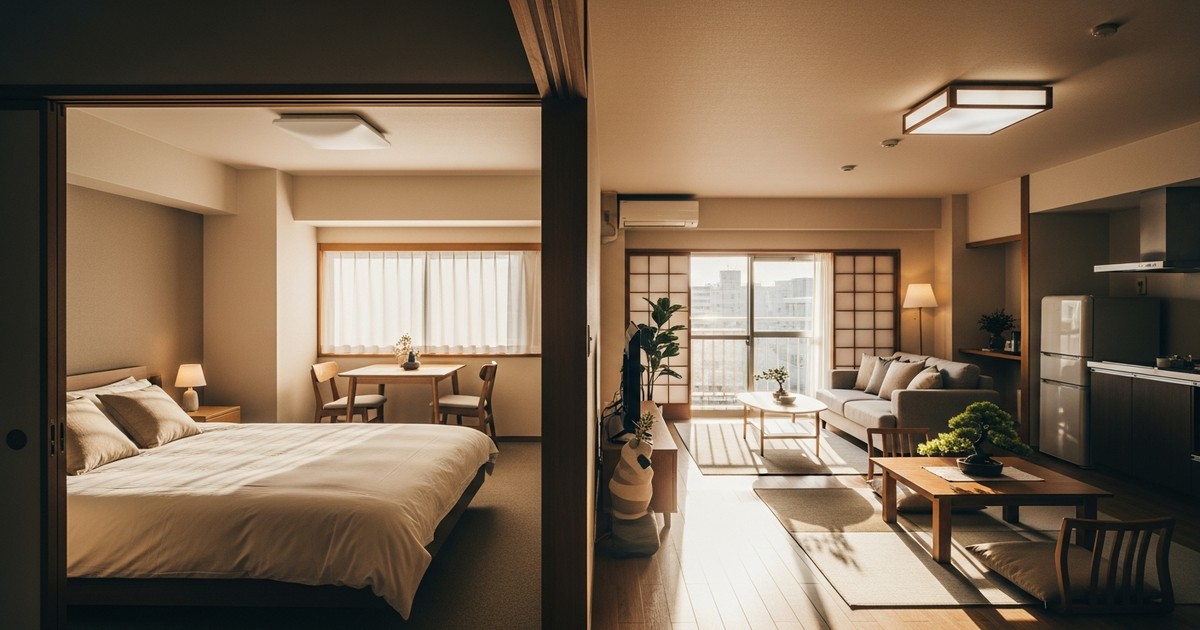
1LDKs typically sleep 2-4 guests, making them ideal for couples, small groups of friends, or compact family trips—giving you a broad range of potential guests. In urban areas, ADR generally falls between ¥10,000 and ¥18,000 per night, with a separate bedroom and living room, plus the presence of a kitchen and washing machine, all significantly influencing price.
Couples looking to relax in a shared living space, and groups wanting to make use of common areas, tend to place high value on the quality of living room furnishings—sofas, TVs, and similar features. Properties with polished interior design and Instagram-worthy spaces can command ¥15,000-¥20,000+ even within the same 1LDK category.
Occupancy and Revenue Outlook
At an ADR of ¥13,000 with 70% occupancy (about 21 nights/month), monthly revenue comes to roughly ¥273,000. Cleaning costs for a 1LDK typically run ¥3,500-¥5,000 per turnover, bringing monthly cleaning expenses to ¥73,500-¥105,000. After OTA fees and utilities, realistic monthly profit falls in the ¥70,000-¥110,000 range. Because the per-stay rate is higher than a studio’s, 1LDKs tend to deliver more stable profits even if occupancy dips slightly.
1LDKs align well with guests seeking “more space than a hotel room” and the ability to cook their own meals—making them a strong fit for extended stays. Offering a multi-night discount (10-15% off for stays of 3+ nights) can boost occupancy while also reducing the number of cleanings needed.
Pricing Strategy for 2LDKs: Ideal for Family Trips and Multi-Couple Groups
ADR Benchmarks and Capacity
2LDKs typically accommodate 4-6 guests, making them well-suited for family trips or groups of couples traveling together. In urban areas, ADR generally ranges from ¥15,000 to ¥25,000 per night. In areas with strong demand from families with young children, providing amenities like a crib, kids’ tableware, and a baby bath can be an effective differentiator.
Since 2LDKs, by definition, have two separate bedrooms, keeping both well-furnished with clean beds and adequate storage directly impacts guest satisfaction. Bedroom privacy is a particularly important factor for groups sharing a property, and well-equipped units can realistically command rates in the upper ¥20,000s.
Occupancy and Revenue Outlook
At an ADR of ¥20,000 with 65% occupancy (about 20 nights/month), monthly revenue comes to roughly ¥400,000. Cleaning costs for a 2LDK typically run ¥5,000-¥7,000 per turnover, bringing monthly cleaning expenses to ¥100,000-¥140,000. After OTA fees, utilities, and consumables, monthly profit typically falls in the ¥100,000-¥160,000 range. As capacity increases, per-guest cost-effectiveness improves, making it easier to capture group travel demand while maintaining both higher rates and solid occupancy.
The key to maximizing 2LDK revenue is positioning the property explicitly as a group-friendly listing—through your profile and photos. Including specific details in your OTA listing description, such as “Sleeps up to 6 comfortably” or “Dining table seats 6,” makes a strong impression on guests searching for group accommodations.
Pricing Strategy for 3LDK+ Units: A Premium Approach for Large Groups and Extended Stays
ADR Benchmarks and Capacity
3LDKs and larger units represent the premium tier of minpaku, accommodating 6-10+ guests. Urban ADR benchmarks typically start at ¥25,000-¥50,000+ per night, with significant upside depending on property rarity, amenity quality, views, and parking availability. Guests in this segment tend to include corporate retreats, large groups of friends, and multi-generational families visiting from overseas—all of whom are willing to spend more per booking.
Because hotels rarely offer accommodation options for large groups, 3LDK+ properties enjoy a natural competitive advantage in the minpaku space. At 8 guests and an ADR of ¥35,000, the per-person cost comes to just ¥4,375—an appealing value proposition for groups splitting the bill.
Occupancy and Revenue Outlook
At an ADR of ¥35,000 with 55% occupancy (about 17 nights/month), monthly revenue comes to roughly ¥595,000. Cleaning costs typically run ¥8,000-¥12,000 per turnover, bringing monthly cleaning expenses to ¥136,000-¥204,000. After OTA fees, utilities, and restocking supplies, monthly profit can reach ¥150,000-¥250,000 or more. Because per-stay revenue is so high, 3LDK+ properties can remain profitable even at 10-15 booked nights per month—a key strength of this floor plan.
That said, larger properties come with higher upfront investment—furniture, appliances, bedding, and more can easily run into the hundreds of thousands of yen just to outfit a unit for full capacity. Your pricing strategy should account for recouping this initial investment. Setting a premium ADR while reliably filling peak-season bookings is especially effective for 3LDK+ properties.
Universal Tips to Boost ADR Across Any Floor Plan
The Link Between Review Scores and Pricing
On OTAs like Airbnb and Booking.com, higher-rated listings tend to rank higher in search results and can command premium pricing without sacrificing bookings. Properties with a 4.8+ rating are often chosen even when priced 10-20% above comparable competitors in the same category. Cleaning quality, check-in experience, and amenity offerings are the primary drivers behind strong review scores.
Practical ways to boost your ratings include following up with guests after check-in, setting out a welcome card, and providing a clear, well-organized house manual. Designing an experience that makes guests want to return—or recommend the property to friends—is key to sustaining premium pricing over the long term.
Leveraging Dynamic Pricing
Regardless of floor plan, treating your rate as fixed rather than demand-responsive leaves revenue on the table. AI-powered dynamic pricing tools like PriceLabs and Beyond Pricing automatically analyze competitor pricing, local events, day of the week, and seasonality to adjust your rates daily for optimal performance. These tools typically cost ¥3,000-¥8,000 per month, and in most cases, the revenue gains far outweigh the subscription cost.
Properties that have implemented dynamic pricing have reported annual ADR increases of 15-25% on average. This applies across every floor plan, from studios to 3LDK+ units—though the benefit is especially pronounced for larger properties, where automatically maximizing peak-season rates has an outsized impact given the higher per-night value.
Have Questions About Pricing Strategy or Minpaku Management? Talk to Stay Buddy
Getting your pricing strategy right by floor plan requires a comprehensive analysis of location, amenities, competitive landscape, and target guest demographics. If you’re unsure which price point suits your property—or worried that raising rates might hurt occupancy—consulting an experienced operator is the fastest path to a confident answer.
Stay Buddy Inc., a full-service minpaku management company, supports properties of every floor plan—from studios to 3LDK and larger—with end-to-end services including ADR strategy, OTA listing setup, dynamic pricing configuration, guest communication, and cleaning coordination. We offer free revenue simulations tailored to your property’s floor plan and location, so you can see the numbers before making any decisions.
We also help operators of existing properties reassess their current pricing, offering improvement recommendations based on real occupancy data. If you’d like to find out whether your current setup is truly maximizing revenue, feel free to reach out—your first consultation is completely free.
Take the first step toward boosting your property’s profitability with a free consultation from Stay Buddy Inc. Our experienced team is here to guide you through everything from floor-plan-specific pricing strategy to full-scale property management.