Leave Your Vacation Rental Management to Us
Free Online ConsultationThe Fundamental Approach to Raising Room Rates at Vacation Rentals and Hotels
When it comes to running a vacation rental or hotel, raising your average room rate is the most direct way to improve profitability. Working to boost occupancy is certainly important, but occupancy has a physical ceiling. Room rates, on the other hand, have no theoretical limit—by increasing the value you offer, you can push rates upward without limit. In fact, it’s not uncommon to see differences of ¥3,000 to ¥5,000 or more per night between properties in the same area with the same layout, simply due to how well they’re managed.
Approaches to raising room rates broadly fall into two categories: improvements to the “hardware” side, meaning the value of the property itself, and improvements to the “software” side, meaning service quality and presentation. This article systematically covers concrete methods that vacation rental and hotel operators can put into practice, spanning both hardware and software improvements. We cover everything from quick wins you can implement immediately to mid- to long-term investments, so please pick and choose based on your own operating situation.
Introduce Dynamic Pricing to Set Rates Based on Demand
What Is Dynamic Pricing?
Dynamic pricing is a pricing strategy that adjusts room rates in real time based on the balance of supply and demand. It’s a technique long used in the airline industry, and in recent years it has become standard in the hospitality sector as well. By raising rates during peak seasons and weekends while moderately lowering them during off-peak periods and weekdays, operators can maximize revenue across the entire year. If you keep rates fixed, you’ll inevitably leave money on the table during busy periods—which is why this is one of the most effective first steps toward raising your average rate.
Practical Implementation and Tools
Automated pricing tools such as PriceLabs, Beyond Pricing, and Wheelhouse can automatically calculate optimal rates by factoring in nearby competitor pricing, booking trends, and local event data. These tools typically cost just a few thousand yen per month, and many operators report a 15% to 30% increase in average room rates after adoption. For example, a property that previously operated at a fixed rate of ¥8,000 per night might see its annual average rate rise to ¥10,400 per night after implementing dynamic pricing—meaning annual revenue increases by 30% even with the same occupancy rate.
Boost Property Appeal with Interior and Facility Upgrades
Investing in Design-Forward Interiors
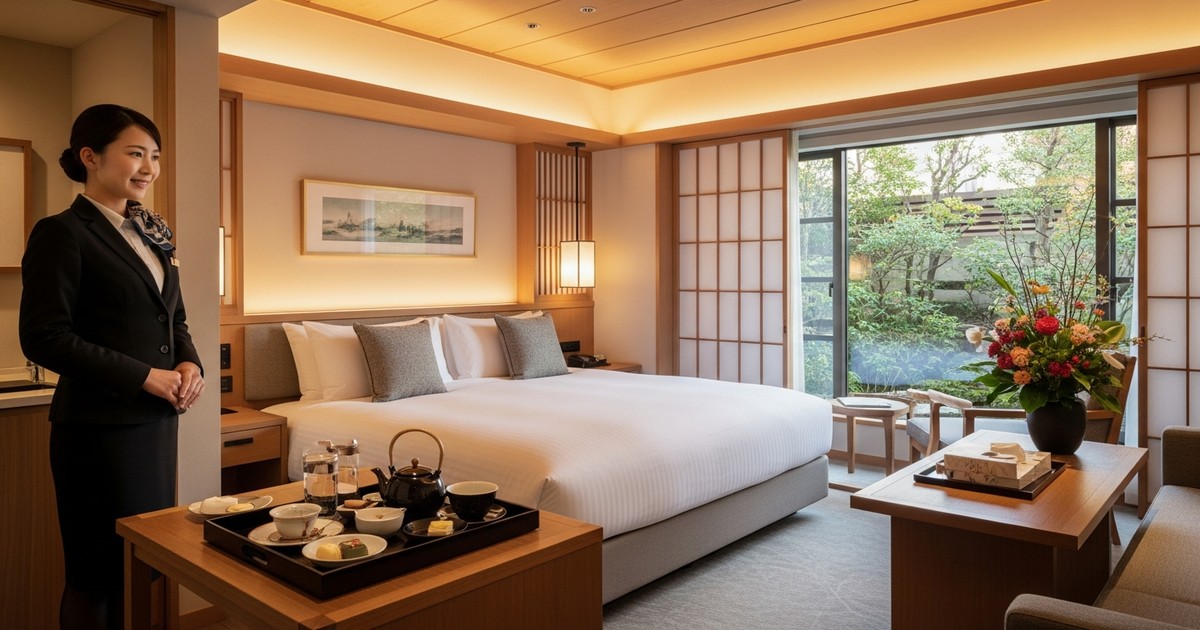
When guests choose accommodations, their first impression from photos directly affects both the booking rate and how much they’re willing to pay. A room furnished with bland, generic furniture and a room styled with a cohesive design concept can differ by ¥2,000 to ¥4,000 per night, even with the same size and location. For instance, in a space themed around wa-modern (Japanese-modern) style, simply unifying the look with shoji-style lighting, low-seated sofas, and wood-grain furniture can dramatically enhance the experiential value for international guests.
Improving Bathroom Quality and Bedding
The two things guests mention most often in reviews are how comfortable the bed was and how clean the bathroom felt. Simply upgrading to mid-range pocket-coil mattresses (around ¥30,000 to ¥50,000 per bed) can increase the number of “I slept comfortably” comments and improve your overall rating. Relatively low-cost upgrades—like switching to a mist-type showerhead (¥3,000 to ¥8,000) or replacing towels with thick, hotel-grade ones (¥1,000 to ¥2,000 each)—can also significantly boost perceived satisfaction. Data shows that raising your review score by 0.3 to 0.5 stars through such improvements can allow you to set rates 10% to 20% above the local area average.
Change How You’re Perceived Through Photography and Listing Optimization
The Impact of Professional Photography
According to official Airbnb data, listings that use professional photos see roughly 24% higher booking rates than those that don’t. A photo shoot typically costs between ¥15,000 and ¥30,000, but since this investment boosts both booking rates and room rates simultaneously, it tends to pay for itself very quickly. Professional techniques—wide-angle shots that make the most of natural light, thoughtfully placed decor that suggests a lived-in feel, and beautifully made beds—can bring out a property’s appeal to its fullest.
Key Points for Improving Your Listing Copy
Just as important as your photos is your listing description. Rather than listing only basic facts like “5-minute walk from the station” or “Wi-Fi included,” it’s far more effective to vividly describe the experience guests will have staying at your property. Adding scene-setting language like “Enjoy freshly brewed coffee in a living room bathed in morning sunlight from large windows” makes it easier for guests to feel the value exceeds the price. Additionally, including value-signaling keywords such as “designer,” “premium,” or “luxury” in your title strengthens your appeal in search results.
Drive Upsells by Offering Value-Added Services
Charging for Early Check-In and Late Check-Out
Offering early check-in and late check-out as paid options is an excellent way to add to your room rate at virtually zero additional cost. For example, if your standard check-in time is 3 p.m., offering early check-in from 1 p.m. for ¥2,000 could generate an extra ¥20,000 per month if just 10 guests take advantage of it. It’s worth setting up a system that lets you check upcoming and previous bookings so you can offer this flexibly.
Enriching Experience-Based Services and Amenities
You can package local experiences—such as cooking classes, kimono-dressing experiences, or local guided tours—into your stay offerings. By partnering with outside experience providers, you don’t need to prepare anything yourself. Taking a 10% to 20% commission on the experience fee increases both guest satisfaction and your revenue. Enhancing amenities—such as high-quality shampoo and body wash, a coffee machine, or a Bluetooth speaker—also increases guests’ sense that the room rate is justified. In some cases, an added cost of just a few hundred yen per night can support a rate increase of ¥1,000 to ¥2,000.
Improving Your Review Score Strengthens Your Pricing Power
Concrete Steps to Earn High Ratings
Within OTA (Online Travel Agency) algorithms, review scores heavily influence both search ranking and how often a listing is displayed. On Airbnb, properties rated 4.8 or higher qualify for Superhost status and are prioritized in search results, making it easier to secure bookings even at higher rates. To earn high ratings, the fundamentals are thorough cleaning quality, courteous pre-check-in messaging, and prompt responses during the stay. Simply sending a message within two hours of check-in asking “Is there anything you need?” can make a big difference in guest peace of mind and satisfaction.
How to Handle Negative Reviews
When you receive a negative review, it’s important to respond calmly and factually rather than emotionally. Writing something like “We have already addressed the issue you raised” and describing the specific action taken gives future prospective guests a sincere impression. In fact, research shows that properties with thoughtful responses to negative reviews see no significant drop in booking rates compared to those without any response. If anything, guests who book after seeing a proper response tend to arrive with well-calibrated expectations, which often leads to a positive cycle of higher ratings down the line.
Clarifying Your Target Audience and Building a Brand Strategy
Why Narrowing Your Persona Raises Your Rates
Trying to appeal to every possible guest often results in a property that resonates with no one in particular. For example, a property specialized for “families with small children”—stocked with a crib, toys, kids’ tableware, and safety measures for steps and level changes—becomes overwhelmingly attractive to families, allowing you to maintain high occupancy even at rates ¥3,000 to ¥5,000 higher per night. For business travelers, you can differentiate with a well-equipped desk area, high-speed Wi-Fi, and a monitor.
Reducing OTA Fees by Building Your Own Booking Site
OTAs like Airbnb and Booking.com charge hosts commissions ranging from roughly 3% to 15%. If you build your own booking site and direct repeat guests and direct traffic there instead, you can convert that commission straight into profit. By combining WordPress with a booking management plugin such as Beds, you can build your own booking site for an initial cost of roughly ¥50,000 to ¥100,000. By setting up traffic flows from social media and Google Maps, and encouraging guests who book through an OTA the first time to rebook directly on your own site, you can effectively raise your average room rate.
Setting Minimum Stay Requirements and Leveraging Long-Term Stay Plans
Reducing Cleaning Costs by Adjusting Minimum Stay Length
Accepting one-night bookings increases the frequency of cleanings, and that cost eats into your profit. For example, if cleaning costs ¥5,000 per turnover and you accept a one-night booking at ¥8,000, your effective revenue is only ¥3,000. Simply setting a two-night minimum stay improves revenue per cleaning to ¥11,000 (¥16,000 for two nights minus the ¥5,000 cleaning fee). Setting a three-night minimum during peak season enables even more efficient operations.
Strategically Leveraging Long-Stay Discounts
At first glance, offering a long-stay discount looks like it lowers your rate, but when you factor in reduced cleaning costs, lower vacancy risk, and less guest-communication workload, your actual profit often improves. For example, consider a property priced at ¥10,000 per night that offers a 15% discount for stays of seven nights or more. The per-night rate drops to ¥8,500, but you only need to clean once for the entire seven-night stay generating ¥59,500 in revenue. If instead you booked seven separate one-night stays, you’d generate ¥70,000 in revenue but incur ¥35,000 in cleaning costs (7 × ¥5,000), leaving a net profit of ¥35,000—far less than the ¥54,500 net profit from the long-stay booking.
For Vacation Rental Management, Consult Stay Buddy Inc.
Raising your average room rate isn’t something that changes dramatically with a single measure—it’s achieved by comprehensively optimizing your pricing strategy, property appeal, service quality, and marketing all together. However, tackling all of this on your own while juggling day-to-day operations is far from easy.
Stay Buddy Inc. is a specialized company handling vacation rental and lodging management on behalf of owners. We provide one-stop support directly tied to revenue growth—from pricing strategy designed to unlock your property’s full potential, to listing optimization, interior coordination advice, and cleaning system setup.
If you’re thinking, “I feel like I could be charging more for my property, but I don’t know where to start” or “I want to hand over the entire operation to maximize revenue,” please don’t hesitate to reach out to Stay Buddy Inc. We’ll provide concrete proposals tailored to your property’s specific conditions and local market characteristics.