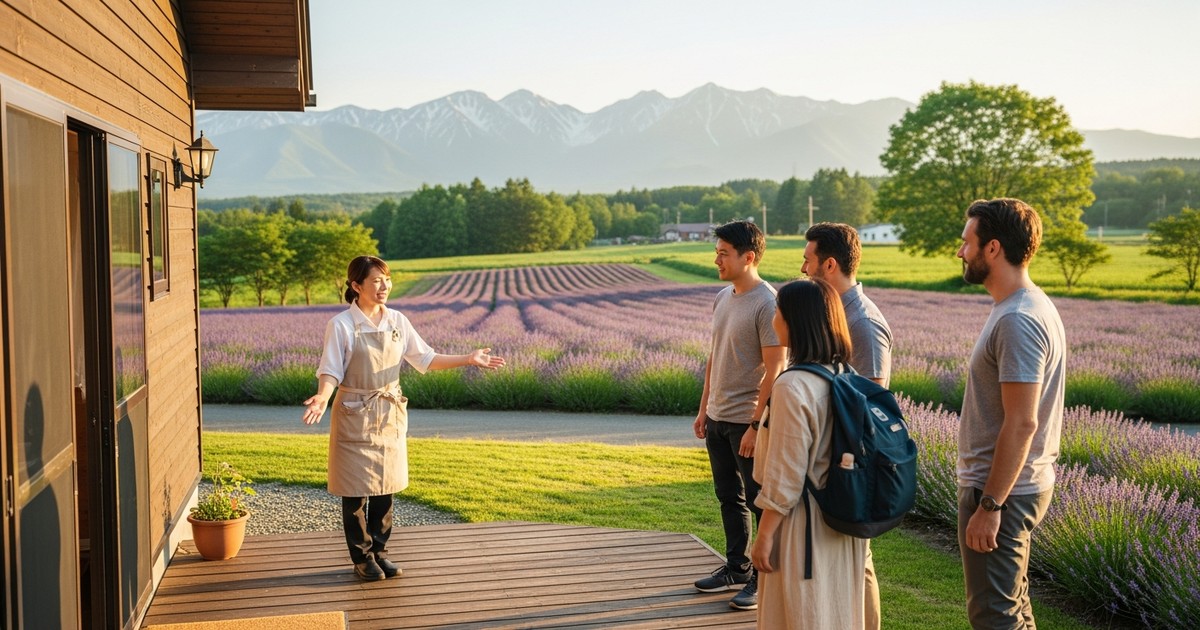
Inbound accommodation demand in Furano is expected to keep climbing through 2025 and beyond. Known worldwide for its lavender fields and powder snow, Furano remains a firm favorite among travelers from Taiwan, Thailand, and Western countries—and clear differences by nationality and region are emerging in how these guests choose accommodations and shape their stays.
This article organizes the trends shaping Furano’s inbound accommodation market heading into 2026 and breaks down the tendencies of Taiwanese, Thai, and Western guests with concrete data. We’ve aimed to provide insights that owners of minpaku and cottage-style properties—or anyone considering entering the Furano hospitality market—can put directly into practice.
Furano’s defining feature is its two major peak seasons: the summer lavender season and the winter ski season. Understanding how this dual-peak structure shapes inbound demand, and which nationalities concentrate during which periods, is the key to maximizing occupancy and revenue.
Why Inbound Accommodation Demand Is Growing in Furano
Trends in Foreign Visitor Numbers Across Hokkaido
Foreign visitor numbers to Hokkaido reached approximately 3.12 million overnight stays in 2019, before the pandemic. The recovery since then has been remarkable, with many months in 2024 surpassing the corresponding 2019 figures. According to Hokkaido Prefecture’s accommodation statistics, foreign guest-nights have been recovering strongly in the central and northern regions of Hokkaido, and Furano is drawing growing attention as a resort destination second only to Niseko.
Foreign guest-nights in the Furano area (Furano City, Kamifurano Town, Nakafurano Town, and Minamifurano Town) were estimated at around 180,000 in 2019. Some forecasts suggest this figure could reach 220,000–250,000 by 2026, driven largely by winter ski demand. Furano Ski Resort’s frequent coverage in overseas ski media as a “hidden gem that avoids Niseko’s crowds” has directly boosted its international profile.
Expanded International Flights at New Chitose Airport and Improved Transport Access
New Chitose Airport has seen a steady increase in direct flights from Taiwan, Thailand, Singapore, Australia, and other destinations, with weekly international flight frequencies in the 2024 winter schedule surpassing pre-pandemic levels. Furano is about a 2-hour drive from New Chitose Airport and roughly 1 hour from Asahikawa Airport, and the track record of charter flights from Taiwan to Asahikawa Airport is providing an additional tailwind.
Furthermore, the growing popularity of JR Hokkaido’s sightseeing trains and rental car use is making Furano increasingly accessible to independent travelers (FIT). As the shift from group tours to FIT continues, demand tends to move away from hotels toward whole-house minpaku rentals and cottages—an opportunity for accommodation operators to raise their per-night rates.
Trends and Accommodation Needs of Taiwanese Guests
Visit Timing and Repeat Visitor Rates
Taiwanese visits to Furano are heavily concentrated in July, during the lavender season. Tours centered on Farm Tomita and Saika no Sato have become a standard fixture, and Hokkaido tour packages sold by Taiwanese travel agencies almost always include Furano. In recent years, however, a growing number of Taiwanese skiers have also been visiting Furano Ski Resort and Tomamu in winter, pointing toward the formation of year-round demand.
The repeat visitor rate among Taiwanese travelers to Hokkaido is high, at around 40%. On second and subsequent visits, a common pattern is to skip Sapporo and Otaru in favor of longer stays in Furano and Biei. Average length of stay in the Furano area is 1.5–2 nights, with booking prices for group-friendly whole-house rentals typically ranging from ¥25,000 to ¥40,000 per night.
What They Look for in Accommodation
Taiwanese guests place strong emphasis on cleanliness and value for money. Since they tend to thoroughly check online reviews before booking, managing reviews on Booking.com and Google Maps directly impacts bookings. In terms of amenities, a washlet-equipped toilet, bathtub, and Wi-Fi are considered essential.
Many Taiwanese guests opt for room-only stays without meals, so simply providing multilingual guidance on nearby restaurants and convenience store locations can significantly boost satisfaction. Whether listing descriptions and check-in instructions are available in Traditional Chinese also heavily influences booking decisions, making Traditional Chinese support for both listing pages and in-property guides a highly cost-effective investment.
Trends and Accommodation Needs of Thai Guests
The Rapidly Growing Thai Market for Hokkaido Travel
Thai visitors to Japan numbered around 1.32 million in 2019, with an estimated 12% visiting Hokkaido. In Thailand, social media—particularly Instagram and Facebook—wields enormous influence over destination choice, and Furano’s lavender fields and the Blue Pond have spread widely as “Instagrammable” spots. Japan’s continued visa exemption for Thai travelers has also helped sustain demand.
Thai visits to Furano tend to cluster in July and August, though there’s also a steady inflow from December to February driven by a longing for snowy scenery. That said, the proportion of Thai visitors coming specifically for skiing is lower than among Taiwanese or Western guests, with snow play and hot spring experiences serving as the main winter motivations. Activity recommendations that reflect this reality can make or break winter bookings.
Booking Behavior and Price Sensitivity
Thai guests’ average travel budget tends to run somewhat lower than that of Taiwanese or Western guests, with nightly rates typically falling in the ¥15,000–¥25,000 range per room. However, since groups of 3–5 people are the norm, keeping the per-person cost down in whole-house rentals is often the deciding factor in booking. Agoda usage among Thai travelers is notably higher than among other nationalities, making listing on Agoda and optimizing pricing there essential.
Thai travelers also rely heavily on LINE as their primary communication tool. Setting up a system for post-booking communication via LINE tends to lead to better reviews. Delivering check-in instructions and recommendations for nearby attractions in Thai or English via LINE can be an effective way to differentiate your property from competitors.
Trends and Accommodation Needs of Western Guests
Long Stays and Ski Resort Demand
Guests from Western countries (Australia, the United States, the United Kingdom, France, and others) overwhelmingly view Furano as a winter ski destination. Average stays run 4–7 nights—significantly longer than other groups—and as Niseko grows more crowded and expensive, more travelers are choosing Furano as an alternative that offers high-quality powder snow at a more reasonable price.
Nightly rates are the highest among all nationalities: whole-house rentals typically command ¥40,000–¥80,000 per night, and it’s not uncommon for peak-week rates (Christmas through New Year, and the February holidays) to exceed ¥100,000. Since bookings often involve 2–3 families traveling together or groups of four or more, properties with spacious 3-bedroom-plus layouts tend to maintain higher occupancy rates.
Expected Amenity Standards and Branding
Western guests are particularly attentive to kitchen quality. Properties equipped with a dishwasher, oven, large refrigerator, and a full set of cookware tend to earn high ratings, as the ability to cook for themselves is a major factor in choosing where to stay long-term. Given the limited dining options in the Furano area, kitchen quality directly translates into competitive advantage.
Airbnb serves as the primary channel for attracting Western guests, and professional photography combined with detailed English-language descriptions significantly affects booking rates. Designing listings around keywords like “Japanese traditional,” “powder snow,” and “mountain view” can be effective. It’s also important to clearly note the reliability of heating systems (especially their ability to handle temperatures below -20°C in January and February), as this helps alleviate Western guests’ concerns.
Accommodation Strategy Insights from Comparing Nationalities
Optimizing Targets by Season
Since summer (June–August) is dominated by Taiwanese and Thai guests, it makes sense to optimize OTA listing languages and pricing for the Asian market during this period. Concretely, this means offering Traditional Chinese and Thai support on Booking.com and Agoda, setting nightly rates in the ¥20,000–¥30,000 range, and marketing layouts suited to groups of 2–4.
In winter (December–March), Western guests become the primary revenue driver, so Airbnb should be your central channel, with nightly rates of ¥40,000 or more achievable. Clearly stating ski resort access information, whether transfer service is available, and the presence of a drying room or ski rack can help differentiate your property from competitors. Some Furano-area properties employing this dual summer-winter strategy have achieved annual occupancy rates above 60% and annual revenue of ¥8 million to ¥12 million.
Review Strategy and Multilingual Support Priorities
When working with a limited budget for multilingual support, the priority order should be English, Traditional Chinese, and then Thai. Since English is used not only by Western guests but by many Asian travelers as well, perfecting your English-language listing and in-property guides should be the first step. Traditional Chinese covers the high-volume Taiwanese market, while Thai support—even limited to essentials like check-in instructions—can still be highly effective.
For generating reviews, a system of sending a thank-you message within 24 hours of checkout and requesting a review tends to work well. Given OTA algorithms that tend to boost search ranking significantly once a listing surpasses 50 reviews, prioritizing review accumulation—even at the cost of lower prices during the early stages of operation—is a tactic that pays off in maximizing revenue over the medium to long term.
Outlook for Furano’s Inbound Accommodation Market Toward 2026
Heading into 2026, several structural tailwinds are working in favor of Furano’s inbound accommodation market. First, as land prices and accommodation costs in Niseko continue to climb, a “spillover effect” is accelerating, pushing cost-conscious travelers toward Furano. With whole-house rentals in Niseko reaching ¥150,000–¥300,000 per night in winter, Furano’s ability to offer comparable snow quality at less than half that price is a powerful competitive advantage.
Furano City’s ongoing tourism infrastructure improvements—expanded multilingual signage, more Wi-Fi hotspots, and greater cashless payment adoption—are also steadily improving conditions for independent travelers. For accommodation operators, taking advantage of this favorable environment by preparing and listing properties early, and building up a solid base of reviews, will be essential preparation for capturing peak demand in 2026.
That said, there are some important considerations. The Furano area faces high winter snow-removal and heating costs, with utility bills sometimes reaching ¥50,000–¥100,000 per month. Additionally, since the area is remote and difficult to staff with an on-site manager, building a solid operational system—covering cleaning, key handovers, and troubleshooting—is the single biggest factor determining profitability.
For Minpaku Management in Furano, Consult Stay Buddy Inc.
If you’re looking to start an inbound-focused accommodation business in the Furano area—or you’re already operating one but facing challenges with occupancy or revenue—we invite you to consult Stay Buddy Inc., a specialist in minpaku property management. We offer one-stop support for everything a hospitality business needs, from creating multilingual listings to designing OTA-specific pricing strategies, cleaning, and guest communication.
At Stay Buddy, we also focus on optimizing seasonal pricing using data on guest trends by nationality, and on designing guest communication systems that accelerate review acquisition. We’ve built up extensive know-how in winter property management and snow removal specific to the Furano area, so even owners living far away can confidently leave their property operations in our hands.
As inbound demand heads toward full-scale growth in 2026, starting your preparations now is the fastest route to maximizing revenue. We also welcome inquiries at the property selection stage, so please feel free to reach out to Stay Buddy Inc. at any time.