Why Long-Stay Guests Matter for Hokkaido Minpaku
For minpaku operators in Hokkaido, attracting long-stay guests is a key strategy for stabilizing revenue. While much attention is often given to boosting turnover through short-term stays, guests who book for a week or more offer several distinct advantages: lower cleaning costs, more stable occupancy, and reduced vacancy risk during the off-season. In fact, it’s not uncommon for hosts to discount their nightly rate by around 15% and still see higher overall profit margins, simply because cleaning and supply-restocking frequency drops so significantly.
Hokkaido has clear seasonal demand patterns—summer escapes from the heat and winter sports draw crowds—but spring and autumn tend to see a noticeable dip in tourists. How well you fill this off-season gap can make or break your annual revenue. Long-stay guests aren’t limited to tourists; they also include remote workers, people trying out life in a new region before relocating, and seasonal laborers. With the right approach, this diverse pool of guests can help you achieve stable occupancy all year round.
This article breaks down concrete tactics for winning week-plus, long-stay guests at your Hokkaido minpaku, covering pricing design, equipment investment, booking channels, and operational structure.
Pricing Design as a Long-Stay Strategy for Minpaku
The most direct way to attract long-stay guests is to clearly offer a discounted rate structure for extended bookings. Airbnb has built-in “weekly” and “monthly” discount settings, and it’s common to see discounts of 10–20% for weekly stays and 25–40% for monthly stays. For example, if your standard rate is ¥8,000 per night, an effective tiered structure might look like ¥6,800/night (15% off) for stays of 7+ nights, and ¥5,200/night (35% off) for stays of 30+ nights.
What matters most here is running the numbers ahead of time to confirm that your discounted rate actually improves your bottom line. Say a single cleaning costs ¥5,000 and linen changes cost ¥2,000. If you host seven separate one-night guests in a week, that’s ¥49,000 in cleaning and linen costs alone—versus just ¥7,000 for one guest staying all seven nights. That ¥42,000 difference is a real, tangible profit gain. Once you understand these numbers, you can set discount rates that actually increase your take-home earnings even as your nightly price drops.
Flat-Rate Cleaning Fees and Long-Stay Price Display
On OTAs (online travel agencies), cleaning fees are typically shown as a fixed, one-time charge—so the longer the stay, the lower that fee becomes on a per-night basis. For instance, an ¥8,000 cleaning fee adds ¥8,000 to a one-night stay, but works out to only about ¥1,143 per night over a 7-night stay. Spelling this out in your listing description—showing the guest an actual figure like “effectively just ¥X per night for a 7-night stay”—is an effective way to highlight the value of booking long-term.
Handling Utility Costs and Clarifying Extra Charges
Winter heating costs can be a significant burden in Hokkaido. Kerosene and electricity bills from January through March can reach ¥30,000–¥50,000 a month, so for stays of 30 nights or more, you’ll need to decide in advance whether to pass some of this cost on to the guest or add it as a winter surcharge. Leaving this ambiguous is a recipe for disputes—so be specific in your house rules or booking confirmation message, for example: “A ¥500 per-night utility surcharge applies during winter (December–March).”
Amenities and Property Design That Long-Stay Guests Look For
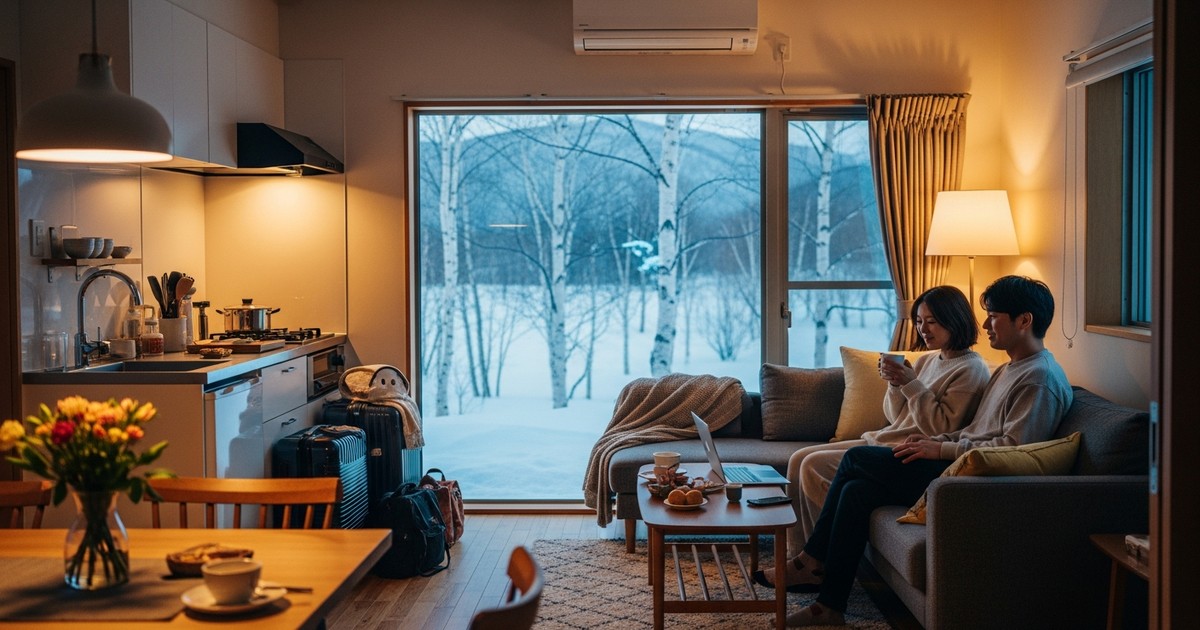
Guests staying one or two nights have very different priorities from those staying a week or more. Short-term guests tend to focus on proximity to tourist spots and photogenic interiors, while long-stay guests prioritize livability above all else. A washing machine, dryer, well-equipped kitchen, a proper desk for work, and reliable Wi-Fi are the kinds of everyday essentials that ultimately determine whether a long-stay guest books your place.
Hokkaido comes with its own unique considerations, namely cold-weather readiness and snow removal. Double-glazed windows, floor heating, and high-insulation construction are all major draws for long-stay guests. Clearly stating your snow-removal arrangements for the parking area also gives peace of mind to guests who’ll be getting around by rental car or their own vehicle.
Setting Up a Workspace and Internet Environment
For remote-work-minded long-stay guests, the work environment is the single biggest factor in choosing where to stay. Equip your property with a desk at least 70cm x 50cm, a chair comfortable enough for long sitting sessions, and fiber-optic Wi-Fi with download speeds of at least 100 Mbps, and you’ll be well positioned to capture workation demand. Listing actual measured speeds builds guest trust—something concrete like “Speed test result: 180 Mbps download” works well.
A Well-Equipped Kitchen
Few guests eat out for an entire week or more—most will cook at least some meals themselves during a longer stay. Stocking an induction or gas cooktop with two or more burners, a refrigerator (200L or larger is recommended), a microwave, a rice cooker, basic cookware, and simple seasonings (salt, pepper, oil, soy sauce) makes it much more likely you’ll see positive review comments like “easy to cook for myself.” A seasoning set costs only about ¥500, but its impact on reviews is disproportionately large.
Laundry Facilities and Everyday Consumables
A drum-type washer-dryer combo is ideal, but even a top-loading washer works fine as long as there’s an indoor drying rack or a bathroom dryer available. Keep detergent and fabric softener stocked in bottles, with enough supply for a full 7-night stay. Consumables like tissues, toilet paper, trash bags, and dish soap should also be stocked generously for a week’s worth of use—doing so prevents mid-stay inconveniences and directly supports guest satisfaction.
Booking Channels and Messaging for Attracting Long-Stay Guests
Long-stay guests don’t just look on Airbnb and Booking.com—they also search on monthly-rental platforms and via social media. Working across multiple channels at once lets you reach audiences that short-term-focused OTAs simply can’t. This is especially true for stays of a month or more, since many long-stay guests prefer to book directly in order to avoid OTA commission fees (typically 3–15%), so it’s well worth setting up your own website and social channels as direct booking pathways.
In Hokkaido, areas like Niseko, Furano, and greater Sapporo see strong inbound demand, while Asahikawa, Obihiro, and Kushiro tend to attract domestic remote workers and prospective relocators. You’ll want to tailor your channels and language to match each target audience.
Optimizing Your OTA Listing
Airbnb has a “long-term stay” filter that prioritizes listings with weekly and monthly discounts enabled. Beyond simply activating those discounts, include keywords like “long-stay welcome” or “workation-friendly” in your listing title, and pack concrete details—”15% off for 7+ nights,” “180 Mbps measured Wi-Fi speed”—into the first three lines of your description. Airbnb’s search algorithm tends to rank listings with high average length-of-stay more favorably, so the more long-stay guests you attract, the easier it becomes to attract the next one—a virtuous cycle.
Leveraging Monthly Rental Platforms
Listing on monthly-apartment search sites and weekly-rental portals lets you reach guests on business trips or trying out relocation. These platforms typically display an all-inclusive monthly rate covering furniture, appliances, and utilities, so it’s important to present your total clearly—something like “From ¥120,000/month (utilities and Wi-Fi included).” Since fees on these platforms tend to be lower than OTA commissions (often just a flat monthly or listing fee), this can also boost your overall profit margin.
Direct Bookings via Social Media and Your Own Website
Regularly posting on Instagram or X (formerly Twitter) about everyday life at your property and Hokkaido’s seasonal charms, then directing followers to your booking page via your profile link, is an effective way to cut OTA fees while building a base of repeat guests. Make your posts concrete and vivid—things like “working remotely with a snowy view outside” or “fresh seafood from the supermarket just five minutes away”—to paint a real picture of long-stay life there. Once you have your own booking site, you can also offer perks like a 5% discount for direct bookings—a win-win for both you and your guests.
Operations and Trouble Prevention for Long-Stay Guests
Hosting long-stay guests brings operational challenges that differ from short-term stays: handling equipment issues mid-stay, maintaining good relations with neighbors, and finding the right cadence for guest communication. Setting clear rules and structures in advance is key to running things smoothly.
In Hokkaido especially, frozen pipes and heating malfunctions are common in winter, so it’s essential to have a documented emergency contact list and response process in place. If you’ve built a network that can dispatch a repair technician within 24 hours, you can minimize any dip in guest satisfaction.
Mid-Stay Cleaning and Linen Change Systems
For stays of 7 nights or more, you’ll need to decide in advance whether to offer mid-stay linen changes or light cleaning. Giving guests options—for example, “free towel and sheet changes every 7 nights” or “additional cleaning available on request for ¥3,000 per visit”—lets guests choose what works for them while keeping your costs manageable. Coordinating with your cleaning staff is much smoother if you set up a shared chat group for schedule updates in advance.
Clear House Rules and Guest Communication
During long stays, issues that rarely come up on short trips—trash disposal rules, quiet hours, smoking policies, and how to handle visitors—can easily turn into disputes. Since garbage sorting rules are quite detailed in many Hokkaido municipalities, it helps to prepare a photo-illustrated sorting guide and post a collection-day calendar in the kitchen. Walking guests through the house rules verbally at check-in, and following up with a PDF copy via message, helps prevent “no one told me that” complaints down the line.
Concrete Tactics for Winning Long-Stay Guests in the Off-Season
The biggest challenge for Hokkaido minpaku is filling vacancies during the April–May and October–November off-seasons. Successfully attracting long-stay guests during these periods can dramatically improve your annual occupancy rate. One effective approach is to set your monthly rate at around 40–50% of your peak-season rate and market it as a themed plan—something like “Try Hokkaido Living for a Month” or “One-Month Remote Work Plan in Spring Hokkaido.”
You might also partner with local municipal relocation-trial or workation-promotion programs. For example, offering your property to a municipality’s relocation support desk to be introduced as trial housing for prospective residents lets you steadily secure off-season long-stay guests without spending on advertising. In fact, demand for relocation trial housing already exceeds supply in several Hokkaido municipalities, and minpaku properties are increasingly stepping in to fill that gap.
Realize Your Long-Stay Strategy with Stay Buddy’s Minpaku Management Service
Winning long-stay guests requires progress on multiple fronts at once—pricing design, equipment investment, booking channel setup, and operational structure. Handling all of this alone is a heavy lift in terms of time and effort for individual owners, and the challenge of managing things on-site becomes even greater if your property is located far from where you live.
Stay Buddy Inc. offers full-service minpaku management, covering everything from listing optimization and pricing strategy to guest communication, cleaning coordination, and issue resolution. We can handle the entire strategic operation on your behalf—from setting up long-stay pricing to listing your property on monthly rental platforms—all geared toward maximizing your revenue.
If you’re interested in running a minpaku in Hokkaido, or if you’re already operating one and struggling to attract long-stay guests, we’d love to hear from you. We’ll propose an optimal management plan tailored to your property’s location and characteristics.
Feel free to get in touch anytime through the Stay Buddy Inc. website.