
Leave Your Vacation Rental Management to the Experts
Free Online ConsultationWhen you own a short-term rental in Japan and can’t physically be there, the quality of your cleaning, linen, and consumables management isn’t a background detail — it’s the main operational variable that drives your reviews, your repeat bookings, and your compliance standing. Japan rental management is built on exceptionally high guest expectations, and the gap between a well-run property and a poorly run one is almost always visible in the turnover room, not the listing copy.
How Cleaning and Linen Management Actually Works in Japan Rental Operations
Most management companies in Japan work with contracted cleaning vendors rather than in-house housekeeping teams. The handover protocol matters more than most overseas owners realise. At a property we manage in Kyoto’s Higashiyama district, our cleaning vendor does a timed walkthrough with a photo checklist uploaded to a shared drive within thirty minutes of each departure. We require this not because we distrust the cleaner, but because photo records are the only reliable dispute mechanism when a guest claims damage that a previous guest actually caused. Without that timestamp, you have nothing to stand on.
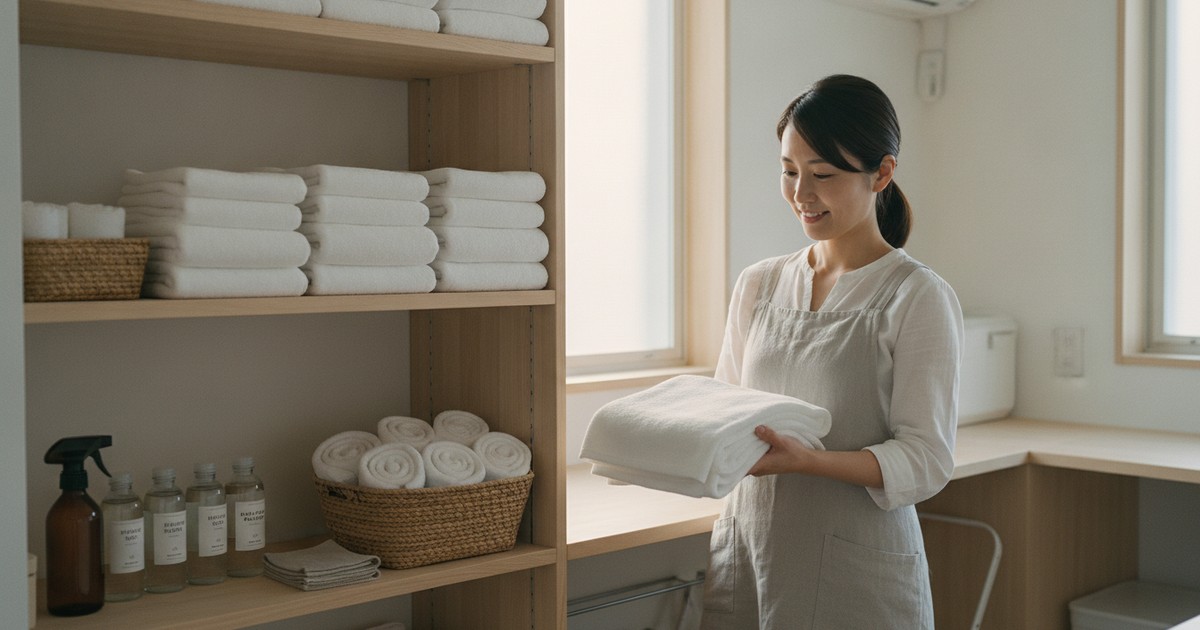
Linen is typically handled through one of two models: a laundry-on-site model, where the cleaning team washes and dries between stays, or a linen rental model, where a commercial linen supplier delivers fresh stock and collects soiled sets on a per-stay basis. For properties with multiple bedrooms or high turnover, linen rental is operationally more reliable — commercial laundering meets the hygiene standards that guests in the upper-mid and luxury segments now expect, and it removes the dependency on the cleaner’s own judgement about whether a set is truly ready to use again. Linen rental costs in Japan typically run somewhere between ¥1,500 and ¥4,000 per set per stay, depending on the supplier, the property location, and volume commitments, but these are negotiated rates and vary considerably.
Consumables: The Detail That Surfaces in Reviews
Japanese guests and inbound travellers staying in well-reviewed properties in Japan have benchmarked their expectations against hotel standards. That means amenities — individually wrapped soap, shampoo, conditioner, toothbrush kits, and toilet paper restocked per stay — are effectively baseline requirements rather than differentiators. The question for overseas owners is who is responsible for inventory management, and how it’s audited.
At Stay Buddy, consumable restocking is built into the cleaning fee calculation, with a per-stay allocation tracked against a monthly inventory count. We report this line separately to owners so the cost is transparent, rather than absorbed into an opaque service fee. When we onboarded a property in Osaka’s Namba area, the previous operator had been averaging consumable costs significantly below what the guest numbers implied — which, on inspection, turned out to mean guests were regularly running out of toilet paper mid-stay. The reviews reflected it. The fix was a straightforward inventory minimum per room per stay, enforced at the cleaning checklist level. Review scores recovered within two months.
Regulatory Context That Affects Cleaning Standards
Under the Housing Accommodation Business Act (the Minpaku Law, which imposes a 180-day annual operating cap on standard minpaku), registered properties must meet specific hygiene and safety standards set out in prefectural regulations. These vary by municipality but consistently require proper linen management and documented cleaning procedures. Properties operating under a ryokan business licence under the Hotel Business Act face more stringent requirements, including rules on minimum room sizes, reception facilities, and sanitation management — all of which affect cleaning protocols and cost structures.
Fire Service Act compliance also touches the cleaning function more than overseas owners typically anticipate. Fire extinguisher checks, emergency lighting inspection records, and smoke detector testing are often scheduled around turnovers. A cleaning team that isn’t briefed on these requirements can inadvertently compromise a compliance record simply by moving equipment or covering detectors during a deep clean. Your management company should have a documented protocol that covers this.
One note relevant to owners considering Osaka specifically: as of 29 May 2026, Osaka City permanently ended new applications for tokku minpaku (the national strategic special zone pathway that previously allowed some operators to sidestep the 180-day cap). Existing certified facilities may continue, but no new tokku minpaku can be started in Osaka City. New properties there now route through either the standard Minpaku Law registration or a ryokan licence, each with its own hygiene and cleaning documentation requirements.
Oversight at a Distance: What to Actually Ask Your Management Company
Overseas owners cannot walk the property. That means the oversight system your management company runs is your only proxy for quality. These are the questions that separate operators who can account for what happens at the property from those who cannot:
- What does the post-cleaning photo checklist cover, and how quickly is it uploaded after each departure?
- Who holds the linen contract — the management company or the cleaner — and are you, as the owner, named on it?
- How are consumable costs itemised in your monthly owner statement, and what is the per-stay restocking standard?
- What happens if a cleaning vendor cancels at short notice before a check-in? Who is the backup, and what is the escalation path?
- How are cleaning-related guest complaints handled, and are you notified before a refund is issued?
Management agency fees in Japan typically range from 10–25% of revenue, depending on scope of involvement, property type, and the company. A lower rate often means cleaning coordination, linen, and consumable management are handled separately at additional cost, or not at all. Always clarify what the fee actually covers before comparing headline percentages.
Financial Transparency for Non-Resident Owners
Cleaning and linen costs are operational expenses deductible against rental income in Japan, which matters because non-resident owners are subject to Japanese income tax — typically withheld at source by the management company under the non-resident withholding rules administered by the National Tax Agency. Your monthly owner statement should show gross revenue, platform fees, management fees, and operational costs (including cleaning and linen) as distinct line items, so your Japanese tax accountant can work with accurate figures. If a management company presents a single net payout figure without a cost breakdown, that is a transparency problem regardless of whether the number looks reasonable.
Currency is a separate practical consideration. JPY payouts to overseas accounts involve conversion costs and transfer fees that erode returns. Some management companies offer scheduled FX transfers; others pay to a Japanese bank account and leave the conversion to the owner. This is worth settling contractually before you start, not after your first payout arrives.
Working With Stay Buddy
We run properties, not dashboards. Cleaning coordination, linen vendor management, consumable standards, photo documentation, and regulatory compliance are handled by our team on the ground — and reported to you in a monthly statement that accounts for every operational cost line. If you own a property in Japan or are assessing whether to acquire one, we’re available to talk through what the actual operating structure looks like for your specific location and licence type.
Leave Your Vacation Rental Management to the Experts
Free Online ConsultationShuhei Makigi
Representative Director, Stay Buddy Co., Ltd.
Registered Housing Accommodation Management Business — Ministry of Land, Infrastructure, Transport and Tourism No. F03862. Stay Buddy operates short-term rentals and licensed hotels across Japan, supporting overseas investors with compliant, high-performing properties.
Written by the Stay Buddy Japan team. This content was produced with AI assistance and reviewed for accuracy.