Leave Your Vacation Rental Management to Us
Free Online ConsultationThe Role a PMS Plays in Day-to-Day Vacation Rental & Ryokan Operations
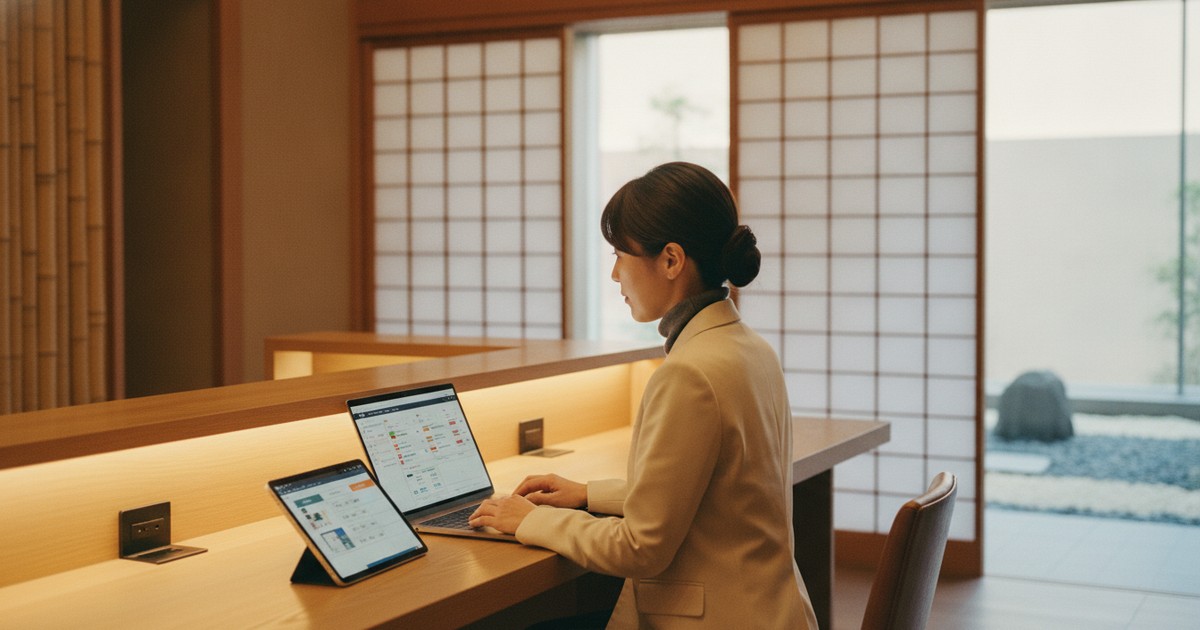
A PMS (Property Management System) is software built for vacation rental and ryokan operators that centralizes reservations, pricing, cleaning coordination, and guest communication in one place. If you’re listing a property across multiple OTAs (Online Travel Agents), going without a PMS means manually tracking every calendar yourself to avoid double bookings. Having managed multiple properties as an operations agency, I can say firsthand that whether or not you adopt a PMS is often the single biggest factor determining how stable your operations will be.
4 Core PMS Features Every Vacation Rental & Ryokan Operator Should Know
Channel Manager Integration (Unified Inventory & Pricing)
When you list the same property on multiple OTAs—Airbnb, Booking.com, Rakuten Travel, and others—each platform’s calendar operates independently. That means the moment a booking comes in on one site, you have to manually close the dates on all the others. With a channel manager built into your PMS, inventory syncs automatically no matter which OTA the booking comes through. A double booking has to be treated as a cancellation of the accommodation contract under the Private Lodging Business Act or the Hotel Business Act, which brings a heavy compensation burden down on your team. Given this risk, we consider channel manager integration an absolute must-have.
Dynamic Pricing (Automated Rate Optimization)
Demand fluctuates significantly depending on the season, day of the week, and local events. Running fixed rates means missing out on profit during peak periods and sitting on empty rooms during the slow season. Some PMS platforms integrate with demand-forecasting algorithms that automatically adjust pricing based on competitor rate trends. That said, how accurately these algorithms account for local festivals or major trade shows varies by product. Occupancy rates vary widely depending on location, property type, and season, so there’s no one-size-fits-all answer—but from real operating experience, we can confirm that pricing precision directly affects both occupancy and revenue.
Cleaning & Maintenance Task Management
Whether a PMS can automatically generate cleaning tasks the moment a checkout is logged makes a huge difference in day-to-day workload. We once managed a property that went without a PMS for a while, and had to contact cleaning staff individually by LINE and phone for every job. During peak season, when checkouts overlapped across multiple properties, messages occasionally fell through the cracks—leading to incomplete cleanings and delayed check-ins, which hurt guest reviews. Since automating the process from checkout detection to cleaning notifications through a PMS’s task management feature, these mistakes have all but disappeared.
Guest Communication (Automated Messaging)
Automated sending of standard messages—booking confirmations, check-in instructions, pre-checkout reminders—needs to be evaluated together with multilingual support. According to Japan Tourism Agency statistics, demand for accommodations among inbound travelers remains consistently high, so whether a system can run templates in English, Chinese, and Korean is a practical and important factor when choosing a PMS.
How Licensing Category Under the Hotel Business Act & Private Lodging Business Act Affects PMS Selection
Properties registered under the Private Lodging Business Act (Japan’s “minpaku” law) differ from those operating as simple lodges, ryokan, or hotels under the Hotel Business Act—in whether there’s a cap on annual operating days, in fire safety equipment requirements, and in recordkeeping obligations. Under the Private Lodging Business Act, there’s a hard cap of 180 operating days per year, and whether your PMS can accurately track that day count is a direct compliance issue for registered operators. Properties under the Hotel Business Act have no such annual cap, but the question there becomes how much of the front-desk role you want your PMS’s guest communication features to cover. Confirm which legal framework governs your property first, then work out exactly which PMS features you actually need.
How to Choose a PMS: Criteria from the Field
Coverage of Domestic OTAs
Overseas-built PMS platforms often handle Airbnb and VRBO well, but their API integration with domestic Japanese OTAs like Rakuten Travel, Jalan, and Yahoo! Travel can be limited. If you’re targeting domestic travelers, or if your property operates under the Hotel Business Act and relies heavily on domestic OTA listings, check the full list of supported channels before committing.
Pricing Structure & Upfront Costs
PMS pricing models vary by product—flat monthly fees, per-booking charges, revenue-share models, and more. A flat monthly fee can feel like a heavy burden when you only have a handful of properties, but as booking volume grows, a per-booking or revenue-share model can end up costing more. It’s worth running the numbers against your actual operating scale, factoring in any separate setup or onboarding fees, before deciding.
Support Quality & Japanese-Language Availability
Problems tend to strike at the worst times—right before check-in, or late at night before a holiday—exactly when OTA support centers are hardest to reach. Whether your PMS offers Japanese-language support, along with chat or email help outside normal business hours, has a direct impact on how confident you feel running day-to-day operations. A practical way to test this: during the free trial period, deliberately reach out to support and see how fast and how well they respond.
Free Consultation & Inquiries with Stay Buddy Inc.
As a company specializing in vacation rental and ryokan management services, Stay Buddy handles everything as one integrated service—from PMS selection to licensing and permit support to on-the-ground cleaning and guest communication operations. Whether you’re not sure which PMS fits your property, or you’re already operating but want to cut down on management workload, our experienced on-the-ground staff will take your questions directly.
We’re set up to walk alongside you from the very first steps—confirming whether your property falls under the Private Lodging Business Act or the Hotel Business Act, handling fire safety equipment compliance, and setting up your OTA listings. We also welcome inquiries from property owners already under contract with another management company, or those considering switching from self-management to a full-service operator.
Your first consultation is completely free. Just let us know your property’s location, current operating status, and what you’re struggling with, and one of our team members will follow up with a concrete proposal. Feel free to reach out through our contact form or by phone.