Leave Your Minpaku Management to the Experts
Free Online ConsultationFire Safety Equipment Standards for Minpaku: How Requirements Differ Under the Hotels and Inns Act vs. the Private Lodging Business Act
The fire safety equipment required for a minpaku property depends heavily on which law governs it. Properties registered under the Private Lodging Business Act (Japan’s “minpaku law”) and those licensed as simple lodging houses under the Hotels and Inns Act are treated differently under the Fire Service Act. Because of this, fire safety planning needs to start as early as the stage where you decide which operating framework to use.
At Stay Buddy, where we handle property management on behalf of owners, it’s not uncommon to hear things like, “We filed our notification, but the fire department is now telling us to make corrections.” Even properties registered under the Private Lodging Business Act—which are technically classified as “residential” under the law—are still subject to Fire Service Act requirements based on the building’s actual use, occupancy, and total floor area. In other words, assuming “it’s a minpaku-law property, so no equipment is needed” is a misunderstanding that can get owners into trouble.
Required Fire Safety Equipment: A Rundown of the Standards
Automatic Fire Alarm Systems
For properties licensed as simple lodging houses under the Hotels and Inns Act, an automatic fire alarm system becomes mandatory once the total floor area exceeds a certain threshold (generally around 300 m², though the exact figure depends on how the property is classified as a specified fire-hazard facility). Properties registered under the Private Lodging Business Act are often classified as “residential” under Appendix 1 of the Enforcement Order of the Fire Service Act, in which case a standard residential fire alarm may be sufficient. That said, even a single unit in an apartment building can be judged differently depending on the management association’s rules or guidance from the local government authority—so it’s essential to check with the jurisdictional fire department in advance.
Evacuation Guide Lights and Exit Signs
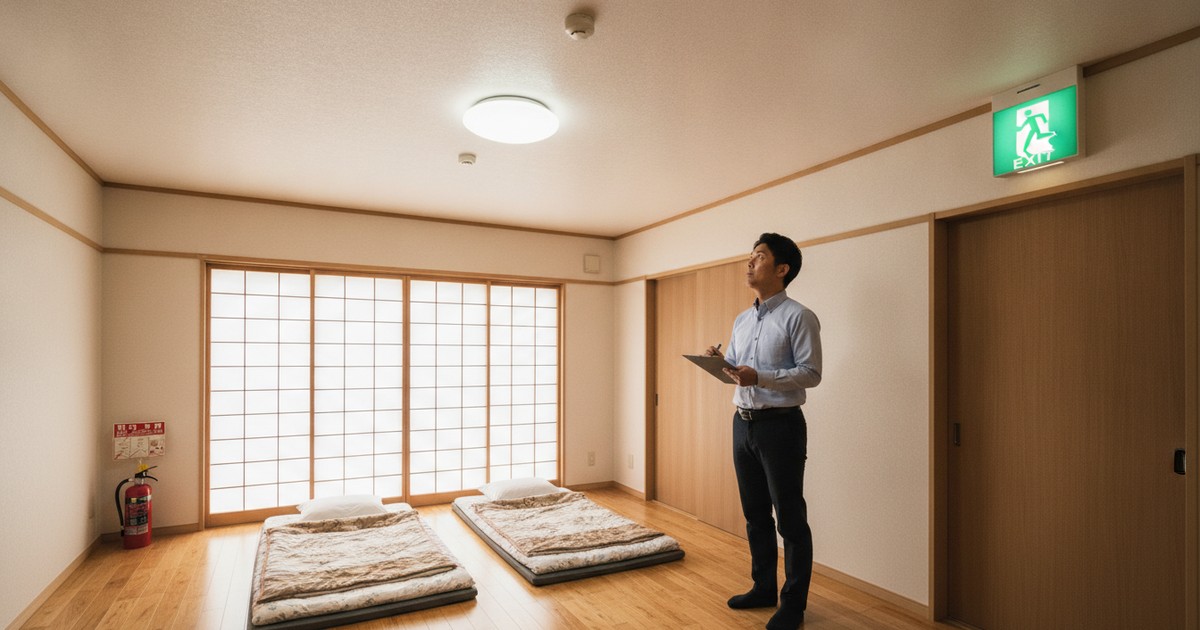
Lodging facilities operating under the Hotels and Inns Act are required, under Article 26 of the Enforcement Order of the Fire Service Act, to install evacuation guide lights and corridor guide lights. Properties under the Private Lodging Business Act may be exempt from this requirement in some cases, but the rules change if the building has mixed uses (for example, a building combining shops and residential units). Whether this equipment is required depends on total floor area, number of floors, and the complexity of evacuation routes—so it’s a mistake to assume “it’s a small property, so we don’t need it.”
Sprinkler Systems
Sprinkler systems are generally required only for specified fire-hazard facilities with a total floor area of 6,000 m² or more, meaning most small-scale minpaku properties won’t be subject to this requirement. However, for certain uses or structural conditions (such as basement floors or windowless floors), the area threshold drops significantly. If you’re pursuing a license under the Hotels and Inns Act, this needs to be confirmed at the stage when fire safety design is incorporated into your renovation plans.
Fire Extinguishers
Under Article 10 of the Enforcement Order of the Fire Service Act, fire extinguishers are mandatory for specified fire-hazard facilities with a total floor area of 150 m² or more. Most minpaku properties fall below this threshold, but if the property has equipment that uses fire (such as cooking appliances), it may be evaluated separately—including whether it falls under “small quantity hazardous materials” rules. Even for small properties, local ordinances sometimes impose stricter standards, so checking local regulations is a step that should never be skipped.
The Fire Safety Inspection Process and Typical Costs
When applying for a license under the Hotels and Inns Act, you’ll need to consult with and apply for confirmation from the fire department alongside your application to the public health center. If renovation work is involved, you’ll need to obtain fire department consent before construction begins. Properties registered under the Private Lodging Business Act aren’t required to go through this prior consultation process, but depending on the region, the fire department may still conduct an on-site inspection.
Costs for installing and inspecting fire safety equipment vary widely depending on property size, equipment type, and the contractor. Installing residential fire alarms alone often costs just a few thousand to a few tens of thousands of yen in materials and labor, while installing a new automatic fire alarm system can run into the hundreds of thousands of yen. The annual fire safety equipment inspection (a legally mandated check under Article 17-3-3 of the Fire Service Act) typically costs somewhere around ¥10,000–30,000 for a small property, depending on the type and quantity of equipment—though this varies by contractor, region, and equipment specifics.
Common Compliance Issues We See On-Site, and How We’ve Handled Them
One of the most frequent issues we encounter in properties we manage is dead batteries in residential fire alarms. Even properties that technically meet installation requirements can go unnoticed until a guest messages through the app saying, “There’s a beeping alarm that won’t stop.” In one case, a guest reached out late at night; we contacted the property manager, coordinated an immediate response, and arranged for a replacement the following morning. This kind of issue is entirely preventable by logging battery replacement history at installation and building a system to track device lifespan (generally around 10 years, though it varies by model).
Another common issue is burnt-out bulbs in evacuation guide lights. Even properties licensed under the Hotels and Inns Act often skip routine inspections after opening. Under Article 17-3-3 of the Fire Service Act, equipment inspections are required every six months, and comprehensive inspections once a year. Failing to keep inspection records can lead to a corrective order if the fire department conducts an on-site inspection.
Never Skip Prior Consultation with Local Ordinances and the Fire Department
Fire Service Act standards apply nationwide, but many prefectures and municipalities layer on stricter requirements through local ordinances. Major cities like Tokyo and Osaka, in particular, have their own fire prevention ordinances—so if you only check national standards when planning your property, you risk overlooking local requirements. Consulting in advance with the fire department that has jurisdiction over your property takes time, but it dramatically reduces the risk of having to carry out corrective work later.
Whether You’re Just Starting Out or Already Running a Minpaku Business, Talk to Stay Buddy
Stay Buddy has handled property management for a wide range of minpaku formats, from properties registered under the Private Lodging Business Act to those licensed as simple lodging houses under the Hotels and Inns Act. From checking fire safety equipment requirements in advance and supporting consultations with the fire department, to setting up systems for ongoing periodic inspections after opening, we support owners using know-how built up through real, on-the-ground experience—tailored to each owner’s specific situation.
We’re happy to help even at the stage of “I got my license, but I’m worried about fire safety compliance” or “I want to start a minpaku business but don’t know where to begin.” Since whether fire safety equipment is required varies from property to property, we won’t give you generic advice—we’ll listen to your specific situation first and guide you from there.
Your first consultation is completely free. Just share some basic information about your property and current operating situation, and we’ll help you sort out what issues you’re facing and what to prioritize. We never push owners into signing a management contract, so feel free to reach out even if you’re just gathering information at this stage.