Leave Your Minpaku Management to the Experts
100% Free Online ConsultationWhen launching a minpaku (private lodging) business, compliance with fire safety regulations is a step you simply cannot skip. Neglecting the required fire safety equipment doesn’t just risk having your operating permit denied — it can also expose you to serious liability if a fire actually breaks out. Many owners wonder exactly what equipment is needed and how much it will cost, and getting accurate information before opening your doors is essential.
This article breaks down the types of equipment required for fire code compliance in minpaku operations, rough installation costs for each, and a realistic estimate of what fire inspections actually cost — all with concrete figures. Whether you’re just starting out or considering renovating an existing property, this guide will give you the practical numbers you need.
The Basics of Fire Safety Equipment for Minpaku
Minpaku properties operate under either the Hotel Business Act or the Private Lodging Business Act (the “minpaku law”), but regardless of which framework applies, compliance with fire safety regulations is mandatory. Unlike an ordinary private home, a lodging facility hosts a rotating cast of unfamiliar guests, so you’re legally required to install proper equipment for evacuation, alerting, and firefighting in the event of a blaze. In many cases you’ll also need to file notifications with the fire department and undergo on-site inspections, so preparing for this early is crucial — it can affect your entire opening timeline.
The specific equipment and standards required depend on your property’s total floor area, number of stories, structure (wood versus fire-resistant construction), and occupancy capacity. For example, the equipment requirements differ significantly between small minpaku properties under 300 square meters of total floor area and larger facilities above that threshold. Figuring out which category your property falls into is the essential first step before you can estimate costs.
Key Equipment Required Under Fire Safety Law for Minpaku
Automatic Fire Alarm System
An automatic fire alarm system detects smoke or heat and sounds an alert automatically. If you’re obtaining a license under the Hotel Business Act, installation is generally mandatory for any facility with 300 square meters or more of total floor area. Even properties registered under the minpaku law may be required to install one if the building exceeds a certain size or is a mixed-use building (for example, shops on the ground floor with residences above). Because the system combines detectors, a receiver panel, manual call points, and audible alarms, costs vary with scale — but even for a small property, expect to budget roughly ¥500,000 to ¥1,500,000.
That said, residential-style minpaku properties under 300 square meters may be able to substitute standard residential smoke alarms instead. This exemption generally doesn’t apply to properties licensed under the Hotel Business Act, though, so it’s essential to confirm the requirements with your local fire department beforehand.
Residential Smoke Alarms
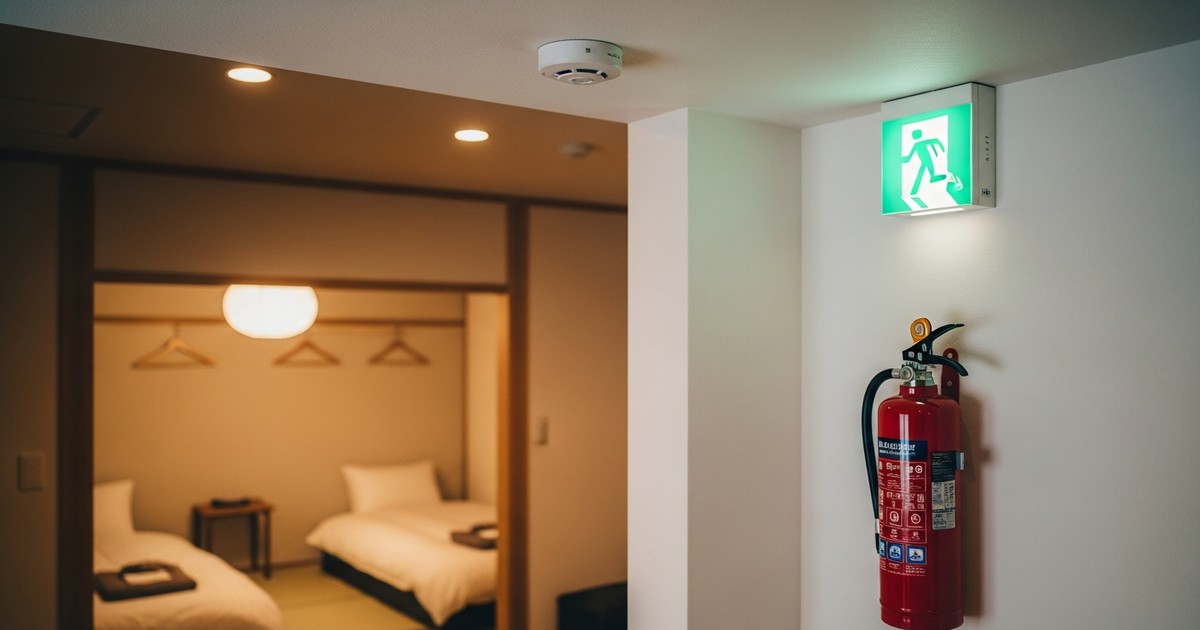
Properties registered under the minpaku law (limited to 180 days of operation per year) are required to install residential smoke alarms. These follow the same standards as ordinary homes, with units required in designated locations such as bedrooms, stairways, and hallways. Each unit typically costs ¥1,500 to ¥3,000, and including installation labor, expect roughly ¥3,000 to ¥8,000 per location. For a typical three-bedroom layout, total costs usually land in the ¥20,000 to ¥40,000 range.
However, if alarms already installed in the property have exceeded their service life (roughly 10 years), they’ll need to be replaced. When you acquire or lease a property for your business, check the installation date on any existing units and be sure to swap out anything old for new equipment.
Emergency Exit Signs and Directional Markers
Emergency exit signs and evacuation route markers, which clearly indicate exits and escape paths, are generally mandatory for properties licensed under the Hotel Business Act. They’re especially critical if the total floor area exceeds 50 square meters and guest rooms are located in a basement or on the second floor or above. LED exit signs (for doorways and corridors) typically cost ¥15,000 to ¥30,000 per unit for the equipment alone, or ¥30,000 to ¥50,000 per unit including electrical work. The number of units required varies with the size and number of floors, but for a two-story single-family home, expect 3 to 6 units, totaling roughly ¥100,000 to ¥300,000.
Directional markers (such as photoluminescent plates) are cheaper than illuminated exit signs, starting around ¥1,000 to ¥3,000 per plate. Whether you need illuminated signs, simple markers, or both depends on your facility’s size and layout, so confirm with your local fire department in advance.
Fire Extinguishers
Fire extinguishers are basic equipment required at most minpaku properties. Under the Hotel Business Act, installation is mandatory for facilities with 150 square meters or more of total floor area, but installing one is strongly recommended even below that threshold. Properties registered under the minpaku law may also receive guidance from the fire department to install extinguishers. Commercial-grade dry chemical extinguishers (ABC type, 10-unit rating) typically cost ¥3,000 to ¥6,000 each, with most properties needing one to several units depending on size. Also keep an eye on the expiration date of your extinguishers (roughly 10 years from manufacture).
Fire extinguishers aren’t just a one-time installation — they require periodic inspection and replacement as well. Inspection costs typically run ¥1,000 to ¥2,000 per unit annually, so consider contracting with a fire equipment inspection service.
Sprinkler Systems
Sprinkler systems are mandatory for facilities above a certain scale (generally 1,000 square meters or more of total floor area under the Hotel Business Act, or smaller if special conditions apply, such as basement or windowless floors). Most small, individually operated minpaku properties won’t trigger this requirement, but guesthouses or large converted single-family homes sometimes do. Installation costs are steep — even a small facility can run ¥2,000,000 to ¥5,000,000 or more, and larger properties can exceed ¥10,000,000.
Whether a sprinkler system is required depends heavily on the property’s structure, scale, and intended use. Consulting with the fire department before acquiring a property is essential for accurately gauging whether this major expense applies to you.
Appointing a Fire Safety Manager (Not Equipment, But an Operational Requirement)
This isn’t about equipment, but it’s an important operational requirement under fire safety law worth mentioning. Facilities with an occupancy capacity of 30 or more people are required to appoint a fire safety manager. Most small minpaku properties fall under this threshold, but guesthouse-style operations or businesses managing multiple properties collectively may be subject to this requirement. Qualifying as a fire safety manager requires completing either the Class 1 Fire Prevention Management Course (two days, roughly ¥8,000) or the Class 2 Fire Prevention Management Course (one day, roughly ¥7,000).
If you appoint a fire safety manager, you’ll also need to file notification with the fire department and fulfill additional obligations, including drafting a fire safety plan and conducting evacuation drills. This is a requirement worth revisiting as your operation grows in scale.
A Realistic Estimate of Inspection and Filing Costs
Beyond installation costs, you also need to budget for expenses related to inspections and filings. Notifying the fire department itself is free, but if you hire a specialist firm to design, install, and inspect your equipment, additional fees apply. It’s standard practice to hire a firm employing licensed fire equipment engineers (Class 1 or Class 2) for design and installation work; design fees vary by scale, but for a small property, expect roughly ¥30,000 to ¥100,000.
Once equipment is installed, the fire department conducts a “completion inspection” or “on-site inspection.” If you hire a specialist to prepare the necessary documentation and drawings for this inspection, expect to pay roughly ¥50,000 to ¥150,000. Additionally, once equipment is installed, periodic inspections (one to two times per year) are mandatory, with annual inspection costs typically running ¥30,000 to ¥150,000 depending on facility size. For a small single-family minpaku property, this often lands around ¥30,000 to ¥50,000 per year.
Estimated Fire Safety Equipment Costs by Property Type
Condominiums and Co-Owned Units
When operating a single condominium unit as a minpaku property, the building as a whole often already has an automatic fire alarm system and exit signs installed, meaning the only additional equipment needed inside your unit is typically a residential smoke alarm and a fire extinguisher. In this case, total equipment costs often come to just ¥20,000 to ¥100,000, keeping your fire safety compliance costs relatively low. That said, the management association’s bylaws or fire department guidance may require additional equipment, so confirm this in advance.
For condo-based minpaku, the bigger hurdle is often not equipment costs but dealing with the management association and checking whether the bylaws even permit minpaku operations in the first place. Even if equipment costs are low, it’s worth ruling out the possibility that the property simply can’t be used for this purpose before diving into detailed planning.
Single-Family Homes
Operating an entire single-family home as a minpaku property means installing equipment from scratch. If it’s registered under the minpaku law, a residential smoke alarm and fire extinguisher may be sufficient. But if you’re seeking a license under the Hotel Business Act, you’ll likely also need exit signs and an automatic fire alarm system (depending on scale). For a two-story single-family home with roughly 120 square meters of total floor area operating under a Hotel Business Act license, a realistic estimate for fire safety equipment costs — including design, installation, and filing fees — is roughly ¥300,000 to ¥800,000.
Older wooden houses often have lower fire resistance, so the fire department may require additional equipment. Before purchasing or leasing a property, take advantage of the free pre-consultation with the fire department to confirm what equipment will be required and get a rough cost estimate — this helps you avoid unexpected expenses once you’re already up and running.
Guesthouses and Larger Facilities
Guesthouses and larger facilities with multiple guest rooms need a full suite of equipment — automatic fire alarms, exit signs, emergency broadcast systems, fire extinguishers, and more — and total equipment costs of ¥1,000,000 to ¥3,000,000 or more aren’t unusual. Facilities exceeding 500 square meters of total floor area may also need sprinkler systems and emergency lighting. It’s important to consult early with a specialist firm capable of handling design, installation, and inspection comprehensively, and to get a rough cost estimate before you acquire the property.
For larger facilities, fire safety equipment costs can account for a substantial share of your total initial investment. If you don’t properly factor these costs into your financing plan and cash flow projections, you risk running short on funds right before opening — so consulting with a specialist early on is essential.
Making the Most of a Pre-Consultation with the Fire Department
The single most effective step you can take for fire safety compliance is scheduling a pre-consultation with your local fire department before acquiring a property or starting renovation work. These consultations are free, and if you bring the property’s floor plans along with your intended use and occupancy capacity, staff will walk you through the specific equipment and installation standards required. Understanding these requirements at this stage dramatically improves the accuracy of your renovation cost estimates.
During your pre-consultation, be clear about whether you plan to register the property under the minpaku law or seek a license under the Hotel Business Act. The same property can be subject to different standards depending on which framework you choose, which changes what equipment is required. Also confirm whether the design and installation work requires a licensed fire equipment engineer, and make sure to hire a firm that employs qualified staff.
Talk to Stay Buddy About Launching Your Minpaku Business
Fire safety compliance for minpaku properties involves a lot of specialized knowledge — from identifying the required equipment to filing with the fire department and managing ongoing inspections — and it can be a heavy burden for owners launching their first property. Stay Buddy Inc. provides comprehensive support for launching a minpaku business, including fire safety compliance, with concrete advice tailored to your property’s specific situation.
If you’re not sure what equipment you need, want to get organized before talking to the fire department, or want a clear picture of your total launch costs, feel free to reach out to us first. We’ll walk you through the necessary procedures and rough costs in a way that’s easy to understand, tailored to your property’s type, size, and operating model.
As experts in minpaku management services, Stay Buddy provides end-to-end support — from permit applications before you open to full operational management after launch. By handling the initial setup thoroughly, including fire safety compliance, we help set you up to start your minpaku business with confidence. Please take advantage of our free consultation.
For inquiries, feel free to reach out through the contact form on Stay Buddy Inc.’s official website. Our team will listen carefully to your needs and propose the plan that’s the best fit for you.