Leave Your Minpaku Management to the Experts
Completely Free Online ConsultationWhy Business Use of Minpaku Is on the Rise
When people think of minpaku (private lodging), they typically picture tourists on vacation. In recent years, however, the number of business guests choosing minpaku has been steadily growing. Business travelers on assignments, long-term projects, or remote work stints are drawn to minpaku over hotels because of the extra space, kitchen facilities, and superior cost performance these properties offer.
In fact, according to data published by Airbnb, business-related bookings account for roughly 15–20% of all reservations, and the average length of stay for business guests is often five nights or more, compared to just two to three nights for typical tourist stays. In other words, successfully attracting business guests allows hosts to stabilize occupancy rates while simultaneously boosting average revenue per booking.
That said, business guests have different needs than tourists. The level of amenities and services they expect differs significantly, and failing to meet those expectations can quickly result in negative reviews. In this article, we’ll walk through the specific steps hosts should take to properly prepare their minpaku properties for business travelers.
What Business Guests Look for in a Minpaku Stay
Understanding why business guests choose minpaku over hotels is the first step toward proper preparation. Key motivations include cost savings on extended stays, the ability to cook their own meals, and the comfort of a “lived-in” space that hotels simply can’t replicate. When comparing nightly rates, business hotels typically run ¥7,000–¥12,000, whereas minpaku properties—depending on location and size—often come in at ¥4,000–¥8,000. This gap becomes especially significant for stays of a week or longer.
At the same time, since business travelers need to actually get work done during their stay, they place high value on essentials like a reliable internet connection and a proper desk space. Because they also need to be well-rested for meetings the next morning, they tend to be particular about bedding quality and soundproofing as well. While tourists often prioritize “fun” and “photogenic” spaces, business guests are primarily focused on functionality and comfort—an important distinction to keep in mind.
Internet Connectivity Should Be Your Top Priority
Installing High-Speed Wi-Fi and Recommended Speeds
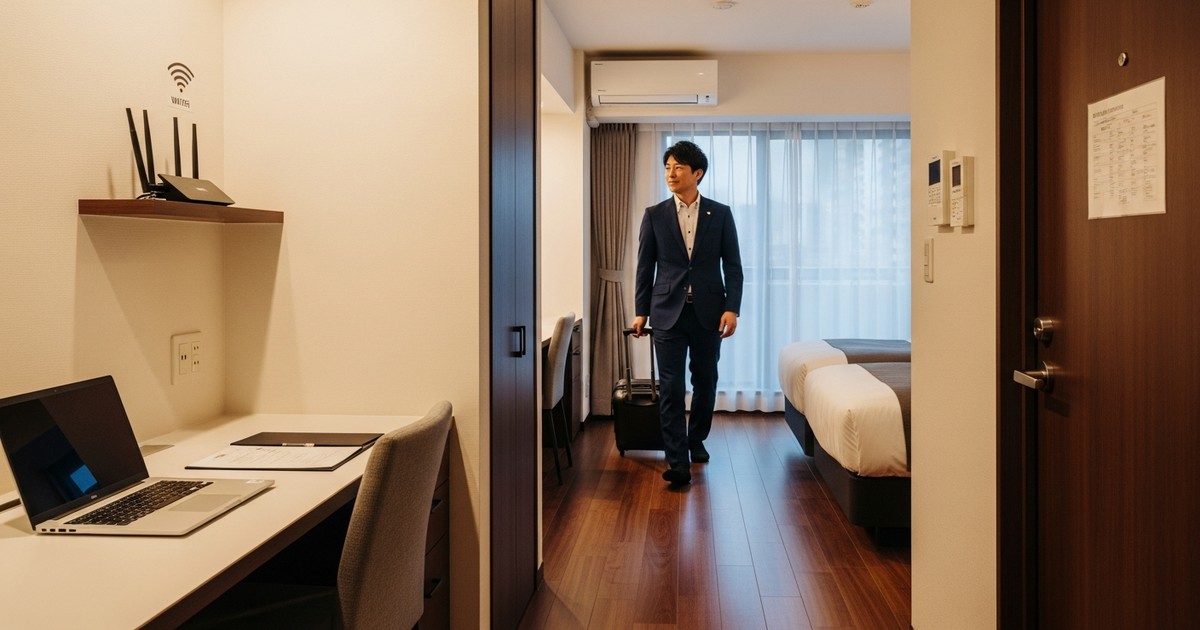
For business guests, a stable, high-speed internet connection is non-negotiable. Since they’ll be regularly attending online meetings, accessing cloud services, and sending large files, aim for a minimum download speed of 50Mbps—ideally 100Mbps or higher. Installing fiber-optic internet and choosing a Wi-Fi router built to handle multiple simultaneous connections will help ensure a stable environment.
Practical measures include placing the router near the workspace and installing a dual-band router that supports both 5GHz and 2.4GHz frequencies. It’s also a nice touch to display the Wi-Fi password not just in the check-in instructions but also on an easy-to-read card near the desk. Monthly internet costs typically run ¥4,000–¥6,000, but consider this a necessary investment for attracting business clientele.
Providing a Wired LAN Connection
In addition to Wi-Fi, offering a wired LAN port and cable can help set your listing apart. For business travelers who rely on VPN connections for security reasons, a wired connection offers major advantages in terms of stability and speed. A single LAN cable costs only ¥500–¥1,000, so keeping one or two on hand near the desk is a low-cost way to significantly boost guest satisfaction.
Creating a Comfortable Workspace
Choosing the Right Desk and Chair
Setting up a workspace suitable for extended periods of desk work is essential when catering to business guests. Rather than relying on a dining table, provide a dedicated desk with a depth of at least 50cm and a width of at least 80cm. A desk large enough to spread out a laptop and documents at the same time will earn high marks for practicality.
As for seating, an office chair with a proper backrest is ideal. A model with height adjustment can accommodate guests of different builds. Chairs in the ¥10,000–¥20,000 range offer more than adequate quality. Folding chairs or stools should be avoided, as they’re poorly suited for long work sessions.
Desk Lighting and Power Outlets
Place an eye-friendly desk lamp with dimming functionality near the workspace. LED desk lamps in the ¥3,000–¥5,000 range often include adjustable color temperature settings, making them suitable for nighttime work as well.
The number and placement of power outlets is another detail that’s easy to overlook. Since guests often need to charge a laptop, smartphone, and portable battery all at once, make sure at least three outlets are available near the desk. Adding a power strip or one with built-in USB ports is a small investment—just ¥1,500–¥3,000—that offers guests substantial convenience.
Prioritizing Bedding Quality and Soundproofing
Aim for Business-Hotel-Grade Bedding
For business travelers with a meeting or presentation the next day, sleep quality is a major factor in choosing where to stay. Choose a mattress that’s at least 15cm thick—either pocket coil or high-resilience foam—for superior pressure distribution and comfortable sleep. Sheets and pillowcases should be clean, crisp white, and of course replaced with every cleaning. Keeping one or two spare pillows on hand is also a thoughtful touch, since it lets guests choose their preferred firmness.
A full bedding set for a single bed typically costs ¥30,000–¥50,000. Cutting corners here tends to directly translate into negative reviews, so consider this an area where investment pays off significantly.
Blackout and Soundproofing Measures for Windows
Blackout curtains are a must. Choose curtains rated for at least Grade 1 light-blocking, ideally capable of blocking 99.99% or more of outside light. Waking up too early because of morning sunlight can interfere with a guest’s rest and lead to dissatisfaction. Blackout curtains typically cost ¥5,000–¥15,000 per window, depending on size.
For properties facing major roads or busy commercial areas, it’s also worth considering double-glazed windows or soundproofing tape to seal gaps. Adding a secondary interior window costs roughly ¥50,000–¥100,000 per window, but the resulting improvement in soundproofing can significantly boost your chances of attracting repeat long-term guests.
Flexibility Around Check-In and Check-Out
Accommodating Early Check-Outs and Late-Night Check-Ins
It’s common for business guests to depart early in the morning or arrive late at night to align with flight or bullet train schedules. Setting up a self-check-in system using a smart lock or key box allows you to accommodate guests around the clock. Smart lock units typically cost ¥15,000–¥30,000, with monthly cloud service fees ranging from a few hundred yen to ¥1,000.
Many hosts fix their check-in window to something like 3pm–10pm, but if you want to attract business guests, you should aim to accept check-ins until at least midnight. You might also consider offering early check-in or late check-out for an additional fee—charging ¥1,000–¥2,000 per instance can boost revenue while keeping guests happy.
Eliminating the Stress of Key Handoffs
In-person key handoffs require guests to coordinate timing, which tends to be unpopular with business travelers. Even without a smart lock, installing a keypad-style key box near the entrance allows for smooth, contactless key exchange. Key boxes cost only about ¥2,000–¥5,000, and including photo-illustrated instructions in your check-in guide ensures even first-time guests can navigate the process with ease.
Stocking Up on Amenities and Everyday Essentials
Amenities Tailored to Business Travelers
In addition to basic amenities like shampoo and body wash, business guests will appreciate items such as fabric deodorizing spray, an iron and ironing board, and a shoe-shine kit. These address common needs like smoothing out wrinkles in a suit after travel or freshening up before an unexpected business dinner.
An iron costs about ¥3,000–¥5,000, an ironing board ¥2,000–¥4,000, and deodorizing spray just a few hundred yen. Stocking these items is a small investment that can lead to reviews highlighting your property as “perfect for business trips”—which in turn attracts more guests with similar needs, creating a positive cycle.
Kitchen Essentials and Coffee Supplies
For business travelers on extended stays, eating out for every meal can take a toll both financially and in terms of health. Stocking basic cookware (a frying pan, pot, knife, and cutting board), tableware, and seasonings (salt, pepper, soy sauce, cooking oil) gives guests the option to cook for themselves.
Morning coffee is also an essential part of many business travelers’ routines. Providing a drip coffee maker, or an electric kettle paired with drip coffee bags, tends to earn favorable reviews. A coffee maker costs around ¥3,000–¥8,000, while drip bags run about ¥30–¥50 per cup.
Optimizing Your Listing and Targeting the Right Audience
Crafting a Listing Title and Description That Appeal to Business Guests
Once you’ve upgraded your amenities, it’s crucial to effectively highlight them in your listing. Include keywords that resonate with business travelers in your title, such as “High-Speed Wi-Fi,” “Work Desk Included,” or “X Minutes on Foot from the Station.” In your description, include concrete, quantifiable details—such as specific internet speeds (e.g., fiber-optic, 200Mbps download), desk dimensions, and travel time from the nearest station.
For your photos, include images showing the overall workspace as well as a realistic depiction of it in use (such as a laptop open on the desk). This helps business guests picture themselves staying and working there. Photos of just the living room and bedroom alone are unlikely to capture the attention of business travelers.
Offering Long-Stay Discounts
Since business guests often stay for anywhere from a week to a month, offering weekly and monthly discounts can be highly effective. Many Airbnb hosts offer 10–15% off for stays of seven nights or more, and 20–30% off for stays of 28 nights or more, making it easier for guests to stay within budget. For hosts, this also comes with benefits like fewer cleanings and reduced vacancy risk between guest turnovers—meaning you can offer these discounts while still maintaining healthy revenue.
Contact Stay Buddy Co., Ltd. for Minpaku Management Support
Optimizing your equipment investments and listing to attract business guests is a challenging area to navigate efficiently without the right experience and know-how. Deciding how much to invest in which amenities, or what pricing makes the most sense, can be difficult to determine on your own.
Stay Buddy Co., Ltd. brings extensive experience in minpaku property management, offering comprehensive support ranging from crafting management strategies tailored to your property’s characteristics and target guests, to selecting equipment, optimizing listings, and handling guest communications. We’re also happy to provide specific advice on attracting business travelers.
Whether you’re looking to start operating a minpaku property or want to improve your current operations and boost revenue, please don’t hesitate to reach out to Stay Buddy Co., Ltd. We’ll propose the optimal plan tailored to your property and budget.