Leave Your Vacation Rental Management to Us
Free Online ConsultationCapturing workation demand at your vacation rental requires more than just a solid internet connection and a functional desk setup—it calls for thoughtful space design that lets guests balance work and leisure seamlessly. According to a survey by Japan’s Ministry of Internal Affairs and Communications, roughly 50% of companies had adopted telework as of 2023, showing that location-independent work styles are no longer a passing trend but a lasting shift. Against this backdrop, whether your property gets chosen by workation travelers ultimately comes down to how thoroughly you’ve prepared in advance.
Workation guests differ from typical travelers in that their stays tend to be longer and often span weekdays. Average stays run from 3 to 7 nights—a significant jump from the 1-2 nights typical of standard tourists, offering a real boost to occupancy. That said, if the environment isn’t conducive to work, these guests won’t return, so it’s essential to set clear standards for both amenities and operations.
This article walks through the concrete steps vacation rental owners should take to reliably capture workation demand, covering everything from internet infrastructure to pricing strategy.
Foundational Knowledge for Capturing Workation Demand at Your Vacation Rental
Understanding the Workation Guest Profile
Most workation guests work in fields like IT, creative industries, or consulting—roles where a laptop and internet connection are all that’s needed to get the job done. They tend to be in their 30s and 40s, often traveling solo or as a couple. Compared to sightseeing guests, they head out less frequently after check-in and spend far more time indoors.
This means cleanliness, quietness, and quality lighting matter enormously for a comfortable extended stay. On review sites, comments like “I was able to focus on work” or “Wi-Fi was rock solid” translate directly into high ratings—while feedback like “the connection was unstable” or “there was no desk, making it hard to work” leads to immediate negative reviews.
Turning the Vacation Rental vs. Business Hotel Difference Into an Advantage
Business hotel workation plans typically run ¥7,000–¥12,000 per night, but the rooms themselves are usually limited to just 15–20 square meters. Vacation rentals, on the other hand, commonly offer 40–60 square meters of space, with separate living and sleeping areas. This extra breathing room—more like living in an apartment than a hotel room—is a genuine strength that hotels simply can’t replicate.
Add a kitchen to the mix, and guests can cook their own meals, keeping food costs down to roughly ¥1,000–¥2,000 per day during longer stays. Hotel guests, by contrast, tend to eat out for every meal, often spending ¥3,000 or more per day on food alone—giving vacation rentals a clear edge on total cost.
Internet Infrastructure Should Be Your Top Priority
Recommended Speeds and Specs
For workation guests, a reliable internet connection is non-negotiable. Zoom recommends a minimum of 3.0 Mbps upload and download for group video calls. In practice, though, once you factor in multiple connected devices and video streaming, you should aim for fiber internet delivering at least 50 Mbps in real-world tests—ideally 100 Mbps or higher.
Some properties get by with a rented mobile Wi-Fi router, but data caps and throttled speeds make these unsuitable for serious business use. Install fixed fiber-optic internet and pair it with a Wi-Fi 6-compatible router. Expect to pay ¥4,000–¥6,000 per month, with total setup costs—including installation—typically coming in at ¥30,000–¥40,000. Listing the actual measured speed in your property description goes a long way toward reassuring prospective guests.
Offer a Wired LAN Connection Option
Beyond Wi-Fi, having a wired LAN port available near the desk is a meaningful point of differentiation. Some companies require wired connections for VPN access due to security policies, so keeping 2–3 Ethernet cables (Category 6 or higher) on hand expands the range of guests you can accommodate. At roughly ¥500–¥1,000 per cable, it’s a low-cost investment with high returns.
Designing a Workspace and Stocking the Right Equipment
Choosing a Desk and Chair
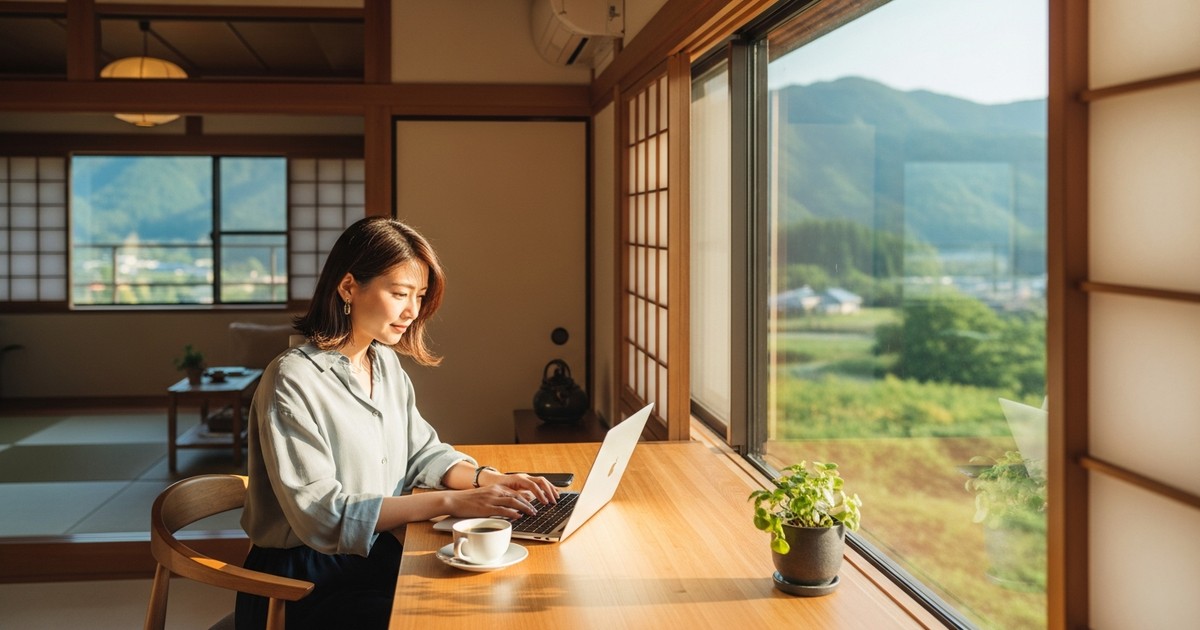
Many properties simply rely on the dining table, but workation guests are better served by a dedicated desk—at least 50 cm deep and 100 cm wide. Ideally, it should be roomy enough to hold a laptop, an external monitor, and paperwork all at once. A simple desk will run you around ¥8,000–¥15,000.
As for the chair, invest in a proper office chair built for long hours of sitting. At minimum, look for adjustable seat height and lumbar support. Models in the ¥10,000–¥20,000 range offer more than sufficient quality. A review complaining about back pain from an uncomfortable chair is a serious blow to your listing, so this is not an area to cut corners.
Ample Power and Charging Options
Make sure the desk area has at least four outlets—six or more is even better. Between laptops, phones, portable batteries, and monitors, the number of devices needing power at once adds up faster than you’d expect. Choose a power strip with individual switches and surge protection for added safety; these typically cost ¥1,500–¥3,000.
It’s also worth setting up a charging station with both USB-A and USB-C ports, so guests who forget their own cables aren’t left stranded. These small touches are often what push a review rating up a notch.
External Monitors and Other Essentials
If possible, consider adding a 24-inch external monitor. Research suggests dual-monitor setups can boost productivity by 20–30%, making this one of the most appreciated amenities among workation guests. Refurbished or discounted models can be found for around ¥10,000–¥20,000.
Rounding things out with a desk lamp (dimmable, around ¥3,000), a headset stand, and small office supplies like a desk calendar or notepad helps reinforce your property’s identity as a business-friendly space.
Pricing and Booking Strategies for Extended Stays
Setting Up Multi-Night Discounts
Offering discounts for longer stays is essential when targeting workation demand. As a general guideline, a tiered structure works well: 10% off for 3+ nights, 20% off for 7+ nights, and 30% off for 14+ nights. For example, a property priced at ¥8,000 per night would come to ¥6,400 per night for a 7-night stay—a total of ¥44,800. That’s a clear price advantage compared to a 7-night hotel stay (¥49,000–¥84,000).
Airbnb has built-in weekly and monthly discount settings that you can configure from the dashboard in just a few minutes, and Booking.com similarly supports long-stay rate plans. Once you’ve set your discount rates, spell them out in the listing description too—something like “20% OFF for stays of 7+ nights”—to make the savings immediately visible.
Strategies to Boost Weekday Occupancy
Workation guests often book stays that span weekdays—for instance, checking in on a Friday and checking out the following Friday. For properties that have historically relied on weekend tourist traffic, this represents a valuable opportunity to fill weekday vacancies. Some hosts have raised monthly occupancy from 60% to over 80% by offering special weekday-only rates in the ¥5,000–¥6,000 range.
Supporting monthly contracts is another avenue for attracting long-term renters. At a price point of ¥120,000–¥180,000 per month, your property can compete favorably with furnished short-term rental apartments, appealing to business travelers doing extended remote work or people testing out a move to a new region.
Elevating Everyday Amenities and the Overall Guest Experience
Well-Stocked Kitchens and Daily Essentials
For long-term guests, the ability to cook is a major factor in choosing where to stay. Make sure your kitchen includes an induction or gas stove with at least two burners, a refrigerator (150 liters or larger), a microwave, a rice cooker, basic cookware (frying pan, pot, knife, cutting board), and a full set of dishware. Stocking basic seasonings—salt, soy sauce, oil, pepper—lets guests start cooking from day one, which noticeably boosts satisfaction.
A washing machine and drying space are also essential. Guests staying 3+ nights will inevitably need to do laundry, so a washer with a built-in dryer function is ideal. Providing small portions of detergent and fabric softener is a nice added touch.
Prioritizing Soundproofing and a Quiet Environment
Outside noise during a video call can seriously disrupt someone’s work, so soundproofing should be a consideration from the earliest stages of choosing a property. For existing units, installing soundproof curtains (¥5,000–¥10,000 per window) alone can reduce perceived noise by 5–10 dB. Positioning the workspace toward the interior of the building rather than facing the street is another effective layout change.
Also consider household noise sources—choose a refrigerator and air conditioner known for quiet operation. This is especially important in studio-style units, where a refrigerator’s compressor hum can end up picked up by a microphone during calls; switching to a quieter model (25 dB or lower) is worth the investment.
Practical Tips for Listings and Marketing
Optimizing Your Listing Title and Description
Work keywords like “workation-ready,” “high-speed Wi-Fi,” and “desk and chair included” into your Airbnb or Booking.com listing title. This makes your property more likely to surface when users filter for “business travel” or “extended stays.” In the description, include concrete specs—actual measured internet speed, desk dimensions, chair brand—to build credibility.
When taking photos, be sure to capture the full workspace, the cable setup on the desk, and someone actually using the monitor. Photos limited to the living room and bedroom make it hard to distinguish your listing from a purely leisure-oriented property, and workation-seeking guests may simply scroll past. According to data from property management companies, listings that include workspace photos see roughly 1.5 times the long-stay booking rate compared to those that don’t.
Building a Review and Improvement Cycle
Reviews from workation guests tend to touch on Wi-Fi speed, the work environment, and quietness—details that directly influence booking decisions for future workation travelers. Sending a follow-up message after checkout asking specifically about their work experience helps you both identify areas for improvement and increase the rate of reviews left.
Using that feedback to review and adjust your equipment and layout roughly once every three months creates a cycle of continuous improvement that keeps your property competitive. In one real case, adding an extra monitor based on guest feedback raised the average rating from 4.3 to 4.7 and increased monthly bookings by about 30%.
For Workation-Ready Vacation Rentals, Trust Stay Buddy Inc.
Running a vacation rental that caters to workation demand takes a wide range of expertise—from building out internet infrastructure and designing workspaces to crafting pricing strategy and optimizing listings. Handling all of this on your own can be a heavy burden in both time and cost, particularly for owners managing multiple properties.
At Stay Buddy Inc., our vacation rental management service offers end-to-end support—from proposing a workation plan tailored to your property’s characteristics, to selecting and installing equipment, writing OTA listing copy, and optimizing pricing. We also have extensive experience renovating existing properties into workation-ready spaces.
If you’re an owner thinking “I want to start catering to workation guests but don’t know where to begin” or “I want to increase long-stay bookings,” please don’t hesitate to reach out to Stay Buddy Inc. Our specialists will carefully assess your property’s current state and provide concrete recommendations for improvement.