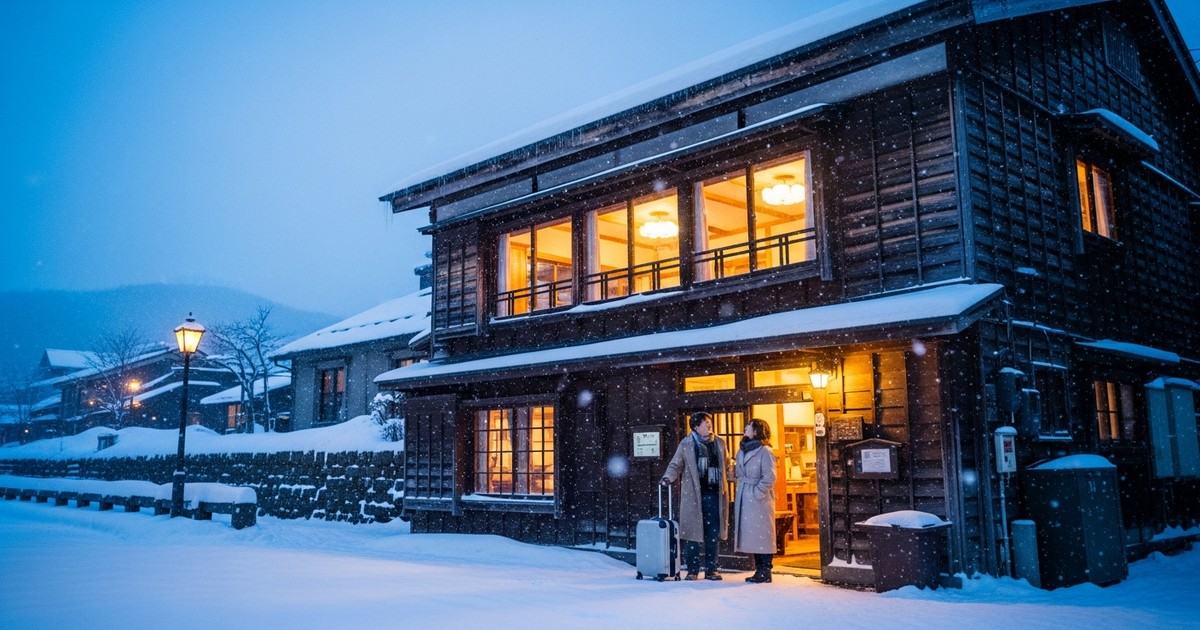
The Winter Challenge Facing Otaru’s Vacation Rentals
For owners running vacation rentals in Otaru, figuring out how to generate revenue during the winter off-season is a pressing concern. While Otaru sees a surge of tourists strolling the canal in summer and admiring the autumn foliage, demand for accommodation tends to drop sharply from December through February. Without a clear strategy for monetizing the off-season, annual profit margins can end up far lower than owners expect.
Generally speaking, occupancy rates for vacation rentals in the Otaru area are said to fall by 30–50% during winter compared to peak season (July–September). For a property charging ¥15,000 per night, just ten fewer bookings a month translates to a ¥150,000 drop in revenue. Yet fixed costs—rent, utilities, cleaning and management fees—keep piling up regardless, which is why many properties slip into the red during this period.
This article introduces three concrete ideas that Otaru vacation rental owners can use to not only survive the winter off-season, but actually tap into the demand that winter itself creates. Each idea is grounded in real-world success stories, so read on and consider how they might apply to your own property.
Idea 1: Mid- to Long-Term Plans for Winter Sports Travelers
Capturing Ski Demand Around Otaru
Otaru enjoys excellent access to winter sports destinations—about a 30-minute drive to Kiroro Resort and roughly 15 minutes to Asarigawa Onsen Ski Resort. It’s also just about 90 minutes by car from the Niseko area, making it a convenient base for skiers and snowboarders who want to hop between multiple resorts. This type of traveler tends to prefer vacation rentals over hotels, valuing the ability to cook their own meals and stay together as a group. Overseas ski visitors in particular typically book stays of one to two weeks.
To capture this demand effectively, offering a 15–25% discount for stays of a week or longer works well. For example, a property normally priced at ¥12,000 per night could offer a 7-night package for ¥60,000 (roughly ¥8,570 per night). While the per-night rate drops, you save ¥3,000–5,000 per cleaning by reducing the number of turnovers, and the more stable occupancy this creates typically drives higher monthly revenue than waiting for one-off bookings. In fact, one Otaru property that introduced a mid- to long-term plan saw its winter occupancy rate improve by more than 20 percentage points year-over-year.
Facility Upgrades That Appeal to Ski Guests
To seriously attract winter sports travelers, some investment in facilities is essential. Practical additions include a ski/snowboard storage rack near the entrance, two or three boot dryers, and a designated drying area with a waterproof mat. These upgrades typically cost only ¥20,000–30,000 in total, but once your listing earns reviews praising it as “great for skiers,” that reputation directly boosts your visibility in search results.
It also helps to include specific details in your listing title and description, such as “30 minutes by car to Kiroro” or “fully equipped ski gear drying space.” This kind of concrete information raises booking rates among guests planning ski trips. According to Airbnb data, listings with specific facility descriptions see, on average, a 1.5x higher conversion rate from views to bookings.
Idea 2: Experience-Based Plans Tied to Winter Events Like the Otaru Snow Light Path
Pairing a Stay with an Otaru-Only Winter Experience
Every February, Otaru hosts the “Otaru Snow Light Path” festival, drawing large numbers of visitors eager to see the magical sight of candles glowing along the canal. During this period, demand for accommodation spikes temporarily, making it possible to fill bookings even at rates 30–50% higher than your usual winter pricing. A property normally priced at ¥12,000 per night can comfortably charge ¥16,000–18,000 during the festival and still remain competitive.
For further differentiation, consider bundling your stay with an experience. For instance, partnering with a local glass workshop to offer an original candle-making experience lets you add ¥2,000–3,000 on top of the room rate. Paying the workshop a referral fee of around ¥500 per guest builds an ongoing partnership that benefits both sides.
Using Experience Content to Drive Bookings Beyond Festival Season
If you rely solely on the festival period, your property will likely sit empty for the rest of winter. Year-round experience content—such as a “Winter Otaru Sushi-Making Workshop” or a “Snowy Canal Photo Walk”—can help fill that gap. Using Airbnb’s Experiences feature, you can earn an additional ¥3,000–5,000 per session, separate from your accommodation revenue.
One vacation rental owner in Hokkaido partnered with a local sushi chef to host a sushi-making experience priced at ¥6,000 per session (capped at 4 guests), running it eight times a month for a total of ¥192,000 in monthly revenue. Since bookings for this kind of content grow more stable as reviews accumulate, it pays to start early and build up your reputation. Even if planning and running your own experience feels like too much, partnering with a nearby experience provider and earning a referral commission can achieve similar results with minimal extra effort.
Idea 3: Shifting to Monthly Rentals or Workation Demand
Switching to Monthly Rentals for the Winter Season Only
Another strong option is to switch your property to a monthly rental format during the three months (December–February) when vacation rental occupancy typically drops the most. While a studio-to-1LDK unit in Otaru typically rents for ¥40,000–60,000 per month on the standard market, a furnished monthly rental can command ¥80,000–120,000. Compared to earning just ¥50,000 a month from regular vacation rental bookings during winter, this represents a clear improvement in revenue.
One major advantage of monthly rentals is the significant reduction in cleaning costs and effort. With vacation rentals, you incur a cleaning fee of ¥3,000–5,000 for every guest turnover, but with monthly rentals, you only need to clean twice—at move-in and move-out. Booking management and guest communication also drop dramatically, saving the owner valuable time as well. Keep in mind, however, that this arrangement falls under the Building Lease Act rather than Japan’s Private Lodging Business Act, so you’ll need proper legal arrangements such as a fixed-term lease agreement. A judicial scrivener (gyoseishoshi) can typically draft a contract template for ¥30,000–50,000.
Targeting Workation Guests
With the spread of remote work, more people are choosing to spend winter in Hokkaido as a “workation” destination. This group prioritizes stable high-speed Wi-Fi (100Mbps download or faster), a proper desk and chair suited for long work sessions, and a quiet environment that won’t disrupt online meetings. Simply stating your Wi-Fi speed in your listing makes it far more likely to appear in workation-related searches.
Typical pricing for workation guests runs ¥5,000–6,000 per night for a two-week plan, or ¥100,000–150,000 per month for a monthly plan. Otaru’s location—just about 30 minutes from Sapporo by rapid train, yet offering the distinctly different atmosphere of a canal-side port town—makes it appealing to remote workers based in Tokyo or Osaka looking for a change of scenery. One vacation rental property near Sapporo that introduced a workation plan reported revenue in January and February that was about 2.3 times higher than its usual winter earnings.
Maximizing Winter Revenue by Combining All Three Ideas
Each of the three ideas covered here is effective on its own, but combining them can create even more stable revenue. For example, you might secure fixed income through a monthly rental in December, boost occupancy with a weekly ski-focused plan in January, and maximize profits in February with high-priced short stays during the festival period.
Suppose you earn ¥100,000 in December through a monthly rental, ¥150,000 in January through a weekly ski plan (¥60,000 per week × 2.5 weeks), and ¥180,000 in February through a combination of high-priced festival bookings and a mid-term plan for the rest of the month. That adds up to ¥430,000 across the three winter months. Compare that to doing nothing and running at a 20% occupancy rate, which would yield only about ¥180,000 (¥12,000 per night × 5 nights × 3 months)—a difference of ¥250,000. That gap can make a significant impact on your annual bottom line, laying the foundation for a stable vacation rental business that doesn’t depend solely on peak season.
Struggling with Your Vacation Rental? Talk to Stay Buddy Co., Ltd.
Even when owners understand the importance of preparing for the winter off-season, there’s a lot of ground to cover in practice—optimizing pricing, improving listings, handling the legal steps for converting to monthly rentals, and planning experience content, to name just a few. For owners running a vacation rental alongside a full-time job, tackling all of this alone often isn’t realistic.
Stay Buddy Co., Ltd. is a team of professionals specializing in vacation rental management. We analyze each property’s characteristics and local demand data to provide one-stop support covering seasonal pricing strategy, guest communication, cleaning arrangements, and legal compliance. We’re particularly skilled at proposals focused on improving winter occupancy, and many owners who entrust their operations to us report noticeable gains in annual revenue.
If you’re thinking, “I need to do something about my winter vacancies” or “I’d like help building an off-season strategy,” please don’t hesitate to reach out to Stay Buddy Co., Ltd. We’ll review your current operating data and propose a concrete improvement plan tailored to your property.