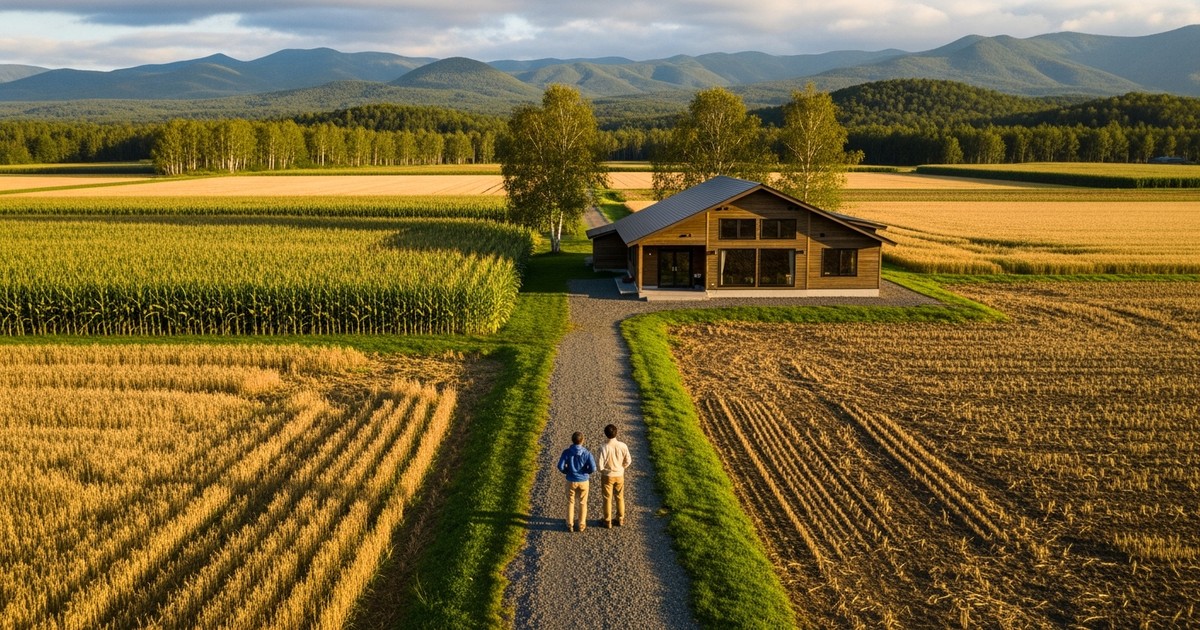
A growing number of people are considering converting Hokkaido farmland into lodging facilities. Glamping sites and farm stays that make the most of the region’s vast natural surroundings are attracting attention as business models fueled by growing inbound demand. However, the reality is that farmland and forest land are subject to a complex web of regulations—including the Agricultural Land Act, the City Planning Act, and the Building Standards Act—making conversion far from straightforward.
This article walks through the specific procedures, cost expectations, and regulatory hurdles involved in turning farmland or forest land in Hokkaido into a lodging facility, along with practical tips for improving your chances of success. It’s designed to give anyone considering a farm-stay business or looking to make use of idle land the information they need, presented in a logical order.
Basic Rules for Converting Hokkaido Farmland into a Lodging Facility
To convert farmland into a lodging facility, you must first obtain “agricultural land conversion permission” under the Agricultural Land Act. The standard process involves applying under Article 4 (conversion of land you already own) or Article 5 (conversion of land acquired from another party) of the Act, submitting the application through the Agricultural Committee to the prefectural governor. In Hokkaido, large-scale conversions exceeding 4 hectares require consultation with the Minister of Agriculture, Forestry and Fisheries.
Farmland is classified into five categories based on productivity and location: “farmland within agricultural promotion areas” (known as “blue land”), Class A farmland, Class 1 farmland, Class 2 farmland, and Class 3 farmland. Blue land, Class A, and Class 1 farmland are, in principle, ineligible for conversion, and a large proportion of Hokkaido’s vast farmland falls into these categories. Conversion permits are relatively easier to obtain for Class 2 and Class 3 farmland, but since farmland near urban areas is limited in Hokkaido, the first step is to check with your local Agricultural Committee to determine which classification applies to your land.
Procedures for Removal from Agricultural Promotion Areas
If your land is designated as “blue land” (farmland within an agricultural promotion area), you must first go through a procedure known as “noshin jogai” (removal from the agricultural promotion area plan) before applying for conversion permission. This involves having the target farmland removed from the municipality’s agricultural promotion area development plan, and the process typically takes one to one-and-a-half years from application to decision. Many Hokkaido municipalities only accept applications once or twice a year, so missing the window can mean waiting an additional six months or more.
To be approved for removal from the agricultural promotion area, applicants must satisfy all five requirements, including “no alternative land exists outside the agricultural promotion area” and “no adverse impact on surrounding agriculture.” For lodging facilities, factors such as noise, wastewater, and increased traffic are commonly flagged as potential impacts on neighboring agriculture, so it’s important to prepare detailed drainage plans and traffic flow documentation in advance.
Application Costs and Timeline for Agricultural Land Conversion Permits
There is no statutory fee for the agricultural land conversion application itself, but if you hire a gyoseishoshi (administrative scrivener), fees typically range from ¥150,000 to ¥300,000. When bundled with the agricultural promotion area removal process, fees generally run from ¥300,000 to ¥500,000. The time required from application to permit is roughly six weeks to three months when removal from the agricultural promotion area isn’t needed, but can take a total of one-and-a-half to two years when it is required.
A factor unique to Hokkaido is that on-site surveys are difficult during winter, which tends to delay application processing. In practice, it’s essential to plan document preparation the year before, timed to coincide with the spring–summer application window.
Regulations and Procedures for Using Forest Land as a Lodging Facility
Unlike farmland, forest land isn’t subject to the Agricultural Land Act—but it comes with its own set of regulations. Developing forest land exceeding 1 hectare requires “forest land development permission” under the Forest Act. In Hokkaido, even plots of 0.5 hectares or less require submission of a “notification of felling and post-felling reforestation,” and felling trees without notification can result in fines of up to ¥1 million.
The forest land development permit review strictly examines four criteria: disaster prevention, flood prevention, preservation of water source recharge function, and environmental conservation. Since Hokkaido’s forest land often includes steep slopes and avalanche-prone areas, the design of disaster-prevention works is often the key to obtaining approval. The application process typically takes three to six months, with gyoseishoshi fees ranging from ¥200,000 to ¥400,000. On top of that, disaster-prevention construction costs can run into the millions of yen, making it essential to obtain accurate estimates at the business planning stage.
Building Restrictions on Forest Land Outside Urban Planning Areas
Much of Hokkaido’s forest land lies outside designated urban planning areas, meaning building confirmation applications aren’t always required. However, structures with a total floor area exceeding 200 square meters, or wooden buildings with two or more stories, require building confirmation even outside urban planning areas. Glamping tents and trailer houses may not always be classified as “buildings,” but if they’re fixed to a foundation or installed permanently in the same location, they could be deemed buildings—so it’s wise to check with the local building guidance division beforehand.
Operating a lodging business also requires a permit under the Hotel Business Act (typically a “simple lodging” business permit). To obtain this permit, requirements include a guest room area of at least 33 square meters (or 3.3 square meters per guest for facilities with fewer than 10 guests), front desk facilities, standards for ventilation, lighting, and moisture control, and installation of fire safety equipment. In Hokkaido, the application fee is ¥22,000, and the process from application to the public health center to permit issuance takes about two to four weeks.
Keys to Successfully Opening a Lodging Facility Through Farmland Conversion in Hokkaido
Clearing the regulatory hurdles is only part of the challenge—a solid revenue plan is equally critical to making the business viable. In Hokkaido, farm-stay and glamping facilities typically charge ¥15,000 to ¥30,000 per night for whole-house rentals, or ¥10,000 to ¥20,000 per person for glamping. While occupancy rates during summer (June–September) can reach 70–80%, many facilities see rates drop to 20–30% in winter, making an average annual occupancy rate of 40–50% a realistic benchmark.
For example, if you operate three whole-house rental units with an average nightly rate of ¥20,000 and an annual occupancy rate of 45%, annual revenue would come to approximately ¥9.85 million. Subtracting loan repayments on construction costs (a total of ¥30 million across three units, repaid over 15 years at roughly ¥2.4 million per year), utility costs (approximately ¥1.2 million per year), labor costs (approximately ¥2 million per year), maintenance costs (approximately ¥1 million per year), and various insurance premiums (approximately ¥300,000 per year), operating profit comes to roughly ¥2.95 million. Including initial farmland conversion and development permit costs, a payback period of 7 to 10 years is a reasonable estimate.
Combining with Farm Stays and Experience-Based Tourism
Combining lodging with agricultural experiences, dairy farming activities, and outdoor adventures is an effective strategy for raising per-guest spending. For example, offering add-on experiences such as harvest experiences (¥3,000 per person), cheese-making workshops (¥4,000 per person), and horseback riding (¥5,000 per person) can generate an additional ¥5,000 to ¥10,000 in revenue per group, on top of the lodging fee.
In Hokkaido, experience-based lodging facilities—particularly in the Niseko, Furano, and Tokachi areas—have earned high praise from international travelers. Subsidies from the Ministry of Agriculture, Forestry and Fisheries’ “Farm Stay” (Nohaku) promotion program (up to ¥2 million to ¥5 million per project) are also available, so it’s worth gathering information on these subsidies early in the planning process and building the application timeline into your overall schedule.
Winter Guest Acquisition Strategies
The biggest challenge for lodging businesses in Hokkaido is the drop in occupancy during winter. One effective countermeasure is offering winter-exclusive content—such as snowshoe trekking, smelt fishing, wood-stove experiences, and winter camping—to appeal to travelers who specifically want to enjoy Hokkaido’s winter season. By setting a premium price point for winter-only plans (¥25,000 to ¥35,000 per night with two meals included), you can offset lower occupancy with higher per-stay revenue.
An increasing number of facilities are also tapping into workation demand by installing high-speed Wi-Fi and dedicated workspaces, offering long-term stay plans of one week or more for ¥150,000 to ¥200,000 per month. Long-term winter stays contribute significantly to stabilizing both occupancy and revenue, so it’s worth investing in strong internet infrastructure and insulation performance from the facility design stage onward.
A Practical Checklist to Avoid Pitfalls in the Conversion Process
Opening a lodging facility that involves converting farmland or forest land requires multiple laws and permits to be processed in parallel, and getting the sequence wrong can significantly delay the overall schedule. Below is a summary of the key points to keep in mind in practice.
Start by reviewing the land registry and confirming the farmland classification with the Agricultural Committee to determine whether removal from the agricultural promotion area is necessary. Next, check with the relevant civil engineering office whether the land falls within an urban planning area and whether forest land development permission is required. In parallel, consult with the public health center regarding the simple lodging business permit to understand the facility design requirements. Consulting with the fire department around the same time can also help avoid costly design revisions later. Budgeting one to two months for this preliminary research, and then proceeding with design and permit applications based on the findings, is the most efficient approach.
Assembling a Team of Specialists
Multiple specialists are typically involved in a project like this: a gyoseishoshi for farmland conversion, an architect for building confirmation, a licensed professional with experience navigating public health center procedures for the hotel business permit, and a fire protection equipment specialist for fire safety systems. Since gyoseishoshi with expertise in agricultural land conversion are limited outside the Sapporo metropolitan area, securing an experienced team early on can make or break the project. Choosing a firm that can coordinate a gyoseishoshi, architect, and land surveyor together as a single team helps minimize delays caused by miscommunication between parties.
In terms of cost, it’s realistic to budget around ¥800,000 to ¥1.5 million for the entire specialist team’s fees. This represents only a small percentage of the overall initial investment, and is a reasonable expense when weighed against the opportunity costs of procedural failures or delays.
For Farmland and Forest Land Lodging Operations, Consult Stay Buddy Inc.
Converting and operating farmland or forest land as a lodging facility in Hokkaido requires broad knowledge and execution capability—from understanding the regulatory landscape and navigating the permit process, to designing a profitable facility and maintaining stable operations after opening. Especially during the operational phase, day-to-day tasks such as reservation management, guest support, cleaning coordination, review management, and price adjustments arise constantly, making it difficult to balance this with your main agricultural work or other business commitments.
Stay Buddy Inc., a minpaku management agency, provides one-stop support from the facility planning stage all the way through to ongoing operations. For projects involving farmland conversion, we also maintain a network of permit-acquisition specialists, and can support everything from schedule management through to opening, as well as preparing revenue and cost simulations.
If you’re interested in a lodging business that makes use of farmland or forest land in Hokkaido, please feel free to reach out to Stay Buddy Inc. We’ll propose a concrete plan tailored to your local conditions and goals.