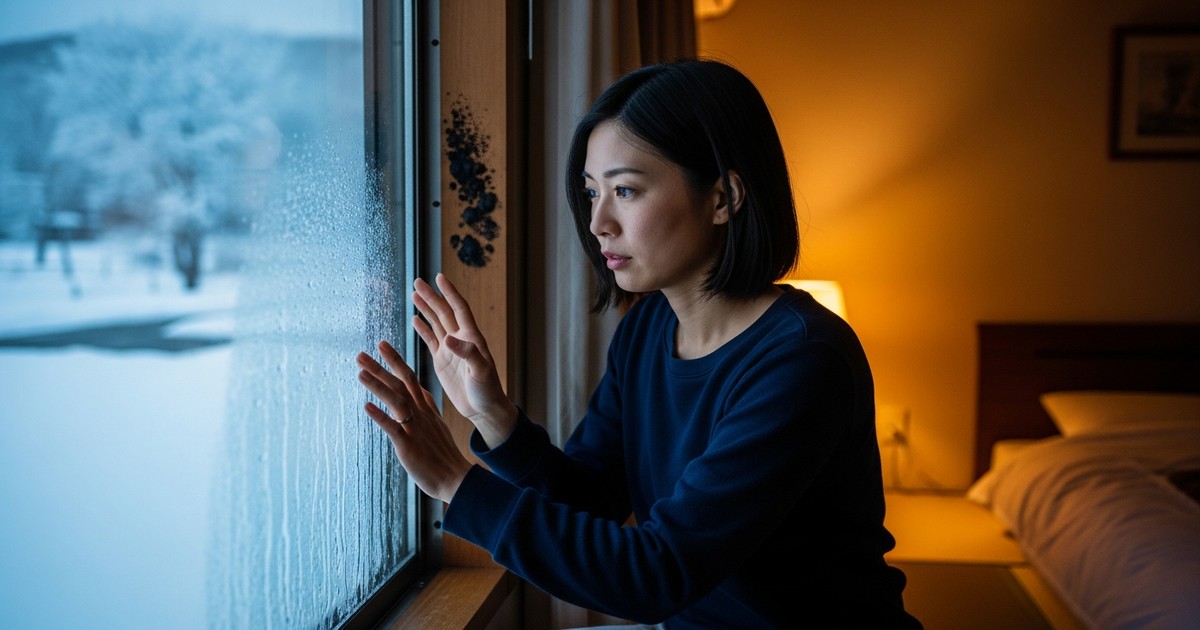
When running a minpaku (vacation rental) property in Hokkaido, winter condensation and mold are serious challenges you simply can’t avoid. Without the right preventive measures in place, it’s not unusual for repair costs to balloon into the hundreds of thousands of yen due to peeling wallpaper and black mold outbreaks. Operators who continue running their properties without understanding proper condensation prevention often see an increase in negative guest reviews, with occupancy rates dropping by 10-20% in some reported cases.
Hokkaido winters frequently bring outdoor temperatures below -10°C, creating indoor-outdoor temperature differences that can exceed 30°C. This extreme temperature gap is the primary driver of condensation problems far more severe than anything typically seen in Honshu properties. On top of that, minpaku properties face unique challenges—guests who don’t have ventilation habits, and properties sitting empty for extended periods after checkout—creating conditions even more favorable for mold growth than in ordinary homes.
This article explains the mechanisms behind condensation and mold problems in Hokkaido minpaku properties, and offers practical, actionable countermeasures spanning everything from property selection to daily management. We’ll also cover typical repair cost ranges and pricing for recommended equipment, so whether you’re just starting a minpaku business in Hokkaido or already operating one and dealing with these issues, this guide should prove useful.
Understanding the Basics: Why Condensation Occurs in Minpaku Properties and How to Prevent It
The Mechanism Behind Condensation
Condensation occurs when warm, moist air comes into contact with a cold surface and drops below the dew point, causing water vapor in the air to form droplets on that surface. For example, air at 22°C room temperature and 60% humidity has a dew point of roughly 14°C—meaning that if the window glass surface falls below that temperature, condensation is guaranteed to form. In Hokkaido, where outdoor temperatures can reach -15°C, single-pane windows can see their surface temperature drop to near 0°C, resulting in heavy condensation.
In minpaku properties, guest behaviors—not running the bathroom exhaust fan after bathing, skipping ventilation while cooking, drying laundry indoors—can combine to push indoor humidity up to 70-80%. In an ordinary household, residents routinely wipe down windows and ventilate the space, but in a minpaku property, days may pass before cleaning staff arrive, giving condensation water time to soak into window frames and wallpaper and create a breeding ground for mold.
Why Hokkaido’s Unique Climate Makes the Problem Worse
Hokkaido’s average January temperature is -3.6°C in Sapporo and -7.5°C in Asahikawa. Because most buildings are designed around running heating 24 hours a day, indoor temperatures typically stay in the 20-25°C range. This creates an indoor-outdoor temperature gap of 25-35°C—compared to roughly 10-15°C in Honshu during winter—meaning condensation volume can be 2-3 times greater.
Additionally, many Hokkaido minpaku properties are located near ski resorts and tourist destinations, where guests often dry their ski gear and boots indoors, causing humidity to spike rapidly. A single set of wet ski wear can release approximately 500ml of moisture as it dries, meaning a group of four drying their gear simultaneously could release over 2 liters of water vapor into the room.
Specific Damage and Repair Costs When Condensation Is Left Unaddressed
Mold Growth and Health Risks
If condensation is left unaddressed, mold spores can begin germinating within 48-72 hours, and visible black mold can form within a week. Areas where air tends to stagnate—rubber window seals, the back of oshiire (Japanese-style closets), and closet walls—are especially prone to mold growth. If a guest staying in a moldy room reports allergic symptoms, you’re not only looking at negative reviews but potentially a liability claim as well.
There have been actual cases of minpaku owners paying 300,000 yen in medical expenses and compensation after a guest suffered an asthma attack caused by mold. Health-related incidents can lead not just to financial losses but also to account suspension on booking platforms, making prevention absolutely essential.
Building Deterioration and Typical Repair Costs
Repeated condensation leads to peeling wallpaper, deteriorating plasterboard, and wood rot. Reworking wallpaper typically costs 50,000-100,000 yen per room, replacing plasterboard can run 150,000-250,000 yen, and if the wood in pillars or foundations has rotted, structural repairs can exceed 1,000,000 yen.
Even just removing mold around window frames and re-caulking runs about 10,000-30,000 yen per location—for a property with 10 windows, that’s 100,000-300,000 yen annually. These repair costs are largely avoidable with proper preventive measures. Given that annual prevention costs typically run only 50,000-150,000 yen, investing in prevention is overwhelmingly the more economically rational choice.
Condensation-Related Points to Check When Selecting a Property
Window Specifications and Sash Materials
When selecting a minpaku property in Hokkaido, window specifications are by far the most important thing to check. Pair glass (double-pane glass) should be considered the bare minimum—ideally, you’ll want a property with Low-E glass or triple-pane windows. Even with pair glass, aluminum sashes can still generate condensation at the sash itself, so resin sashes or aluminum-resin composite sashes are preferable.
For existing properties with single-pane glass and aluminum sashes, adding secondary interior windows (inner sashes) is an effective fix. Products like YKK AP’s “Plamado U” or LIXIL’s “Inplus” can be installed for 40,000-80,000 yen per location and can raise window surface temperature by more than 10°C, dramatically reducing condensation. Even installing them on six windows would cost around 240,000-480,000 yen—a fully recoverable investment when weighed against several years’ worth of repair costs.
Checking Insulation and Airtightness Performance
Hokkaido homes generally feature higher insulation and airtightness specs compared to those in Honshu, but performance varies significantly depending on the building’s age. Properties built before 1999 were often constructed under older energy-efficiency standards with insufficient insulation thickness, raising the risk of in-wall condensation. As a benchmark, choosing a property with a UA value (average heat transfer coefficient) of 0.46 or lower can significantly reduce condensation risk.
A C-value (equivalent leakage area) of 2.0 or lower is considered an acceptable level of airtightness, though 1.0 or lower offers even greater peace of mind. Properties with high airtightness allow planned ventilation systems to function properly, preventing moisture from stagnating in specific areas. Be sure to check the property’s construction date and specification documents, and confirm whether any insulation upgrades have been carried out.
Preventive Measures to Implement During Operation
Proper Operation of 24-Hour Ventilation Systems
Properties built after 2003 are required to have 24-hour ventilation systems installed, but guests frequently turn them off due to noise or cold air. As a countermeasure, attach multilingual stickers (Japanese, English, Chinese, Korean) near the switch reading “Please do not turn off this switch,” and be sure to explain the importance of ventilation in your house manual as well. Installing a switch cover to physically prevent guests from turning it off is another effective option.
For properties with Type 3 ventilation systems (mechanical exhaust only), you’ll need to regularly check that air intake vents haven’t been closed. Even a single closed intake vent can reduce ventilation volume enough to trap moisture indoors. Adding “confirm all intake vents are open” to your cleaning checklist helps prevent this from being overlooked.
Introducing Dehumidifiers and Humidity Management Devices
In winter, Hokkaido’s heated indoor air combined with dry outdoor conditions leads some guests to use humidifiers. However, in a minpaku setting, excessive humidification is a direct cause of condensation, so it’s wise to either avoid providing humidifiers altogether or only offer models with automatic humidity control. Ideally, indoor humidity should be managed within the 40-50% range.
Smart devices like SwitchBot or Nature Remo let you monitor temperature and humidity remotely in real time. These devices typically cost 3,000-5,000 yen each and can be configured to send a smartphone notification if humidity exceeds 60%. Since you can act on actual data, you can adjust cleaning staff visit timing and respond quickly when needed.
Condensation Checks and Preventive Routines During Cleaning
Building condensation checks into the post-checkout cleaning process leads directly to early detection of problems. Specifically, be sure to wipe up any water droplets at the bottom of every window sash, check rubber window seals for mold, and physically check the walls inside oshiire closets and clothes closets for dampness. These tasks typically take just 10-15 minutes per property.
Applying anti-mold spray (roughly 800-1,500 yen per bottle) to window frames and sashes once a month can also significantly reduce mold occurrence. Condensation absorption tape (500-1,000 yen per roll) applied to the bottom of windows is another simple yet effective way to prevent water droplets from running down onto walls or floors. These consumable costs run only about 2,000-3,000 yen per month—a trivial amount compared to potential repair costs.
Reducing Condensation Risk Through Guest Communication
What to Include in Your House Manual
Getting guests on board is essential to maximizing the effectiveness of your condensation prevention efforts. Your house manual should clearly state three things: run the bathroom exhaust fan for at least two hours after bathing, use the exhaust fan when drying laundry indoors, and avoid keeping curtains closed for extended periods. Including illustrations helps get the message across regardless of language barriers.
International guests in particular often aren’t aware of how important ventilation is in Japan’s highly airtight homes, so including a line like “Japanese homes are highly airtight, so ventilation is essential” in English, Chinese, and Korean can be very effective. One Sapporo-based minpaku owner who implemented this kind of guidance reported roughly a 40% year-over-year drop in winter condensation complaints.
Guidance on Heater Usage
When guests turn the heater completely off while out, indoor temperatures drop sharply and walls and windows become thoroughly chilled—so when the heater is switched back on after their return, condensation forms rapidly. To prevent this, it’s important to instruct guests to keep the heater running at a low setting of around 15-18°C even while they’re out. This may increase gas and electricity costs by about 3,000-5,000 yen per month, but the resulting savings on repair costs are far greater.
If you’ve installed smart locks or smart remote controls, you can even set up a system that automatically switches the heater to a lower setting when it detects a guest has left the property. This kind of automated control is an excellent way to manage condensation risk without placing any burden on guests.
If You’re Struggling With Minpaku Operations in Hokkaido, Talk to Stay Buddy Inc.
Condensation and mold problems are a serious issue that directly impacts profitability in Hokkaido minpaku operations. From property selection to equipment investment to day-to-day management systems, consistently implementing the right countermeasures requires broad knowledge and hands-on experience. Entrusting operations to professionals lets owners reduce their own burden while protecting the asset value of their property.
Stay Buddy Inc., a minpaku property management company, brings extensive know-how in property management including condensation and mold countermeasures—offering comprehensive support that covers condensation checks during cleaning, help introducing humidity monitoring devices, and creating multilingual guest manuals, all in one package. We also provide concrete proposals aimed at maximizing profitability, including cost simulations for equipment investments and repair planning.
If you have any concerns about running a minpaku property in Hokkaido, please feel free to reach out to Stay Buddy Inc. first. We’ll propose the optimal condensation prevention plan tailored to your property’s situation and support you in achieving stable, successful operations.