How Much Revenue Can You Expect from Operating a Rental Villa in Furano?
Revenue from operating a rental villa in Furano varies significantly depending on the property’s size, location, and operational strategy, but as a general benchmark, you can expect annual sales of ¥6–12 million and operating profit of ¥2–5 million. By obtaining a ryokan business license and establishing a 365-day operating structure, you can build a stable revenue model that isn’t constrained by the 180-day limit imposed on private lodging (minpaku) operations.
The Furano area attracts a large number of domestic and international travelers not only during the winter ski season but also for summer lavender tourism and outdoor experiences. In recent years, the recovery in inbound demand has provided an additional tailwind, pushing average nightly room rates upward. Against this backdrop, an increasing number of individual investors and owners are entering the rental villa business by obtaining ryokan business licenses and operating year-round.
This article presents a detailed revenue simulation for operating a rental villa in Furano 365 days a year under a ryokan business license, breaking things down stage by stage—initial investment, sales, expenses, and profit—with concrete figures. Our goal is to provide content that those considering entering this market can use as a basis for investment decisions.
The Overall Revenue Structure of a Rental Villa in Furano
The revenue structure of a rental villa business is evaluated across three elements: sales (accommodation revenue), operating profit after deducting operating expenses, and the payback period for the initial investment. In Furano’s case, ADR (average daily rate) varies significantly between winter and summer, so a simulation that accounts for seasonal fluctuations is essential.
Specifically, typical market rates are as follows: during the ski season (December–March), ADR ranges from ¥30,000–60,000; during the green season (June–September), ¥20,000–40,000; and during the off-peak periods (April–May, October–November), ¥15,000–25,000. With a ryokan business license allowing 365-day operation, an annual occupancy rate of 60–75% is a realistic target. Compared to the 180-day limit under the Private Lodging Business Act (minpaku registration), this roughly doubles the potential sales ceiling.
Breakdown of Initial Investment and Cost Estimates
Property Acquisition Costs
Used properties suitable for rental villas in the Furano area are typically available in the range of ¥15–40 million. Areas near the ski resorts such as Kitanomine and around Furano Station tend to command higher prices, but this allows for higher ADRs as well. On the other hand, expanding your search to Nakafurano and Kamifurano towns can turn up properties in the ¥10 million range. Detached houses with land, offering 80–120 square meters of floor space and accommodating 6–10 guests, are well-suited for rental villa use.
Renovation and Facility Investment
To meet the licensing standards for the ryokan business, you’ll need to install fire safety equipment, emergency lighting, and front desk functionality (or an equivalent alternative system). In addition, many owners undertake bathroom/kitchen renovations and interior design upgrades to boost guest satisfaction and review scores. Costs typically range from ¥3–8 million, varying depending on the property’s condition. If you add value-enhancing amenities such as a wood stove, sauna, or BBQ deck, expect an additional ¥1–3 million.
Costs of Obtaining a Ryokan Business License
Application fees for a ryokan business license vary by municipality, but in Furano City they run approximately ¥20,000–30,000. However, if you hire a gyoseishoshi (administrative scrivener) to handle the application on your behalf, expect fees of ¥150,000–300,000. Preparatory steps—such as prior consultations with the public health center and fire department, confirming zoning designations, and explaining the project to neighboring residents—also require time and cost. It’s safest to allow 1–3 months from application to receiving approval.
Estimated Total Initial Investment
Assuming a property acquisition cost of ¥25 million, renovation costs of ¥5 million, furniture/appliances/supplies of ¥1.5 million, and licensing-related costs of ¥300,000, the total initial investment comes to approximately ¥31.8 million. The ratio of personal funds to financing varies by investor, but for those utilizing a loan from the Japan Finance Corporation, a common benchmark is 30% personal funds (approximately ¥9.5 million) and 70% financing (approximately ¥22.3 million).
Annual Sales Simulation
High-Season Sales (December–March)
The four-month ski season sees the highest demand in the Furano area, with bookings particularly concentrated around the New Year holidays and Lunar New Year. Calculating with an ADR of ¥40,000 and an occupancy rate of 80%, you get: 121 days × 80% × ¥40,000 = approximately ¥3.87 million in sales. Inbound skiers tend to book multiple consecutive nights, and stays of 3–5 nights per group are not uncommon.
Green Season Sales (June–September)
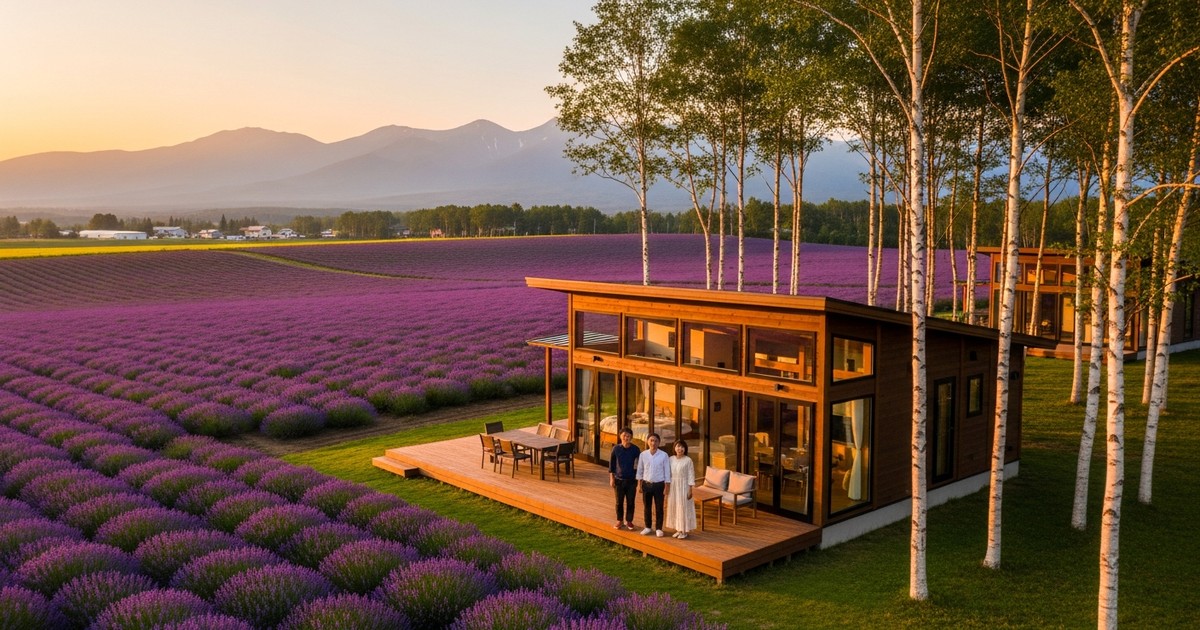
Furano bustles with tourists in summer, centered around July when the lavender fields are at their peak. Calculating with an ADR of ¥30,000 and an occupancy rate of 70%, you get: 122 days × 70% × ¥30,000 = approximately ¥2.56 million. In recent years, stays centered around activities such as cycling, rafting, and hot air balloon experiences have been increasing, with steady demand from family groups and group travelers.
Off-Peak Sales (April–May, October–November)
For the four-month off-peak period, we’ll conservatively estimate an ADR of ¥20,000 and an occupancy rate of 45%. That gives us: 122 days × 45% × ¥20,000 = approximately ¥1.1 million. How well you can raise the occupancy rate during this period is a key factor in overall annual revenue. Capturing workation demand and offering long-stay discount plans (for stays of a week or more) could potentially improve occupancy to 50–55%.
Total Annual Sales
Adding up the three seasons above, total annual sales come to approximately ¥7.53 million. This is a conservative estimate, and with higher ADRs and improved occupancy rates, reaching ¥9–10 million is entirely feasible. In particular, larger properties accommodating 8 or more guests that successfully capture group demand can realistically command an ADR of ¥50,000–80,000 per night.
Breakdown of Annual Operating Expenses
Cleaning Costs
Cleaning costs are the most frequently recurring expense in rental villa operations. The cost per cleaning depends on the property’s size, but for an 80–120 square meter detached house, the going rate is ¥8,000–15,000. Assuming 240 annual occupied days (the total from the simulation above) and an average stay of 2 nights, that comes to approximately 120 cleanings per year. At ¥10,000 per cleaning, that’s ¥1.2 million annually.
OTA Commission Fees
Bookings made through OTAs (online travel agencies) such as Airbnb, Booking.com, and Rakuten Travel incur commission fees. Airbnb’s host fee is typically 3%, Booking.com around 15%, and Rakuten Travel 8–10%. This varies depending on your OTA mix, but it’s reasonable to budget for commissions equal to 10–12% of sales. For annual sales of ¥7.53 million, that’s approximately ¥750,000–900,000.
Utilities and Communication Costs
Since heating costs rise significantly in winter, rental villas in Furano typically see monthly utility costs averaging ¥30,000–50,000, or ¥360,000–600,000 annually. Properties using kerosene or propane gas tend to run even higher. Wi-Fi service costs around ¥5,000 per month, or approximately ¥60,000 annually.
Consumables and Linen Costs
Consumables such as towels, sheets, shampoo, and detergent, along with linen cleaning costs, typically average ¥20,000–40,000 per month, or ¥240,000–480,000 annually. Since this directly affects guest satisfaction, excessive cost-cutting here carries the risk of lowering review scores.
Management and Operations Outsourcing Fees
Since it’s realistically difficult for owners living remotely to manage the property themselves, most outsource operations to a property management company. Management fees typically run 10–30% of sales (varying by company and scope of services), which for sales of ¥7.53 million comes to approximately ¥1.13–1.88 million. Since this can cover guest communication, reservation management, cleaning coordination, and issue resolution all in one package, it’s an essential expense for owners running the business as a side venture.
Property Tax and Insurance Premiums
Depending on the property’s assessed value, annual property tax for a detached house in the Furano area typically runs ¥100,000–250,000. Adding fire insurance and facility liability insurance brings an additional ¥50,000–150,000. Budget a combined total of ¥150,000–400,000.
Loan Repayment
If you borrow ¥22.3 million of the initial investment at a 2.0% interest rate over a 20-year repayment term, the monthly payment comes to approximately ¥113,000, or approximately ¥1.36 million annually. While this is a cash flow expenditure rather than an operating expense per se, it must be factored into your revenue simulation.
Operating Profit and Investment Payback Simulation
Let’s summarize the figures so far. Against annual sales of ¥7.53 million, total major expenses—cleaning costs of ¥1.2 million, OTA fees of ¥830,000, utilities of ¥480,000, consumables of ¥360,000, management outsourcing fees of ¥1.5 million (calculated at 20% of sales), and property tax/insurance of ¥250,000—come to approximately ¥4.62 million. This yields an operating profit of approximately ¥2.91 million.
Subtracting the ¥1.36 million loan repayment from this leaves a pre-tax cash flow of approximately ¥1.55 million. Against personal funds of ¥9.5 million, that’s an annual cash flow yield of approximately 16.3%, meaning your personal investment would be recouped in approximately 6 years. Since depreciation expenses also provide income tax savings, the effective payback period is even shorter. That said, it’s important to build in a margin of safety in your financial planning to account for unexpected repair costs and the risk of declining occupancy.
Operational Strategies to Maximize Revenue
Seasonal Pricing Strategy
Dynamic pricing is essential for maximizing revenue from a rental villa in Furano. During the New Year holiday period or when nearby Niseko-area properties are fully booked, you can set rates 1.5–2 times higher than usual. Conversely, during off-peak periods, long-stay discounts and weekday-only plans can help boost occupancy. Adopting automated pricing tools such as PriceLabs or Beyond Pricing allows you to automate flexible rate adjustments in sync with market rates at nearby properties.
Introducing Differentiating Amenities
As competition in the Furano rental villa market increases, differentiation through amenities has a direct impact on review scores and booking rates. Features such as barrel saunas, private open-air baths, wood stoves, and living rooms equipped with projectors can boost ADR by ¥5,000–10,000. While this increases initial investment, the resulting boost to annual sales makes payback fully achievable.
Using Multiple OTAs and Social Media Together
Relying solely on Airbnb carries risk. Listing across multiple OTAs—Booking.com, Vrbo, Rakuten Travel, Jalan, and others—to diversify your booking channels is key to stable operations. Furthermore, leveraging Instagram and Google Business Profile to attract direct bookings can reduce OTA commission fees, potentially cutting annual costs by ¥300,000–500,000.
Important Considerations When Obtaining a Ryokan Business License
The first step to obtaining a ryokan business license in Furano City is confirming the zoning designation. Ryokan-type business operations are not permitted in Category 1 Low-Rise Exclusive Residential Zones, so be sure to check this before acquiring a property. In the Furano area, commercial zones, neighborhood commercial zones, and quasi-residential zones within urbanization areas tend to be easier to obtain approval for.
Additionally, while amendments to the Ryokan Business Act now allow ICT equipment to substitute for the mandatory front desk requirement, operational standards vary by public health center jurisdiction. To avoid costly mistakes, it’s best to consult in advance with the Kamikawa Public Health Center, which has jurisdiction over Furano City, and confirm the specific equipment requirements before beginning construction. Regarding fire safety equipment standards, in most cases you’ll be required to install automatic fire alarm systems and emergency exit lighting, so you should budget ¥300,000–800,000 for this installation work.
For Consultations on Rental Villa Operations, Contact Stay Buddy Inc.
Many people are interested in operating a rental villa in Furano but feel uncertain about the process of obtaining a ryokan business license or the accuracy of their revenue simulations. From property selection and license applications to renovations, OTA listings, and day-to-day guest communication, running a rental villa business involves a wide range of tasks.
Stay Buddy Inc., a vacation rental management company, provides one-stop support for planning and operating rental villas under ryokan business licenses. We offer flexible support tailored to each owner’s situation—from assessing a property’s revenue potential and assisting with the administrative procedures for license acquisition, to guest acquisition and operational management support after opening.
We provide highly accurate revenue simulations, free of charge, based on the operational data we’ve accumulated to date. We can answer your specific questions—such as “Will this property actually be profitable?” or “How much can I reduce my initial investment?”—with concrete figures.
If you’re considering a rental villa business in Furano, please feel free to reach out to Stay Buddy Inc. for a consultation.