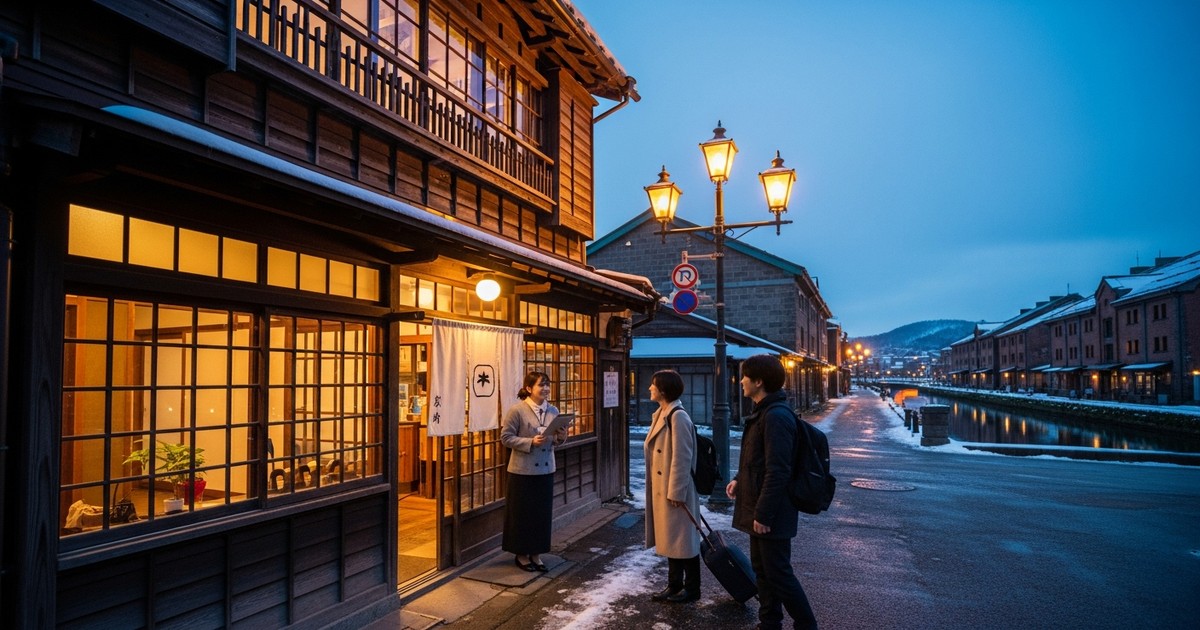
If you’re planning to start a minpaku (private lodging) business in Otaru, the first things you need to understand are the local market conditions and regulatory environment specific to the area. As one of Hokkaido’s premier tourist destinations, Otaru draws visitors from Japan and abroad year-round with its canal scenery, historic architecture, and renowned sushi and seafood cuisine. That said, the rules governing minpaku and ryokan (traditional inn) businesses vary by municipality, and Otaru City has its own set of ordinances and operational guidelines.
This article compiles, based on information current as of 2026, everything you need to know to open a minpaku, ryokan, or simple lodging (kan’i shukusho) business in Otaru. From market demand trends to legal procedures, property selection, financial simulations, and operational tips, we’ve aimed to provide practical, actionable content for anyone considering entering this market.
According to the Japan Tourism Agency’s accommodation statistics, total overnight stays across Hokkaido have now surpassed pre-pandemic levels, and occupancy rates at Otaru’s accommodation facilities have exceeded 80% during peak months. Against this favorable backdrop, we’ll walk you step by step through how to build a successful business here.
Market Trends to Know Before Starting a Minpaku Business in Otaru
The Recovery of Inbound Demand and Otaru’s Position
According to statistics from the Japan National Tourism Organization (JNTO), the number of inbound foreign visitors to Japan has maintained an annual level in the tens of millions, and Hokkaido has firmly established itself as a top destination, ranking just behind Tokyo, Osaka, and Kyoto. Visitors from East and Southeast Asia in particular tend to favor routes starting from New Chitose Airport that take in Sapporo, Otaru, and Niseko, and demand for overnight stays in Otaru is growing as more travelers feel that “a day trip just isn’t enough.”
Otaru City’s annual visitor numbers hover around 7 million, of which an estimated 800,000 to 900,000 are overnight stays. Given the high proportion of day-trippers, there’s significant room for the market to shift toward longer stays as accommodation capacity increases—making this a market with real growth potential for minpaku operators. Demand is especially concentrated during winter, when the snowy scenery and events like the Otaru Snow Light Path Festival draw crowds, and per-night rates tend to rise accordingly during this season.
Existing Accommodation Supply and the Competitive Landscape
Otaru is home to roughly 50 to 60 hotels and ryokan, offering a combined total of around 2,000 rooms. Compared to Sapporo, the supply is dramatically smaller, and many facilities reach full occupancy during peak season. Meanwhile, registrations under the Private Lodging Business Act (the “minpaku law”) number over 3,000 across Hokkaido as a whole, but within Otaru City itself the count remains in the dozens—meaning competition is still relatively limited.
That said, it’s worth noting that as minpaku supply in Sapporo becomes increasingly saturated, more operators are looking to Otaru as an alternative. With supply likely to increase over the next two to three years, developing a differentiation strategy early on will be key to securing stable returns.
Understanding the Differences Between Minpaku, Ryokan, and Simple Lodging—and How to Choose
Registration Under the Private Lodging Business Act (Minpaku Law)
Registering under the Private Lodging Business Act is the lowest-barrier entry point. You can begin operating simply by filing a notification with the prefectural governor (in Otaru’s case, the Governor of Hokkaido)—there’s no permit process required, so the procedure is relatively quick. However, this comes with a cap of 180 operating days per year, meaning you cannot operate on the remaining 185 days. Otaru City has not imposed any additional restricted zones by ordinance, but under Hokkaido’s own ordinance, operations in exclusively residential zones may be restricted during certain periods.
Under the 180-day cap, there’s a clear ceiling on annual revenue no matter how high your occupancy rate. For example, even with a 90% occupancy rate at an average nightly rate of ¥15,000, annual revenue would max out at roughly ¥2.43 million (¥15,000 × 162 days). This model suits side businesses or making use of idle property, but if you’re pursuing this as a full-time venture, obtaining a ryokan business license is worth considering.
Simple Lodging (Kan’i Shukusho) License Under the Ryokan Business Act
Operating as a simple lodging facility (kan’i shukusho) requires a license under the Ryokan Business Act, but comes with no cap on annual operating days. Since you can operate 365 days a year, your revenue potential more than doubles compared to the minpaku law framework. To obtain a license, you’ll need to meet certain facility standards: total guest room floor area of at least 33 square meters (or at least 3.3 square meters per guest if capacity is under 10 people), a front desk or equivalent facility, and proper fire safety equipment.
Applications are handled through the Otaru City Public Health Center, and the process from application to approval typically takes about one to two months. Before applying, it’s important to consult with the fire department and confirm the property’s zoning classification under the Building Standards Act, submitting a use-change confirmation application if needed. Initial costs vary depending on the property’s condition, but typically run from ¥1 million to ¥3 million when combining fire safety equipment installation, interior renovation, and application fees.
How This Differs from a Full Hotel/Ryokan Business License
The Ryokan Business Act also includes a separate category for “hotel/ryokan business,” which is suited to larger-scale facilities. This category comes with stricter requirements for room count and amenities than simple lodging, including a permanently staffed front desk and dedicated lobby space. For those operating a whole-house rental or a small handful of rooms in Otaru, a simple lodging license is the more practical choice.
Which format is right for you depends on your property’s size and location, your available investment budget, and your operational setup. As a general rule: if 180 days or fewer per year is sufficient for a side business, the minpaku law route works; if you’re pursuing full-time, year-round operations, simple lodging is the way to go; and for larger-scale facilities, a full hotel/ryokan business license is appropriate.
Concrete Steps and Procedures for Opening a Business in Otaru
Property Selection and Confirming Zoning Designations
Otaru City has designated zoning areas under the City Planning Act, and as a general rule, ryokan businesses may only operate in commercial zones, neighborhood commercial zones, quasi-industrial zones, and similar areas. Exclusively residential zones will not be approved for ryokan business licenses, so it’s essential to confirm the zoning designation with Otaru City’s Urban Planning Division before signing a property contract. Under the minpaku law notification system, operation is possible even in residential zones, but as noted above, Hokkaido’s ordinance may impose seasonal restrictions.
Areas around the Otaru Canal and Sakaimachi Street shopping district attract high concentrations of tourists, making them attractive locations. However, if you’re working with an older historic building, achieving compliance with earthquake resistance and fire safety standards may involve additional costs. For properties over 30 years old, you should budget not only for interior renovation but also for updating electrical wiring and plumbing—renovation costs exceeding ¥5 million are not uncommon in such cases.
Steps for Notifications and License Applications
The typical process for obtaining a simple lodging business license begins with a preliminary consultation at the Otaru City Public Health Center. Next, you’ll submit a notification of intended use to the fire department, complete fire safety equipment installation, and undergo a fire safety inspection. If a change of building use is required under the Building Standards Act, you’ll need to have an architect handle the confirmation application. These steps can proceed in parallel; once complete, you submit the ryokan business license application to the Public Health Center, undergo an on-site inspection, and receive your license.
Required application documents include facility drawings (floor plans and elevations), a summary of structural specifications, the fire department’s inspection certificate, and, for rented properties, the owner’s written consent. Fees for hiring an administrative scrivener (gyoseishoshi) typically run ¥100,000 to ¥200,000, while fire safety equipment installation costs range from roughly ¥300,000 to ¥1 million depending on the property’s size. All told, the process from signing the property contract to opening for business can take as little as two to three months, or over six months for larger-scale renovations.
Selecting a Management Company and Building an Operational Structure
Under the minpaku law notification system, if the host does not live on-site, outsourcing to a registered residential lodging management business is legally required. Management fees typically run 10% to 30% of revenue (varying by company and scope of service) and can cover cleaning coordination, guest communication, key handovers, and emergency response as an all-in-one package. Even for simple lodging operations, using a management agency is often the most efficient option if you live remotely or manage multiple properties.
Otaru is about 30 to 40 minutes from Sapporo by JR rapid train, but winter snowfall can cause transit delays, making it essential to have a partner who can respond quickly on-site. Securing cleaning staff is also important—typical per-visit cleaning costs run ¥3,000 to ¥5,000 for a studio-type unit, and ¥8,000 to ¥15,000 for a whole-house rental (roughly a 3-bedroom, living/dining/kitchen layout).
Financial Simulation and Estimated Payback Period
A Simple Lodging Model (Whole-House Rental, Capacity of 4)
Here’s a model case for leasing a roughly 30-year-old detached house in Otaru and operating it as a whole-house-rental simple lodging facility. Assumed conditions: monthly rent of ¥80,000, initial renovation cost of ¥2 million, capacity for 4 guests, a nightly rate of ¥18,000 (¥4,500 per person × 4 guests), and an average annual occupancy rate of 65%.
Annual revenue comes to ¥18,000 × 365 days × 65% ≈ ¥4.27 million. Subtracting annual expenses—¥960,000 in rent, roughly ¥770,000 in management fees (18% of revenue), roughly ¥1.19 million in cleaning costs (approximately 237 stays per year × ¥5,000), roughly ¥360,000 in utilities and internet/Wi-Fi costs, roughly ¥150,000 in supplies and amenities, and roughly ¥340,000 in OTA fees (3% to 15% of revenue, averaging around 8%)—leaves an annual operating profit of roughly ¥500,000. At that rate, recovering the initial ¥2 million investment would take about four years. If occupancy could be raised to 75%, annual operating profit would rise to roughly ¥1.1 million, shortening the payback period to about two years.
Three Variables That Determine Your Bottom Line
The three variables that most heavily influence your bottom line are occupancy rate, average nightly rate, and fixed costs. Otaru experiences a bimodal seasonal demand pattern, with peaks in summer (July–September) and winter (December–February), so how well you maintain occupancy during the slower months of April–May and October–November will largely determine your annual profitability. Dynamic pricing is an effective strategy here: lower your nightly rate by ¥2,000 to ¥3,000 during the off-season to secure bookings, and set more aggressive pricing during peak season to maximize your average rate.
OTA (Airbnb, Booking.com, etc.) commission rates also vary by platform, and building your own direct booking website can reduce your overall fee burden by increasing the share of direct reservations. If direct bookings account for 30% of your total reservations, you could expect to save roughly ¥100,000 to ¥150,000 annually in commission fees.
Differentiation Strategies and Marketing Tips Unique to Otaru
Leveraging Historic and Retro Architecture
Otaru retains numerous stone warehouses and wood-framed stone merchant buildings dating from the Meiji through early Showa eras, and renovating these into accommodation facilities can create significant added value. The experience of “staying in a historic building” becomes a booking motivator in its own right, allowing you to set nightly rates ¥3,000 to ¥5,000 higher than a typical detached-house minpaku. Otaru City has taken a supportive stance toward preserving and utilizing historic buildings, and subsidy programs for renovation costs may be available if certain conditions are met.
That said, renovating a historic building requires careful confirmation of exemptions or relaxed provisions under the Building Standards Act. If the property is designated as a cultural asset, coordination with the Board of Education will also be necessary, making it essential to work with architects and administrative scriveners who have specialized knowledge in this area.
Pairing With Experience-Based Content
Rather than offering accommodation alone, pairing your property with experience programs that draw on Otaru’s local resources can boost both your average nightly rate and guest satisfaction simultaneously. Examples include hands-on sushi-making experiences led by Otaru sushi chefs (¥5,000–¥8,000 per person), tombodama glass bead-making workshops at local glass studios (¥2,000–¥3,000 per person), and winter snow activities. Offering these as bundled packages through your OTA listings or your own website can also help boost your booking conversion rate.
Listing under Airbnb’s “Experiences” category lets you attract experience bookings even from guests who aren’t staying at your property, creating an additional revenue stream. Partnering with local businesses also allows you to earn referral commissions without having to host the experiences yourself.
Operational Considerations and Risk Management
Being Considerate of Neighbors and Preventing Disputes
The most common issues in minpaku operations involve noise and trash disposal. Since Otaru’s residential and tourist areas sit close together, clearly communicating house rules to guests is essential. At check-in, present noise-related guidelines in multiple languages (Japanese, English, Chinese, and Korean) both in written form and via a tablet device, and set clear rules requiring quiet after 10 p.m.
Explaining your business plans to your neighborhood association and nearby residents in advance, and sharing emergency contact information, will allow for a faster initial response if problems arise. If a complaint does come in, a delayed response can escalate into administrative guidance or, in the worst case, license revocation—so make sure you have a system in place to respond within 24 hours.
Winter-Specific Risks and How to Manage Them
Otaru receives extremely heavy snowfall, and from December through March, clearing snow from the roof and property grounds is essential. Neglecting snow removal can lead to guest slip-and-fall accidents or damage to the building itself. Seasonal contracts with snow removal companies typically run ¥20,000 to ¥50,000 per month, so you should budget ¥100,000 to ¥200,000 for the season overall.
Preventing frozen pipes is another important consideration. If guests check out and leave the heating off for several days before the next reservation, water pipes can freeze and burst. Installing a room temperature monitoring system linked to your smart lock (initial cost of ¥10,000–¥20,000, plus a few hundred yen per month) that sends an alert if the room temperature drops below 5°C is a smart precaution.
For Minpaku Operation Support, Talk to Stay Buddy Inc.
If you’re considering opening a minpaku or simple lodging business in Otaru but feel uncertain about navigating the regulations, selecting the right property, or handling the license application process, you’re not alone. For anyone entering the accommodation business for the first time in particular, coordinating simultaneously with the public health center, fire department, and building authorities can be a significant burden.
Stay Buddy Inc. is a specialist company dedicated to minpaku and simple lodging operation support. We provide comprehensive, one-stop assistance covering everything from pre-launch legal procedure support to OTA listing creation, pricing optimization, cleaning coordination, and guest communication.
We also offer tailored advice based on your specific situation, including financial simulations for your property and guidance on whether simple lodging or the minpaku law notification route is the better fit for you. If you see potential in Otaru’s accommodation market, feel free to reach out to Stay Buddy Inc. to get started.