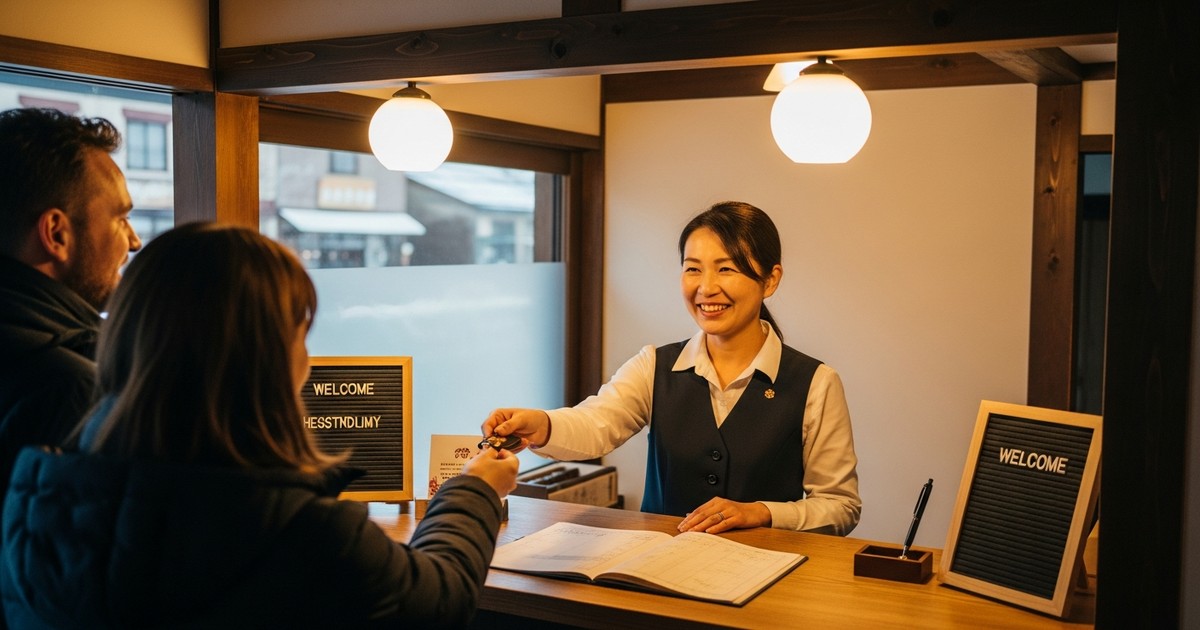
As the number of foreign tourists visiting Otaru continues to rise, an owner’s ability to serve international guests well has become a key factor determining both revenue and reputation for minpaku and guesthouse operators. Proper management of the guest registry, in particular, is not only a legal requirement under the Hotel Business Act but also a foundation of hospitality that helps put overseas travelers at ease. To handle foreign guest service properly in a minpaku setting, operators need both accurate knowledge of legal compliance and practical know-how in multilingual communication.
Otaru is a highly accessible destination—just about 30 minutes from Sapporo by rapid train—and offers a wealth of attractions, from its canal and historic buildings to fresh seafood cuisine. In recent years, the area has seen growing interest not only from travelers across Asia but also from Europe, the Americas, and Oceania, driving demand for whole-house minpaku rentals and guesthouses converted from traditional old homes. Against this backdrop, building a proper system for welcoming foreign guests is no longer optional—it has become an essential management task.
This article provides practical, operational-level guidance for owners running minpaku and guesthouses in Otaru, covering everything from the legal obligations around guest registries to concrete multilingual support measures and tips for preventing trouble with guests.
The Basics of Serving Foreign Guests in Minpaku and the Current State of Otaru
The number of foreign visitors to Hokkaido reached approximately 3.12 million in 2019, the year before the pandemic. Although numbers temporarily dropped afterward, the recovery has been remarkable, and it is now an everyday sight to hear foreign languages spoken throughout Otaru. Around the Otaru Canal area and Sakaimachi Shopping Street, the proportion of foreign guests at lodging facilities has been rising, and it is not uncommon for minpaku properties to see 30–50% of their bookings come from overseas via platforms like Airbnb and Booking.com.
The requirements involved in welcoming foreign guests fall broadly into two categories: “legal obligations” and “hospitality-based service.” The former includes legally mandated items such as recording guest information in the registry and verifying passports, and violations can result in penalties. The latter covers practical measures like multilingual signage and simplified check-in procedures, which directly affect guest satisfaction and review ratings. Since neither element alone is sufficient for sound operations, preparation is needed on both fronts.
Legal Obligations for the Guest Registry and Requirements for Foreign Guest Entries
Registry Entry Requirements Under the Hotel Business Act and the Private Lodging Business Act
Article 6 of the Hotel Business Act and Article 8 of the Private Lodging Business Act both require operators to create and retain a guest registry. For Japanese guests, the basic entries are name, address, occupation, and dates of stay; for foreign guests, operators must also record nationality and passport number. Failure to record this information—or providing false information—can result in a fine of up to 500,000 yen under the Hotel Business Act, and under the Private Lodging Business Act, it can lead to a business improvement order or a suspension of operations.
Registries must be retained for three years under both the Hotel Business Act and the Private Lodging Business Act. Digital record-keeping is permitted in addition to paper records, but because specific operational standards vary by municipality, it’s best to confirm details in advance with the Otaru City public health center. As of fiscal year 2024, roughly 60 private lodging business notifications had been filed in Otaru City, and as this number continues to grow, administrative oversight has become increasingly detailed.
How to Verify Passports and Practical Considerations
For in-person check-ins, the standard method for verifying a foreign guest’s passport is to have them present the original document and take a copy. If self-check-in is in use, an effective approach is to have guests upload a photo of the passport’s photo page (the page showing the photograph, passport number, and nationality) in advance. When paired with a smart lock check-in system, guests can complete registry entry and passport image submission online before arrival, which also accommodates guests arriving late at night.
Common mistakes in practice include photographing only the passport cover (making the passport number unreadable) and collecting information only from the group’s representative during group stays. Under the Hotel Business Act, all guests must be recorded in the registry—if three people are staying in one room, passport information must be recorded for all three. Clearly stating in multiple languages at the check-in guidance stage, “Please photograph the photo page of every guest’s passport,” helps prevent missing entries.
Practical Approaches to Building Multilingual Communication
Translating Check-In Guides and House Rules
The first information a foreign guest encounters is the check-in guide. English is the bare minimum, but given the nationality mix of travelers visiting Otaru, it’s effective to also provide Chinese (Simplified and Traditional), Korean, and Thai—four additional languages. Tools like DeepL and Google Translate can be used for translation, but for documents requiring precision, such as house rules, it’s recommended to have a native speaker review the text. Using crowdsourcing services, you can hire a professional translator for around 5,000–10,000 yen per language.
At minimum, house rules should cover five points: how to sort garbage, noise considerations at night, how to operate heating equipment (essential in Otaru, where winter temperatures can drop below -10°C, making instructions for kerosene heaters or central heating a must), the Wi-Fi password, and emergency contact information. It’s effective to compile these into a laminated card of one to two A4 pages placed inside the room, while also sending a PDF version via message at the time of booking confirmation so guests can review it before arrival.
Using Translation Tools and Chatbots
For handling inquiries during a guest’s stay, real-time translation tools are highly effective. Airbnb’s messaging feature includes built-in automatic translation, but if you’re concerned about accuracy, you can also set up a separate chat tool integrated with the DeepL API. DeepL Pro is available starting at 750 yen per month (Starter plan), and if using the API on a pay-as-you-go basis, up to 500,000 characters per month are available for free.
An increasing number of operators are taking things a step further by setting up chatbots powered by generative AI tools like ChatGPT as their inquiry contact point. By pre-registering answers to frequently asked questions (nearest convenience store, bus schedules, recommended sushi restaurants, etc.), you can offer automated multilingual support around the clock. As guest reviews increasingly mention things like “fast replies” and “no language barrier at all,” this directly translates into higher search rankings and improved booking rates.
Concrete Measures to Prevent Trouble with Foreign Guests
Noise, Garbage Disposal, and Consideration for Neighbors
Many minpaku properties in Otaru are located in densely populated residential areas, so maintaining good relationships with neighbors is essential to sustaining operations. While this isn’t unique to foreign guests, it’s especially important to provide careful advance explanations to guests unfamiliar with Japanese etiquette due to cultural differences. Specifically, the check-in guide should include illustrated rules such as, “Please refrain from loud conversation indoors after 10 p.m.,” and “Please place garbage in the designated bags in the sorting box in the kitchen.”
Otaru City’s garbage sorting system is based on four basic categories—”burnable,” “non-burnable,” “recyclable,” and “large items”—and requires the use of designated garbage bags. Since garbage sorting in Japan can seem complicated to foreign guests, it’s effective to provide visual explanations with actual photos, such as “Remove the cap and label from PET bottles before placing them in this bag.” One owner reported that after implementing this approach, complaints from neighbors about garbage disposal dropped to zero.
Key Handover and Ensuring Security
Since foreign guests often arrive late at night or early in the morning, relying solely on in-person key handovers can place a significant burden on operations. Installing a smart lock (keyless entry system) typically costs between 15,000 and 40,000 yen per unit, and since a different passcode can be issued each time, it also offers peace of mind from a security standpoint. Products like RemoteLock, SESAME, and Qrio are widely used by minpaku operators, and choosing one that integrates with reservation management systems like Airbnb or Booking.com allows passcodes to be automatically generated and sent for each booking.
It’s also important to establish a management system capable of quickly responding to any key-related issues that may arise (such as incorrect passcode entry or a dead smart lock battery), with staff able to reach the property on foot if nearby. The Private Lodging Business Act requires a management system capable of responding within approximately 10 minutes of the registered property. If self-management is difficult, entrusting operations to a licensed lodging management company is a practical option.
Hospitality Tips for Foreign Guests Unique to Otaru
Providing Local Information and Enhancing the Guest Experience
Otaru is a compact city packed with tourist attractions, offering a wide range of experiences within walking distance—strolling along the canal, touring glass workshops, visiting the music box hall, and dining along Sushi-ya Street. For foreign guests, “insider information only locals would know” holds the most value, so simply providing an original English-language map featuring the owner’s personal recommendations can significantly boost review ratings. In fact, some guesthouses in Otaru that offer handmade maps have maintained an overall Airbnb rating of 4.9.
During winter, advice on walking on snowy roads and cold-weather preparation is also much appreciated. Otaru sees heavy snowfall from December through February, and icy road surfaces are common. Simply offering free anti-slip spikes at the entrance or providing information on nearby shops that rent winter boots can achieve both guest safety and thoughtful hospitality at the same time. These kinds of small, considerate touches tend to spread through word of mouth, strengthening customer acquisition over the medium to long term.
Introducing Food Culture and Accommodating Allergies and Religious Needs
One of Otaru’s great appeals is its food culture, especially seafood, but some foreign guests may require halal or vegetarian options. While the number of restaurants in the city with halal certification remains limited, the number offering vegetarian menus is on the rise. Compiling this kind of information into a list and placing it in the guest room can significantly reduce the effort guests spend searching for places to eat.
For minpaku properties with kitchens, it’s also helpful to label seasonings and cooking utensils in English. For distinctly Japanese seasonings like soy sauce, miso, and mirin, simply adding an English label makes self-catering much smoother for foreign guests. Providing the locations and business hours of nearby supermarkets (such as MaxValu or Ralse) further enhances convenience during their stay.
For Minpaku Operation Concerns, Contact Stay Buddy Inc.
Serving foreign guests, properly managing the guest registry, and building a multilingual communication system all require specialized knowledge and hands-on operational know-how. Balancing legal compliance with high customer satisfaction, in particular, demands operational design grounded in real experience.
Stay Buddy Inc. offers minpaku and guesthouse management services, providing one-stop support that covers everything from property cleaning management and guest services to optimizing operations across booking platforms. We have extensive experience welcoming foreign guests and also provide support for building multilingual systems and implementing check-in solutions.
If you’re wondering where to start with setting up a system for welcoming foreign guests, feeling unsure whether your guest registry practices are correct, or hoping to hand off overall operations so you can focus on being a property owner, please don’t hesitate to reach out to Stay Buddy Inc. We’re happy to walk you through everything from an initial consultation to concrete improvement proposals.