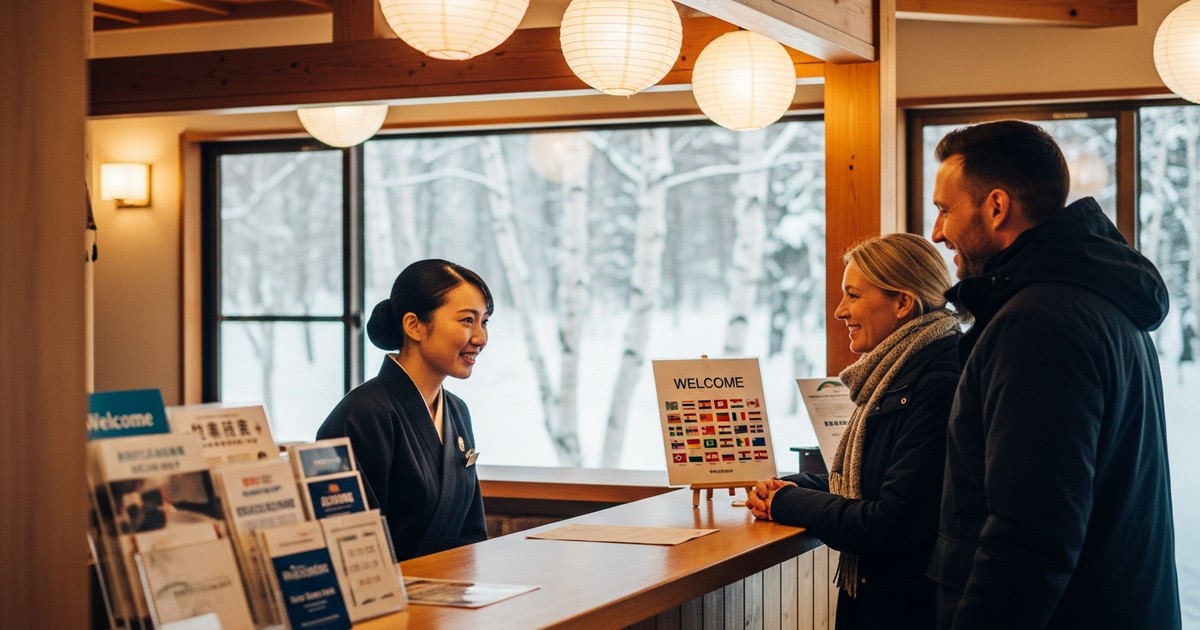
Building solid multilingual support at Hokkaido accommodations is essential for boosting guest satisfaction, earning positive reviews, and driving repeat bookings. With foreign tourist arrivals to Hokkaido consistently exceeding three million annually, support for multiple languages—English, Chinese, Korean, and more—has effectively become the standard in popular areas like Niseko, Furano, and Sapporo.
Yet many owners still struggle with questions like “Which language should we prioritize?”, “How much will translation actually cost?”, and “How much can be handled with tools alone?” This article breaks down the concrete multilingual measures Hokkaido properties need when hosting international guests, covering priorities, cost estimates, and real-world examples.
We’ve covered everything from approaches that even owners without confidence in foreign languages can take, to staff training and technology adoption—so be sure to read through to the end.
The Current State and Necessity of Multilingual Support at Hokkaido Accommodations
According to statistics from the Hokkaido District Transport Bureau, the total number of foreign guest-nights in Hokkaido reached approximately 8.9 million in 2019, before the pandemic. Even now, as numbers recover, data shows roughly 70% of guests in the Niseko area are international visitors—and whether or not a property offers multilingual support directly affects booking rates. In fact, an analysis of reviews on Booking.com and Airbnb shows that comments like “there was no English guidance” or “we couldn’t figure out how to check in” rank among the top reasons for low ratings.
A factor unique to Hokkaido is the need for emergency information during winter, when transportation delays and icy roads are common. If evacuation routes and heater instructions aren’t explained in multiple languages, it can compromise guest safety. On top of that, uniquely Japanese customs—such as onsen etiquette and garbage sorting rules—are hard to convey when there’s a language barrier, making it essential to document them in advance. In short, multilingual support has moved from “nice to have” to “a necessity, or it becomes an operational risk.”
How to Prioritize Languages and Scope of Support
Language Priorities Based on Data
Looking at the nationality breakdown of foreign visitors to Hokkaido, South Korea, Taiwan, China, Hong Kong, and Australia make up the top five. This means English, Chinese (both Traditional and Simplified), and Korean should be your top three priority languages. In areas with many Western guests, such as Niseko and Furano, English carries more weight, while in areas with more Asian visitors, such as Sapporo, Otaru, and Noboribetsu, Chinese and Korean take on higher priority. By reviewing your own property’s booking data from the past year and checking the nationality breakdown, you can identify which languages will deliver the best return on investment.
Defining Levels of Support
Multilingual support doesn’t require perfect translation of everything. Level 1 covers the bare essentials—booking confirmation emails, check-in instructions, and Wi-Fi passwords—and typically costs around ¥50,000–¥100,000 for three languages if outsourced to a translation company. Level 2 involves preparing more detailed documents such as house rules, sightseeing information, and emergency contacts, with additional costs of roughly ¥100,000–¥200,000. Level 3 covers real-time messaging and phone support, which realistically requires either hiring bilingual staff or outsourcing to a property management company. The most efficient approach is to solidly establish Level 1 first, then progress to Levels 2 and 3 as booking volume grows.
Multilingual Strategies for Check-In and Check-Out
Leveraging Self Check-In Systems
When in-person language support isn’t practical, pairing a smart lock with a self check-in system is highly effective. Products like RemoteLOCK, Keycafe, and SESAME let guests complete check-in simply by receiving a PIN code or QR code on their smartphone. Setup typically costs ¥10,000–¥30,000 upfront plus ¥3,000–¥5,000 per month, and since it enables 24-hour access, it also cuts labor costs. Some property management companies report that pre-preparing an image-based PDF of check-in instructions in English, Chinese, and Korean, automatically sent once a booking is confirmed, reduced inquiry volume by an average of 40%.
Creating a Multilingual Welcome Guide
The welcome guide is often the first thing guests pick up after arrival, and it shapes their first impression of your property. A guide of roughly 4–6 A4 pages should cover how to use amenities (air conditioner, water heater, induction cooktop, etc.), garbage sorting rules, a map of nearby convenience stores and restaurants, and emergency contacts. One pension in Niseko created a welcome guide in four languages and saw in-stay inquiries drop from an average of 25 per month to just 8, while review scores rose from 4.2 to 4.6. You can create a rough draft translation using DeepL or ChatGPT and then have a native speaker review it via crowdsourcing platforms like Lancers—producing high-quality documents for around ¥10,000–¥20,000 per language.
Translation Tools and Technology to Support Communication During a Stay
Comparing Real-Time Translation Tools
For handling guest messages, the three go-to options are Google Translate, DeepL, and POCKETALK (a voice translation device). Google Translate is free, supports 113 languages, and even includes a camera translation feature—though its handling of Japanese honorifics can sometimes feel slightly unnatural. DeepL offers a free plan of up to 500,000 characters per month and produces notably natural translations, though it only supports 33 languages. POCKETALK costs around ¥15,000 for the device and supports voice translation in 74 languages, making it ideal for face-to-face interactions. In terms of cost-effectiveness, a practical approach is to use DeepL for text-based communication, POCKETALK for in-person exchanges, and Google Translate for any other languages.
Introducing Chatbots and Automated Message Responses
Both Airbnb and Booking.com offer template message features in their management dashboards. By pre-registering reminders for the day before check-in, check-out instructions, and answers to frequently asked questions in three languages, you can send the appropriate version with a single click based on the guest’s language settings. Adding a channel manager like Beds24 or Guesty for Hosts allows you to manage messages across multiple platforms in one place and set up automated sending rules. Monthly costs run around ¥5,000–¥15,000, but preventing missed responses and speeding up reply times makes it much easier to maintain Airbnb’s Superhost benchmarks of a 90%+ response rate and responses within 24 hours.
Translating House Rules, Safety Information, and Local Etiquette
How to Communicate House Rules
For house rules like noise restrictions, no-shoes policies, and smoking rules, pairing text with pictograms (icons and symbols) dramatically improves comprehension. Using pictograms based on International Organization for Standardization (ISO) standards ensures the meaning gets across regardless of language. At one minpaku property in Sapporo, introducing multilingual house rules with pictograms reduced neighbor complaints about rule violations from 12 per year to just 3. Templates can be created using free design tools like Canva, and the whole process typically takes just 1–2 hours.
Winter Safety Information and Emergency Response
Hokkaido winters routinely see temperatures drop below minus 10 degrees Celsius, bringing risks like frozen pipes, heating malfunctions, and falls on icy roads. Preparing a multilingual manual with photos explaining how to drain water pipes can prevent burst pipes from freezing. One whole-property rental in Asahikawa reported zero winter water pipe issues after installing English and Chinese pipe-draining manuals. Displaying a multilingual card indoors listing the address and contact information for the nearest hospital, police station, and fire department also helps guests respond quickly in an emergency. It’s also reassuring to note that Japan’s Fire and Disaster Management Agency offers multilingual support for 119 emergency calls, and the National Police Agency does the same for 110.
Subsidies and Support Programs for Foreign Guest Services
Building out multilingual support does come with costs, but you can ease the burden by taking advantage of subsidies and support programs offered by Hokkaido and local municipalities. For example, Hokkaido’s “Hospitality Environment Development Support Program” can subsidize a portion of costs (up to ¥500,000, at a 1/2 subsidy rate) related to inbound tourism measures like multilingual signage and Wi-Fi setup. The Japan Tourism Agency’s “Accommodation Facility Inbound Support Program” may also cover costs for creating multilingual guides and installing cashless payment terminals.
Since the details of these programs change from year to year, it’s a good idea to check in regularly with the Hokkaido Bureau of Economy, Trade and Industry or your local municipality’s tourism division. Applications often require quotes and a business plan, so it’s smart to get estimates from translation companies or system vendors ahead of time. The ideal approach is to use subsidies to fully build out Level 1 and 2 multilingual support at once, then let improved guest satisfaction drive up occupancy rates—speeding up your return on investment.
Need Help with Multilingual Operations? Consult Stay Buddy Co., Ltd.
Multilingual support for foreign guests spans everything from drafting translated documents and setting up check-in systems to handling day-to-day messaging. Managing all of this alone takes considerable time and effort, and many owners find it difficult to balance with their main business.
At Stay Buddy Co., Ltd., our minpaku property management service provides round-the-clock guest support in English, Chinese, Korean, and other languages. We offer one-stop support for everything needed to attract international guests—from creating multilingual welcome guides and house rules, to helping set up self check-in systems, to optimizing your listings on booking platforms.
We have extensive experience managing properties across Hokkaido, delivering improved occupancy rates and review scores for properties in Niseko, Sapporo, Furano, and beyond. If you’re unsure about multilingual support or want to start capturing inbound demand, please feel free to reach out to Stay Buddy Co., Ltd. today.