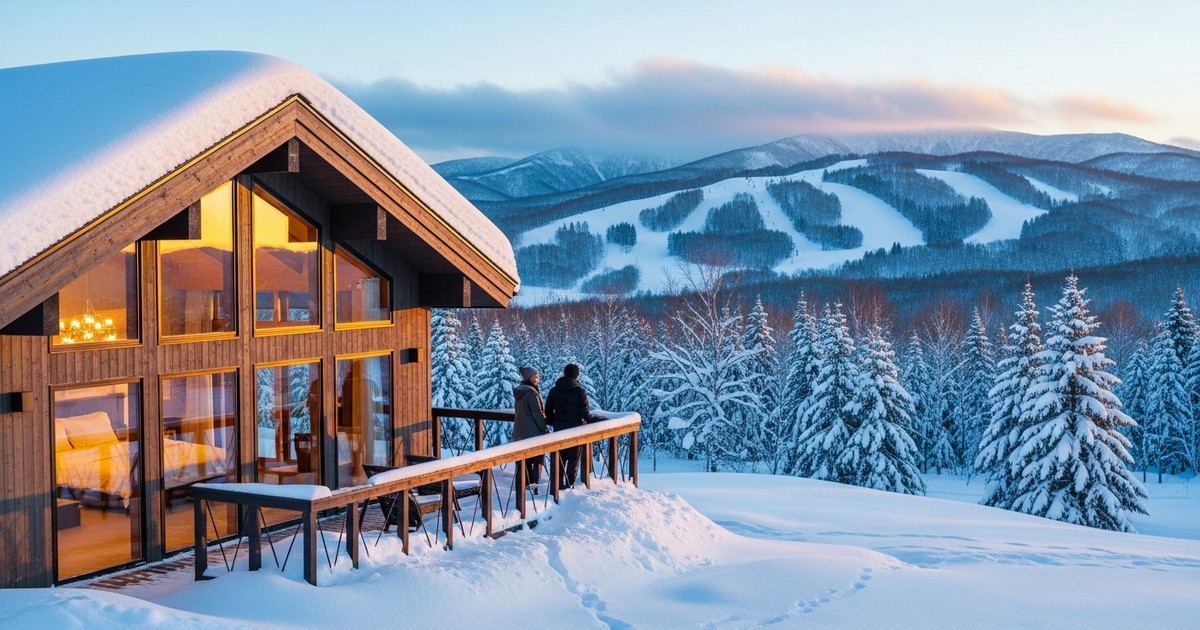
Pricing for accommodations in Furano is one of the most critical themes that significantly impacts revenue during the ski season. In the Furano area, which attracts skiers and snowboarders from Japan and around the world in search of world-renowned powder snow, how effectively you maximize your winter nightly rates holds the key to your annual profitability.
However, simply setting high prices isn’t enough. Strategic pricing requires taking into account multiple factors, including competing properties, guest expectations, booking lead times, and length of stay. This article walks property owners operating accommodations in the Furano area through concrete, step-by-step methods for maximizing winter nightly rates.
In an area like Furano, where it’s not uncommon for the price gap between peak and off-peak seasons to exceed threefold, a scientific yet practical pricing strategy is essential. Follow the steps below to reassess the pricing at your own property.
Understanding the Overall Market for Furano Accommodation Pricing
Understanding the Price Gap Between Winter and Summer
Demand for accommodations in the Furano area is concentrated during the ski season, from mid-December through late March. Generally, during peak winter periods (New Year’s, Lunar New Year, and February holidays), nightly rates can jump to 2.5 to 4 times what they are in summer. For example, a whole-house rental property that goes for ¥15,000 per night in summer often books up at ¥50,000 to ¥60,000 per night during winter peak periods.
To take full advantage of this price gap, the starting point is organizing your property’s annual calendar into four stages: “off-season,” “shoulder season,” “high season,” and “peak season.” For Furano, a common breakdown is: late November through mid-December and mid-to-late March as shoulder season; mid-December through mid-March as high season; and the roughly two-week periods around New Year’s and Lunar New Year as peak season.
Understanding Inbound Demand’s Price Sensitivity
Among ski visitors to Furano, the proportion of inbound travelers—primarily from Australia and Asia—has been increasing year after year. Many of them are flowing into Furano in response to soaring prices in Niseko, and while they seek a sense of “good value” compared to Niseko, they also tend to be willing to pay a fair price for a certain level of quality. Specifically, while comparable properties in Niseko run ¥80,000 to ¥120,000 per night, high-quality properties in Furano typically fall in the ¥50,000 to ¥80,000 range.
In other words, you can use roughly 60-70% of Niseko’s price range as an upper benchmark, while leaving room to add a premium based on your property’s unique value (proximity to the slopes, hot springs, private space, etc.). Make it a habit to regularly check the pricing of Niseko properties on English-language OTAs (Booking.com, Airbnb, etc.) to verify your own property’s positioning.
Designing a Pricing Calendar for the Entire Season
Setting Concrete Rates Across Four Pricing Tiers
Based on the four-stage breakdown mentioned above, let’s set concrete rates. For example, taking a whole-house rental property that sleeps six as a case study, the following pricing serves as a useful benchmark: off-season (April through November) at ¥18,000-¥25,000 per night; shoulder season (late November through mid-December, mid-to-late March) at ¥30,000-¥38,000; high season (mid-December through mid-March) at ¥45,000-¥55,000; and peak season (New Year’s, Lunar New Year) at ¥60,000-¥75,000.
Under this pricing structure, the gap between the lowest and highest rates is roughly fourfold. The key is to set gradations between each tier so that the price jumps aren’t too abrupt. Without a shoulder-season rate, you’d end up with a situation where “a room that was ¥25,000 yesterday suddenly becomes ¥55,000,” which erodes trust among guests booking on short notice. It’s more effective to create a gradual transition over a one-to-two-week window.
Incorporating Day-of-Week Rate Adjustments
Even during the ski season, there’s a difference in demand between weekend stays with Friday or Saturday check-ins and weekday stays. Long-term inbound guests tend not to pay much attention to the day of the week, but domestic ski travelers tend to concentrate their 2-3 night stays around Friday, Saturday, and Sunday. Setting weekend rates 10-15% higher than weekday rates lets you capture this elevated weekend demand as revenue.
That said, once high season begins, weekday occupancy also rises significantly, so it’s more realistic to limit day-of-week rate differentiation to the shoulder season and the early part of high season. During peak season, it’s better to apply the same rate every day of the week and instead raise the minimum stay requirement to 3-5 nights, which does more to protect revenue by preventing the opportunity loss that comes with short-term bookings.
Responding to Demand Fluctuations with Dynamic Pricing
Tiered Price Increase Rules Based on Booking Status
Relying solely on a fixed pricing calendar leads to opportunity loss when demand exceeds expectations. This is where tiered price increase rules triggered by booking status become valuable. For example, you might establish rules in advance such as: “raise the price 10% above the original rate if the date is already booked 60 days out” or “raise it 20% if booked 30 days out.”
Airbnb offers a Smart Pricing feature, but in an area with dramatic seasonal swings like Furano, the algorithm often fails to calculate the optimal price. Adopting an external dynamic pricing tool such as PriceLabs, Wheelhouse, or Beyond Pricing enables automatic adjustments that factor in competitor pricing and regional demand data. For a monthly cost of roughly ¥5,000-¥15,000, you can expect annual revenue gains in the hundreds of thousands of yen, making the return on investment extremely strong.
Repricing Strategy When Cancellations Occur
While cancellation rates are relatively low in winter, a certain number of last-minute cancellations still occur due to bad weather or flight cancellations. Since cancellations during peak season represent a significant opportunity loss, it’s worth establishing a rule to reprice within 24 hours of a cancellation. Specifically, an effective approach is to maintain the original price immediately after a cancellation, then apply a 5% discount after 48 hours, and a 10% discount after one week if the date remains unbooked.
It’s also important to tighten your cancellation policy specifically for peak season. Even if your standard policy offers a “full refund up to 7 days before check-in,” changing the terms during New Year’s or Lunar New Year to something like “full refund up to 30 days before, only 50% refund thereafter” can discourage casual cancellations. Since policy flexibility varies by OTA, be sure to check each platform’s specifications in advance.
Boosting Effective Nightly Rates by Optimizing Minimum Stays and Cleaning Fees
Guidelines for Setting Minimum Stays
During Furano’s ski season, accepting single-night bookings significantly undercuts revenue efficiency. Since cleaning and linen-changing costs run ¥8,000-¥15,000 per turnover (depending on property size), even a ¥40,000 single-night stay can see its effective profit margin drop substantially. By setting a minimum stay of 3+ nights during high season and 5-7 nights during peak season, you can achieve high occupancy while reducing the number of cleanings required.
Inbound ski travelers average 5-7 nights per stay, which means that even a long minimum-stay requirement is unlikely to turn away demand. Domestic guests, on the other hand, tend to stay 2-3 nights, so flexible operation—such as relaxing the minimum to 2 nights during shoulder season—is called for depending on the time of year.
A Strategic Approach to Setting Cleaning Fees
Whether you bundle the cleaning fee into the nightly rate or charge it separately has a direct impact on how your price appears to guests. Because Airbnb displays cleaning fees separately, your nightly rate may look cheaper on its face, but this can put you at a disadvantage when guests compare total costs. The recommended approach is to set a flat, fixed cleaning fee as a mechanism to encourage longer stays.
For example, if you set the cleaning fee at ¥12,000, a one-night stay adds ¥12,000 per night, but a seven-night stay adds only about ¥1,700 per night. This structure naturally incentivizes guests toward longer stays. As a result, you can reduce the frequency of cleanings while simultaneously cutting labor costs and maintaining high occupancy.
Boosting Guest Spend with Value-Added Services
Referral Commissions for Airport Transfers and Ski Equipment Rentals
There’s a limit to how much you can raise your nightly rate, but there’s substantial room to boost guest spending through value-added services. In the Furano area, demand for transfer services from Asahikawa Airport or New Chitose Airport is high, and by partnering with local transfer operators, you can earn a referral commission of ¥2,000-¥5,000 per group. The same applies to partnerships with ski equipment rental shops, where you can earn commission income by referring guests.
These kinds of partner services enhance guest convenience and contribute to better reviews, delivering benefits beyond simply increasing revenue. In fact, data shows that simply offering guidance in a pre-check-in message—”Would you like us to arrange an airport transfer?” or “We can take advance reservations for ski rentals”—results in 30-40% of guests taking advantage of the offer.
Arranging Food Delivery and Private Chef Services
While whole-house rental properties see high demand for self-catering thanks to their kitchen facilities, many guests find meal preparation during their trip to be a hassle. By partnering with local restaurants or catering businesses to offer food delivery—such as hot pot or Genghis Khan (grilled lamb) sets—you can earn a commission of ¥1,000-¥3,000 per order.
For an even higher-value offering, arranging private chef services is also effective. Services that provide a course meal made with local Furano ingredients within the property command demand in the ¥30,000-¥60,000 range per group, with the potential to earn a 10-15% referral commission. For affluent inbound guests in particular, this kind of premium experience can be the deciding factor in choosing a property.
Building a System for Competitor Analysis and Price Monitoring
How to Conduct Regular Benchmark Research
Pricing isn’t a “set it and forget it” task—it needs to be continually reviewed throughout the season. In practice, this means listing 5-10 competing properties of similar grade and location, recording their prices on major OTAs once a month, and tracking them in a spreadsheet. The four items worth checking are: nightly rate, cleaning fee, minimum stay requirement, and cancellation policy.
Repeating this research allows you to catch changes early—such as a competitor shifting to more aggressive pricing, or a new property entering the market at a low price and disrupting it. New properties open in the Furano area every year, so the competitive landscape is always shifting. Making a monthly check a habit will dramatically improve the precision of your pricing.
Leveraging the Correlation Between Reviews and Pricing
Review ratings on OTAs not only directly influence guests’ booking decisions but also serve as a basis for pricing. Generally speaking, properties with an Airbnb rating of 4.8 or higher can maintain booking rates even at nightly prices 15-20% higher than comparable properties in the same area and grade. Conversely, if the rating drops below 4.5, occupancy tends to fall sharply unless prices are lowered.
Therefore, alongside your short-term pricing strategy, you should also invest in measures that improve your review ratings. Setting out a welcome gift (local snacks or drinks) costs ¥500-¥1,000 per group, but the resulting boost in reviews can potentially allow you to raise winter rates by several thousand yen. Indirect price-boosting measures like this are also essential for maximizing revenue over the medium to long term.
If You’re Struggling with Accommodation Management in Furano, Talk to Stay Buddy Co., Ltd.
The pricing optimization strategies outlined here require an ongoing cycle of data collection, analysis, execution, and verification—a substantial burden for an individual owner to manage alongside a full-time job. In particular, running dynamic pricing, monitoring competitors, and providing multilingual support for inbound guests all require specialized know-how and operational infrastructure.
Stay Buddy Co., Ltd., a vacation rental property management company, provides comprehensive support for accommodations in resort areas including Furano—from developing pricing strategies to daily rate adjustments, guest communication, and cleaning arrangements. Our pricing approach, built on accumulated operational data, has a track record of boosting annual revenue by 20-30% compared to owners managing their properties on their own.
If you’re struggling with concerns like “I want to raise my winter rates further,” “I don’t understand the basis for my pricing,” or “I don’t have the bandwidth to manage operations,” please reach out to Stay Buddy Co., Ltd. We’ll propose an optimal plan tailored to your property’s characteristics and local market conditions.
Why not take the first step toward maximizing your winter revenue with a free consultation?