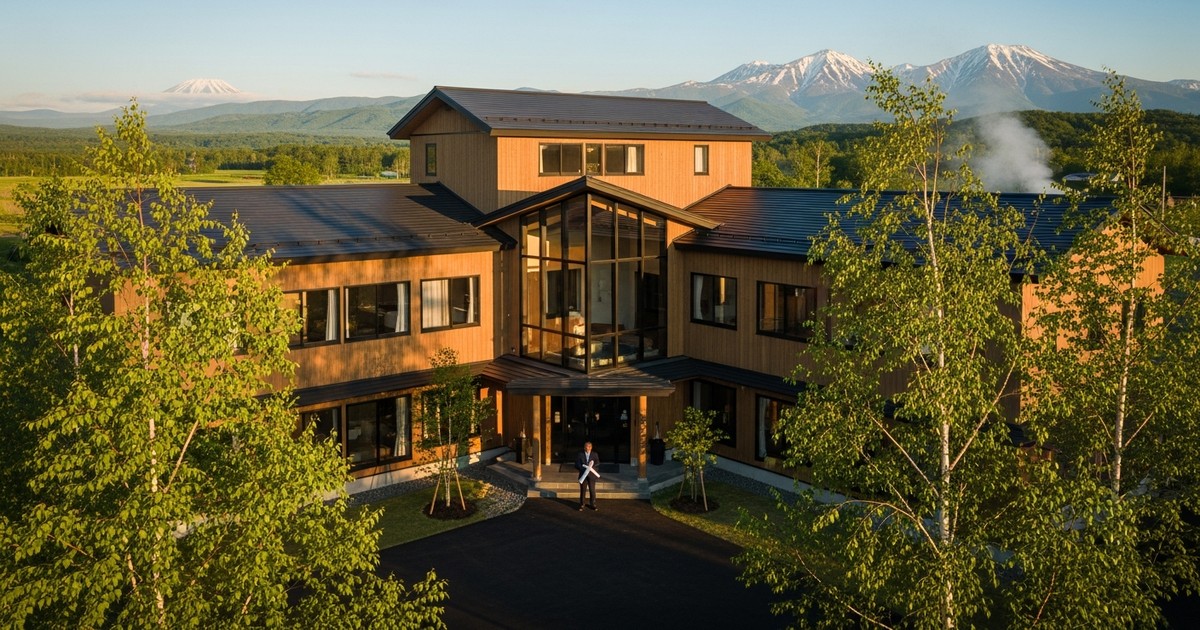
The Big Picture: Opening a Hotel in Hokkaido
Opening a hotel in Hokkaido requires working through a long sequence of steps — from obtaining a ryokan business license, through construction and renovation, all the way to launching actual operations. Hokkaido remains a perennially popular tourist destination with strong potential on both the inbound and domestic travel fronts. That said, it comes with its own set of considerations that differ from Honshu, including construction costs unique to a cold-climate region and land-use regulations shaped by the region’s vast open spaces.
This article walks through the concrete timeline and overall cost picture for anyone aiming to open a hotel in Hokkaido, from securing your ryokan business license to the grand opening. We’ll trace the entire development project chronologically — land acquisition, design and construction, various filings and permits, procurement of furnishings and equipment, and building out an operational structure — while outlining the expected duration and approximate costs for each phase.
Note that this article assumes you are pursuing a license for hotel/ryokan operations under the Hotel Business Act. We’ll touch briefly on simple lodging (kani shukusho) operations as well, but please be aware that the procedures differ from notifications filed under the Private Lodging Business Act (the “minpaku law”).
Essential Knowledge on Licensing Requirements for Opening a Hotel in Hokkaido
Choosing Your Business Category Under the Hotel Business Act
The Hotel Business Act broadly divides operations into two categories: “Ryokan/Hotel Operations” and “Simple Lodging Operations.” Under a 2018 legal revision, the previously separate categories of “Hotel Operations” and “Ryokan Operations” were merged into a single unified category: “Ryokan/Hotel Operations.” While requirements around room count and front-desk staffing were relaxed, standards for sanitation and safety management remain strictly enforced.
In Hokkaido, properties with 10 or more rooms typically operate under Ryokan/Hotel Operations, while smaller guesthouses and pensions generally opt for Simple Lodging Operations. The choice between the two affects minimum room-size standards and equipment requirements, which in turn impacts construction costs. For example, Ryokan/Hotel Operations require at least 7 square meters per guest room, while Simple Lodging Operations require a minimum total floor area of 33 square meters (or at least 3.3 square meters per guest, depending on occupancy).
Hokkaido-Specific Ordinances and Regulatory Considerations
Many municipalities in Hokkaido have established their own local ordinances that add extra requirements on top of the Hotel Business Act. In resort areas like Niseko and Kutchan, for instance, scenic-landscape ordinances impose height restrictions and exterior color guidelines on buildings. In Sapporo, zoning regulations can restrict where lodging facilities may be located, making it essential to confirm the applicable zoning designation before moving forward.
Because Hokkaido is a heavy-snowfall region, snow-load calculations required under the Building Standards Act are significantly stricter than in Honshu. Whereas typical regions design for snow loads of around 30 to 50 kilograms per square meter, heavy-snowfall areas in Hokkaido must account for 150 to 200 kilograms or more — a difference that directly drives up structural design and building material costs.
The Path to Opening: A Phase-by-Phase Breakdown
Phase 1: Business Planning and Land Acquisition (3–6 Months)
The first phase involves defining your business concept, identifying your target market, and building out financial projections. In Hokkaido, peak seasons vary dramatically by area: ski-resort regions peak from December to March, while flower-tourism destinations like Furano and Biei peak from June to September. It’s common practice to project annual occupancy at 60–75% and multiply that by your average daily rate (ADR) to forecast revenue.
There are two general paths to acquiring land: purchasing an existing property through a real estate broker, or acquiring vacant land. Renovating an existing ryokan or pension typically runs from ¥10 million to ¥50 million for the property itself, depending on location. Land prices in Kutchan and the Niseko area have surged, with per-tsubo (approximately 3.3 square meters) prices reaching ¥300,000–¥800,000 in some cases. By contrast, land in the more rural parts of eastern and northern Hokkaido can be acquired for as little as ¥10,000–¥50,000 per tsubo.
Phase 2: Design and Building Confirmation Application (3–6 Months)
Once land is secured, you’ll work with an architectural firm to develop your building plan. Because the design must satisfy licensing standards under the Hotel Business Act, it’s crucial to consult with the local public health center at the design stage. In Hokkaido, the Sapporo City Public Health Center or the health and environment divisions of the regional promotion bureaus serve as the point of contact, and getting your drawings reviewed early helps you avoid the risk of failing to meet standards after construction is already complete.
The standard review period for a building confirmation application is typically 4–6 weeks, but in Hokkaido you’ll need to plan your schedule around winter construction restrictions. Foundation work is generally not feasible from November through March, when the ground is frozen, so groundbreaking typically happens after the spring thaw in April or May. This means it’s ideal to have your building confirmation application completed by December or January of the preceding year at the latest.
Phase 3: Construction (6–12 Months)
For new construction, a hotel with 20–30 rooms typically requires roughly 8–12 months of build time, while renovating an existing building can often be completed in 3–6 months. In Hokkaido construction, insulation performance is the top priority — exterior wall insulation thickness generally needs to be more than double that used in Honshu (200mm or more of glass wool, for example), and double- or triple-pane windows are standard practice.
Because exterior and roofing work is restricted during winter, project timelines can be extended. Specifically, exterior work essentially halts for about four months, from late November through mid-March, with only interior work proceeding during that period. Failing to account for this seasonality when building your schedule can push back your opening by six months or more, so plan carefully.
Phase 4: Hotel Business License Application and Related Filings (1–2 Months)
As construction nears completion, you’ll submit your application for a hotel business operating license. In Hokkaido, applications are filed with the public health center that has jurisdiction over the facility’s location. The standard processing time from application to license approval is 2–4 weeks, but incomplete documentation or requests for corrective action can extend this to 1–2 months. Application fees run approximately ¥22,000 for Ryokan/Hotel Operations and ¥11,000 for Simple Lodging Operations.
Beyond the hotel business license itself, several other filings are required, including a notification of use for fire-prevention purposes under the Fire Service Act, a food business license (if a restaurant is attached), an onsen usage permit (if drawing on hot spring water), and a food and beverage business license. Fire inspections check for automatic fire alarm systems, emergency exit lighting, and fire extinguishers, and operations cannot begin until any deficiencies are corrected. Managing all of these parallel procedures effectively is the key to hitting your planned opening date.
Phase 5: Procurement, Staff Hiring, and Pre-Opening (1–3 Months)
Once licensing approval is in sight, you’ll move forward on procuring in-room furnishings (beds, linens, amenities), common-area furniture, signage, and reservation systems. For a 20-room hotel, furnishing costs typically run ¥300,000–¥800,000 per room, or roughly ¥6 million to ¥16 million overall. Shipping costs in Hokkaido tend to run higher than in Honshu, and large furniture items can incur an additional shipping surcharge of several tens of thousands of yen per piece.
On the staffing side, securing seasonal workers is a common challenge in Hokkaido’s tourist areas. Consider building a structure that combines year-round full-time staff with part-time workers during peak season. Hourly wages typically run ¥1,000–¥1,200 in Sapporo, and can reach ¥1,300–¥1,500 in the Niseko area due to labor shortages. It’s advisable to set aside a 2–4 week pre-opening period to test operations and train staff.
Estimated Total Costs: A Simulation by Property Size
Small Properties (5–10 Rooms)
This scenario involves obtaining a Simple Lodging Operations license and running a pension or guesthouse with 5–10 rooms. Assuming renovation of an existing building, expect roughly ¥10 million–¥30 million for property acquisition, ¥15 million–¥30 million for renovation work, ¥3 million–¥6 million for furnishings and equipment, ¥2 million–¥4 million for design and various application fees, and ¥3 million–¥6 million in working capital (three months’ worth) — bringing the total to approximately ¥33 million–¥76 million.
Even when reusing an existing building, renovations to meet Hokkaido’s insulation standards are often necessary — window replacement alone can run ¥2 million–¥5 million per building. You should also budget for freeze-prevention measures in plumbing, such as pipe heaters and frost-proof valves, which can add another ¥500,000–¥1 million.
Mid-Sized Properties (20–30 Rooms)
Building a new 20- to 30-room property under a Ryokan/Hotel Operations license involves substantially larger total costs. Expect ¥20 million–¥100 million for land acquisition (varying widely by area), ¥200 million–¥500 million for construction (calculated at ¥800,000–¥1.2 million per tsubo, multiplied by total floor area), ¥20 million–¥50 million for design and supervision, ¥10 million–¥25 million for furnishings and equipment, ¥1 million–¥3 million for various licensing-related costs, ¥2 million–¥5 million for pre-opening marketing, and ¥15 million–¥30 million in working capital (six months’ worth) — bringing the total to an estimated range of ¥270 million to ¥660 million.
Construction costs per tsubo in Hokkaido, once you factor in cold-climate insulation and equipment, generally run 15–25% higher than for comparable properties in Honshu. On the other hand, land acquisition costs are often lower than in major tourist destinations in Honshu — aside from certain areas like Niseko — which can make the total investment competitive overall.
Easy-to-Overlook Additional Costs
Beyond initial investment, snow removal is a cost that’s easy to overlook. Lodging facilities in Hokkaido need daily snow clearing of parking lots and walkways during winter, and annual contracts with snow-removal services typically run ¥300,000–¥1 million, or over ¥2 million for larger properties. If you install road heating systems, expect initial costs of ¥20,000–¥40,000 per square meter, plus several hundred thousand yen annually in electricity costs.
If you plan to draw on hot spring water, you’ll also need to budget for onsen rights acquisition costs (ranging from several million to tens of millions of yen), ongoing maintenance of onsen piping (¥500,000–¥2 million per year), and the onsen usage tax (¥150 per guest, though this may be waived if the bathing fee is ¥1,000 or less). Failing to factor these costs into your projections in advance is a common reason why post-opening cash flow falls short of expectations.
Practical Tips for a Successful Hotel Launch in Hokkaido
A Dual-Season Strategy: Winter and Summer Guest Acquisition
For a Hokkaido lodging facility to achieve stable revenue, a dual-season strategy — targeting high occupancy in both winter and summer — is essential. In the Niseko area, for example, it’s effective to design facilities that target skiers in winter and rafting or golf enthusiasts in summer. Room rates can vary widely, from ¥30,000–¥80,000 during the winter peak to ¥15,000–¥30,000 in summer, but achieving an average annual occupancy rate of 70% makes a realistic path to recouping your investment.
By contrast, areas in eastern Hokkaido like Shiretoko and Lake Akan rely primarily on nature tourism in summer, making winter guest acquisition a challenge. A growing number of facilities in these areas are addressing off-season demand by developing workation offerings and extended-stay plans. There are cases where investing just ¥500,000–¥1.5 million in Wi-Fi infrastructure and workspace amenities improved off-season occupancy by 10–15 percentage points.
Financing and Subsidy Programs
Hotel development in Hokkaido can draw on financing programs from the Japan Finance Corporation as well as small-business support programs offered by the Hokkaido prefectural government. For example, the Japan Finance Corporation’s “New Business Startup Loan” offers financing of up to ¥72 million (with higher caps available under certain conditions) at interest rates in the 1–2% range. In addition, subsidy programs aimed at regional tourism promotion sometimes cover one-third to one-half of renovation costs.
One key point to note when using subsidy programs: it typically takes 2–4 months from application to approval, and several more months after project completion to submit performance reports and finalize accounting — so it’s important to build sufficient buffer into your cash flow planning. Also, work that begins before a subsidy decision has been made is generally ineligible for coverage in most cases, making careful schedule coordination essential.
For Consultation on Opening and Operating Lodging Facilities, Contact Stay Buddy Inc.
Opening a hotel in Hokkaido is a project that demands substantial specialized knowledge and experience — from securing your ryokan business license to navigating cold-climate construction requirements and adapting to seasonal fluctuations. Receiving consistent support, from the early stages of business planning through guest-acquisition strategy after opening, is the surest path to success.
Stay Buddy Inc. is a specialized firm providing one-stop support for everything from launching lodging facilities to full operational management. From helping you navigate the procedures needed to obtain your hotel business license, to building financial projections, optimizing your OTA listings, and handling day-to-day reservation management and guest communication, we work to maximize your revenue while minimizing the burden on you as an owner.
Whether you’re still in the early stages of selecting a site or you’ve already acquired a property and are working through how to build out your operational structure, please feel free to reach out to us. Our experienced staff will provide concrete proposals tailored to where your project stands.
We look forward to hearing from you — please get in touch via the contact form or by phone through Stay Buddy Inc.’s official website.