Hokkaido is one of Japan’s most sought-after destinations for inbound tourists, and high-end hotel development strategies are drawing significant attention in the region. Home to globally recognized destinations such as Niseko, Furano, and Hakodate, Hokkaido offers a rich variety of year-round attractions—ski resorts, hot springs, nature experiences, and culinary culture—that have helped it consistently rank among the top areas nationwide for both average length of stay and spending per visitor among international travelers. This article provides a systematic overview of how to approach high-end hotel development in Hokkaido by accurately capturing inbound demand, covering everything from market analysis to concrete development methods and revenue simulations.
In recent years, the number of foreign guest-nights in Hokkaido has exceeded 7 million annually, with a growing share coming from affluent travelers in Australia, Southeast Asia, and Western countries. These travelers are often willing to pay ¥30,000 to over ¥100,000 per night, driving clear demand toward luxury condominiums and boutique hotels rather than conventional business hotels or traditional ryokan.
At the same time, developing a high-end hotel involves numerous considerations, including site selection, construction costs, operational systems, and regulatory compliance. This article walks through, from the perspective of investors and operators, the practical steps needed to succeed in high-end hotel development in Hokkaido.
Current State and Growth Potential of Hokkaido’s Inbound Tourism and Hotel Market
Hokkaido’s inbound accommodation market ranks fourth in scale among Japan’s prefectures, behind only Tokyo, Osaka, and Kyoto. The average length of stay for foreign visitors in Hokkaido is approximately 3.5 nights, exceeding the national average of about 2.8 nights—a clear indicator of strong demand for extended stays. According to the Japan Tourism Agency’s accommodation statistics, foreign guest-nights in Hokkaido peaked at approximately 8.7 million before the pandemic, and the market is now recovering steadily toward that level.
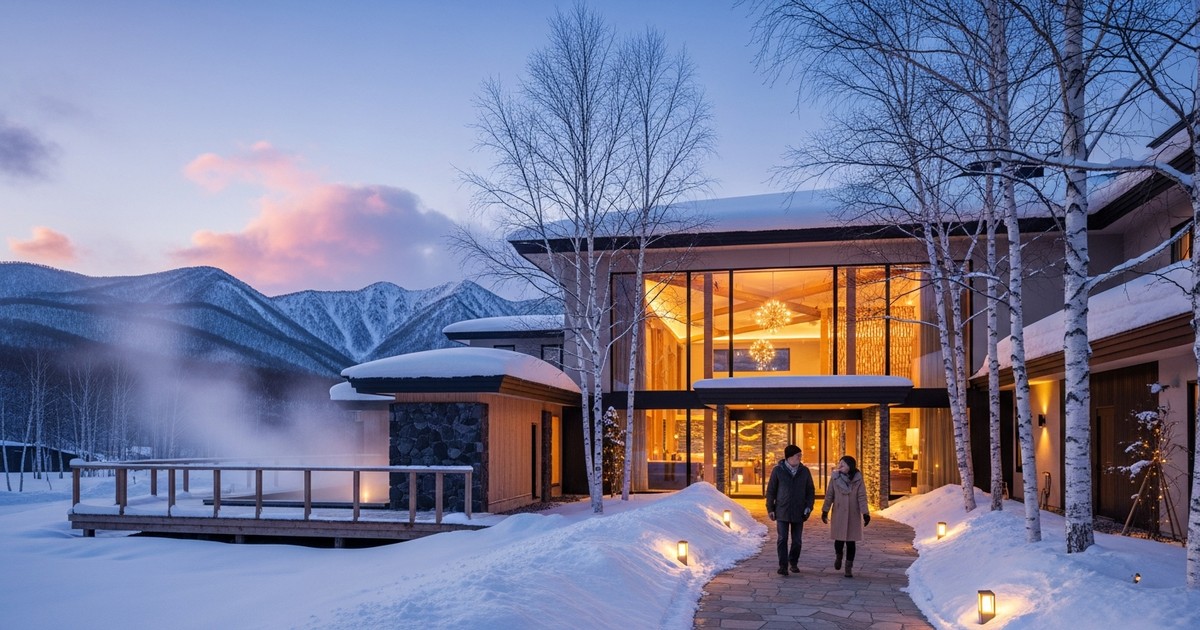
Niseko in particular has a proven track record, with luxury condominiums priced at ¥50,000 to ¥150,000 per night achieving near-full occupancy during the winter season—occupancy rates exceed 90% from December through March, with an annual average of 65–75%. In the Furano and Tomamu areas, high-end properties including those operated by Hoshino Resorts are also performing strongly, while hot spring resort areas such as Hakodate, Lake Toya, and Lake Akan are seeing accelerated development of luxury accommodations targeting affluent foreign travelers. This market environment presents an extremely attractive opportunity for investors considering entry into the sector.
Selection Criteria for Areas Where High-End Hotels Can Succeed
Balancing International Name Recognition with Accessibility
For a high-end hotel to succeed, it’s essential that the target market of affluent foreign travelers already recognizes the destination’s name. Niseko is known to skiers across the US, Europe, and Australia as “Japan’s Aspen,” and its accessibility—about two hours by car from New Chitose Airport—adds to its appeal. Hakodate similarly benefits from name recognition through its three-star rating in the Michelin Green Guide for its night views and morning market, and the Hokkaido Shinkansen has made it reachable from Tokyo in about four hours. Site selection should be evaluated as a multiplication of “name recognition × accessibility”—areas lacking either factor will struggle to support a high-end pricing strategy.
Analyzing Competing Supply and Price Ranges Within the Area
To assess the feasibility of a high-end hotel project, it’s necessary to understand the number of rooms and average rates of existing accommodations already operating in the target area. In the Niseko Hirafu area, for example, the supply of luxury condominiums has reached approximately 2,000 rooms, yet winter demand still far exceeds supply, keeping ADR (average daily rate) at ¥50,000–¥80,000. In summer, however, ADR drops to roughly ¥15,000–¥30,000, meaning that any financial plan assuming year-round operation must accurately account for seasonal fluctuations. Identifying areas with limited competition and high demand potential is the single biggest factor determining investment returns.
Richness of Natural Environment and Experiential Content
Affluent inbound travelers pay not just for a place to sleep, but for the experiential value they gain during their stay. Hokkaido is a treasure trove of experiential content—skiing, rafting, canoeing, horseback riding, farm tours, and winery visits, to name a few. Around Niseko, summer rafting and cycling tours have become popular and have contributed significantly to boosting summer visitor numbers. When selecting a development site, the variety and quality of experiential content available in the surrounding area is a key factor that drives up ADR and should always be thoroughly researched.
Structuring Development Costs and Revenue Simulations
Construction Cost Benchmarks and Hokkaido-Specific Cost Factors
Building a high-end hotel in Hokkaido involves several cost factors not typically seen on the main island of Honshu. Structural designs must account for snow loads, and for reinforced concrete construction, per-tsubo costs run 10–15% higher than in Honshu, at roughly ¥1.2–1.6 million. Add cold-climate specifications such as insulation, double-glazed windows, road heating systems, and hot spring piping, and development costs per room can reach ¥20–40 million without difficulty. For wooden luxury villa-style properties, investment scale can run ¥50–100 million per building, making a financing strategy tailored to the scope of the project essential.
Revenue Projections Based on RevPAR
RevPAR (revenue per available room) is a useful metric for evaluating the profitability of a high-end hotel. For example, assuming a 20-room boutique hotel with an ADR of ¥50,000 and an annual occupancy rate of 70%, RevPAR would be ¥35,000, yielding annual room revenue of approximately ¥255.5 million. After subtracting operating costs (30–40% of revenue), management fees, depreciation, and loan repayments, an operating margin of 20–30% is a realistic benchmark. Based on actual results in Niseko, well-managed luxury properties have achieved GOP (gross operating profit) margins of 35–45% in some cases, underscoring just how much operational skill can affect profitability.
Leveraging Depreciation and Tax Benefits
Accommodation buildings can be depreciated according to their statutory useful life—47 years for reinforced concrete and 22 years for wood construction. High-end hotels tend to have a higher proportion of investment in interior finishes and FF&E (furniture, fixtures, and equipment), and by separating these from the main building and depreciating them over a shorter period (5–8 years for fixtures and fittings), taxable income in the early years can be significantly reduced. For a 20-room hotel with ¥10 million in interior investment per room, the FF&E component alone can generate approximately ¥25 million in annual depreciation expense—substantially improving cash-flow-based effective yield.
Design and Operational Strategies That Appeal to Affluent Foreign Travelers
Room Size and Private Space
Affluent foreign travelers typically expect room sizes of at least 40㎡, with 60–100㎡ suite-class rooms considered ideal. In successful Niseko properties, one-bedroom condominiums (approximately 60㎡) typically command ¥70,000–¥120,000 per night in winter, while two-bedroom units (approximately 100㎡) go for ¥100,000–¥200,000. Features such as private balconies, in-room hot springs, and fireplaces serve as key differentiators and help boost review ratings on OTA (online travel agency) platforms. Room size and a sense of exclusivity are the most critical factors in directly driving up ADR.
Multilingual Support and Concierge Services
English-language support is the bare minimum; the ability to also serve guests in Chinese (Traditional and Simplified), Korean, and Thai has a direct impact on booking rates. In Niseko, properties that station native English-speaking concierges on-site—handling everything from ski lesson bookings and restaurant reservations to airport transfers and activity arrangements as a one-stop service—consistently earn high guest ratings. Concierge staffing costs run roughly ¥5–8 million per year, but this investment can boost repeat booking rates by 15–20%, and when combined with the additional new bookings generated through word-of-mouth, it represents a cost that typically pays for itself.
Finding the Optimal Balance Between OTAs and Direct Bookings
For high-end hotels, commission fees from OTAs such as Booking.com and Expedia (10–30%, depending on the provider and scope of services outsourced) can significantly erode profitability, making it important to increase the share of direct bookings through the property’s own website. Successful properties have raised their direct booking ratio to 40–50% through tactics such as leveraging Google Hotel Ads, promoting on social media platforms (Instagram, Xiaohongshu/RED), and introducing membership programs for repeat guests. Simply reducing OTA dependency from 60% to 40% can save a property generating ¥200 million in annual revenue roughly ¥20–30 million per year in commission fees.
Key Regulatory and Licensing Considerations
Obtaining Operating Permits Under the Hotel Business Act
Operating a hotel requires a permit under Japan’s Hotel Business Act, which must be applied for through the relevant public health center in Hokkaido. Hotel operations must meet requirements for room count and structural/facility standards (whether a front desk is mandatory depends on local municipal ordinances), and the application-to-approval process typically takes two to three months. In Niseko Town and Kutchan Town, the recent development boom has led to more cases requiring prior consultation with local authorities before proceeding, making close coordination with government offices from the planning stage essential to avoiding schedule delays.
Compliance with Zoning and Landscape Ordinances
Many municipalities in Hokkaido’s resort areas have their own ordinances aimed at preserving the natural landscape. Kutchan Town, for instance, imposes building height restrictions (ranging from 13 to 20 meters depending on the area) and exterior color standards, while Furano City requires notification under its landscape plan. In cases requiring conversion of agricultural land, obtaining approval from the local Agricultural Committee can take six months to over a year, so it’s critical to conduct thorough due diligence before acquiring land in order to eliminate the risk of a project stalling due to unforeseen regulations.
Common Traits of Successful High-End Hotels in Hokkaido
Successful high-end hotel developments in Hokkaido share several common traits. First, they strategically design attractions to draw guests not just in winter but also during summer and autumn. Several properties in Niseko sell golf, rafting, and trekking packages during the summer months, maintaining year-round occupancy above 65%. A model that depends solely on winter demand leaves annual RevPAR unstable, so a strong green-season strategy is critical to a property’s long-term sustainability.
Second, successful properties incorporate “experiences you can only have here” into their accommodation packages by partnering with local food producers and activity operators. Examples include farm-to-table dinner experiences developed in partnership with local farmers and programs offering Ainu cultural experiences—both of which serve as powerful differentiators for affluent foreign travelers. Accommodation packages that include such experiences can boost ADR by 30–50% compared to room-only plans. Third, an increasing number of properties are gaining favor with sustainability-minded Western travelers by emphasizing environmentally conscious design, such as geothermal energy use, solar power, and the use of locally sourced timber.
Contact Stay Buddy Inc. for High-End Hotel Development and Operations in Hokkaido
Developing a high-end hotel that capitalizes on Hokkaido’s inbound tourism market requires specialized expertise spanning site selection, design, licensing, and operational setup. In particular, operating a property targeting affluent foreign travelers demands know-how that goes beyond conventional hotel management—multilingual guest support, OTA strategy, and concierge service design are just a few examples.
Stay Buddy Inc. specializes in accommodation management outsourcing, offering comprehensive support to maximize the profitability of high-end properties. From financial simulations and operational design to multilingual guest support and marketing strategy, we provide consistent support from the earliest stages of development.
If you’re considering a hotel investment or development project in Hokkaido, or looking to improve the profitability of an existing property, please feel free to reach out to Stay Buddy Inc. Backed by extensive experience and data, we’ll propose the plan best suited to your business objectives.