The Value of Vacation Rental Management Services in Sapporo and the Current State of Occupancy Rates
For owners considering vacation rental management services in Sapporo, the biggest concern is likely whether they can maintain a stable occupancy rate. Sapporo attracts domestic and international tourists year-round, but occupancy rates for vacation rental properties vary dramatically depending on how they’re managed. While some self-managed properties struggle to reach 40-50% occupancy, many properties using professional management services maintain a stable 70% or higher.
Sapporo’s vacation rental market sees demand surge during major events like the Sapporo Snow Festival and the Lilac Festival, while both nightly rates and occupancy tend to drop during off-peak seasons. Controlling this gap between peak and off-peak periods is the key to breaking through the 70% annual occupancy barrier. This article walks through concrete strategies for achieving high occupancy in Sapporo through the use of professional management services.
Rather than simply saying “leave it to a management company and you’ll be fine,” we’ll share specific points owners should understand, along with concrete measures to work on in partnership with a management company—complete with actual figures. This content will be useful both for those just starting out in vacation rentals and for those already operating who feel their occupancy rate has plateaued.
Understanding Sapporo’s Vacation Rental Market: Demand Fluctuations and the Competitive Landscape
Annual Trends in Accommodation Demand in Sapporo
Sapporo’s total number of overnight stays remains at approximately 15 million per year, giving it overwhelming drawing power within Hokkaido. Looking at monthly trends, February (Snow Festival), July-August (summer retreat season and use as a base for trips to Furano), and December (year-end/New Year holidays and the start of ski season) are peak demand periods. Meanwhile, April-May and October-November tend to see a dip in tourist numbers, with nightly rates dropping accordingly.
If you don’t account for these seasonal fluctuations, you’ll end up with high occupancy only during peak season, capping your annual average at 50-60%. For example, during the Snow Festival period, rooms can book instantly at 15,000-25,000 yen per night, while the same property might sit vacant even at 8,000 yen in mid-April through early May. Addressing the off-peak season is essential if you’re aiming for 70% annual occupancy.
Increasing Competition and the Need for Differentiation
The number of registered private lodging businesses in Sapporo is on the rise, with competition especially fierce in the Susukino, Odori, and Sapporo Station areas. Searching “Sapporo” on Airbnb returns hundreds of listings, meaning price alone is no longer enough to stand out. Properties that maintain 70%+ occupancy tend to win against competitors through a combination of location, interior design, review scores, and pricing strategy.
Specifically, properties with review scores of 4.7 or higher tend to see occupancy rates 15-20 percentage points higher than properties in the same area and price bracket. In vacation rentals, operational quality—such as speed of guest response and the quality of amenities—directly translates into occupancy performance, which is precisely why management expertise makes such a significant difference.
Pricing Strategies to Maintain 70%+ Occupancy
Implementing Dynamic Pricing
One of the most immediately effective ways to maintain high occupancy is dynamic pricing—adjusting nightly rates according to demand. Tools like PriceLabs, Beyond Pricing, and Wheelhouse automatically analyze competitor pricing, booking trends, and local events to set optimal daily rates. Most management companies have these tools in place, enabling fine-grained price adjustments that would be impossible to manage manually.
For example, for a 1LDK property (sleeping 4) a 10-minute walk from Sapporo Station, it’s common to see rates fluctuate from 20,000-28,000 yen per night during the Snow Festival, down to 8,500-11,000 yen on regular weekdays, and 6,500-8,000 yen on off-peak weekdays. Setting a fixed rate of 12,000 yen would result in both lost revenue during peak season (missing out on rooms that could have sold for 20,000 yen) and vacancies during the off-season (12,000 yen appearing overpriced). It’s not uncommon for annual revenue to increase by 15-25% simply by implementing dynamic pricing.
Flexible Adjustment of Minimum Stay Requirements
Adjusting minimum stay requirements is an effective way to boost occupancy during the off-season. By setting a minimum stay of 2+ nights during peak season to secure higher per-booking revenue, while accepting 1-night stays during off-peak periods, you lower the barrier to booking. In fact, one property in Sapporo saw a 12-percentage-point improvement in monthly occupancy simply by changing the minimum stay requirement from 2 nights to 1 night during the off-season.
Applying discounts to last-minute bookings (within 3 days of check-in) is another effective tactic. It’s more profitable to fill a room at a 20-30% discount than to leave it vacant. Making this kind of timely judgment call requires constantly monitoring booking trends—one of the major benefits of outsourcing to a management company.
Optimizing Your Listing to Increase Click-Through and Booking Rates
Professional Photography and Strategic Photo Ordering
On Airbnb and Booking.com, whether a listing gets clicked from search results is largely determined by the very first photo. Data shows that properties using professional photography see click-through rates that are, on average, over 40% higher than those using smartphone photos. While professional photography typically costs 20,000-40,000 yen per session, this is a worthwhile investment given the resulting boost in annual occupancy.
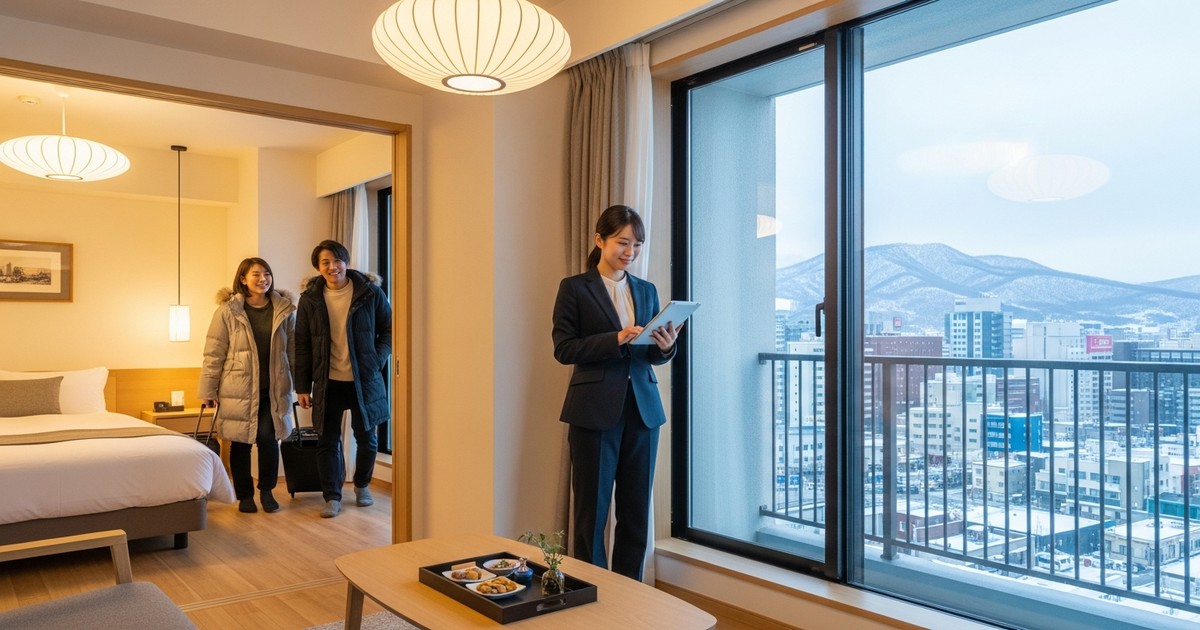
For listing photos, it’s effective to lead with an impactful shot of the living room or view, followed by the bedroom and bathroom in the second and third positions, then the kitchen, amenities, and surrounding area. For a Sapporo property, including photos of the snowy scenery or night view from the window, or images showing easy access to nearby ramen shops or soup curry restaurants, can concretely raise travelers’ expectations.
SEO and Conversion Optimization for Titles and Descriptions
To rank higher in in-platform searches, it’s important to include keywords guests are likely to search for in your title, such as “5-min walk to Sapporo Station,” “near Susukino,” or “sleeps up to 6.” Rather than a vague title like “Stylish Apartment,” pack in specific, search-friendly information such as “5 min to Sapporo Station · Near Odori Park · Sleeps 6 · Full Wi-Fi.”
In your description, including practical details—not just check-in instructions and amenity lists, but information like “Approx. 40 min from New Chitose Airport by JR,” “2 convenience stores within a 3-minute walk,” or “Free washer/dryer available”—can ease the concerns of guests who are comparing options. Management companies accumulate know-how from operating numerous properties about which wording actually drives conversions, which makes a significant difference in how well a listing is crafted.
Improving Guest Response Quality to Protect Your Review Score
Message Response Speed and Automation
Airbnb’s algorithm factors in a host’s response speed when ranking search results. Hosts who reply within an hour of receiving an inquiry are more likely to earn Superhost status and appear higher in search results. Management companies often have a 24-hour messaging support team, allowing them to respond instantly even to late-night or early-morning inquiries.
Templating and automating a sequence of communications—a welcome message after booking confirmation, a reminder the day before check-in, and a thank-you message after check-out—helps prevent missed responses while boosting guest satisfaction. Building this kind of system for self-management requires a significant time investment, making it one of the areas where outsourcing to a management company makes the most sense.
Standardizing Cleaning Quality and Inspection Procedures
Cleanliness is consistently one of the top categories that draws negative reviews. Even a single stray hair or a small water stain in the bathroom can lead to a low rating, which is why standardizing cleaning quality is essential to sustaining occupancy. Management companies typically use detailed checklists (roughly 50-80 items) to standardize the work performed by cleaning staff.
In Sapporo, winter heating use creates a risk of condensation and mold, so ventilation and dehumidification measures need to be built into the cleaning process. Snow removal at the entrance during winter also strongly affects guests’ first impressions. Whether a management company can handle these Sapporo-specific challenges is an important criterion when choosing a locally experienced partner.
Maximizing Booking Channels Through Multi-Platform Distribution
Expanding Exposure Through Multiple OTAs
Relying solely on Airbnb leaves you directly exposed to the effects of algorithm changes or fee revisions on that platform. Listing simultaneously across multiple OTAs (online travel agencies) such as Booking.com, Expedia, Agoda, Rakuten Travel, and Jalan diversifies your booking channels and expands your visibility. In particular, many travelers from Asia book properties in Sapporo through Booking.com or Agoda, so relying on domestic Japanese OTAs alone means missing out on this segment.
However, using multiple platforms simultaneously introduces the risk of double bookings. To prevent this, it’s essential to implement a channel manager (such as Beds24 or Neppan) that automatically syncs your calendar across platforms. Management companies typically handle the setup and management of these systems as well, significantly reducing the technical burden on owners.
Building Repeat Business Through a Direct Booking Site and Social Media
Since bookings via OTAs typically incur commissions of 10-15%, securing direct bookings from repeat guests through your own booking site or social media DMs results in higher profit margins. Regularly posting on Instagram about your property’s atmosphere and Sapporo travel information, with a direct booking link in your profile, is an effective approach.
In fact, one Sapporo vacation rental that posted 2-3 times a month for six months saw roughly 15% of all bookings come through as direct bookings. Since direct bookings incur no OTA commission, this translates to annual cost savings of 200,000-300,000 yen. Some management companies also offer social media management and marketing support, so it’s worth confirming the scope of services before signing a contract.
Concrete Strategies for Getting Through the Off-Season
Offering Mid-to-Long-Term Stay Plans
During off-peak periods like April-May and October-November, short-term tourist stays alone are often insufficient to sustain occupancy, making mid-to-long-term stay plans targeted at business travelers and workation users an effective strategy. Offering discounts such as 15% off for stays of 7+ nights or 30% off for stays of 30+ nights can help secure bookings lasting one to two weeks or longer.
In Sapporo, business travelers in the construction and IT industries sometimes stay for one to three months, and monthly plans priced at 120,000-180,000 yen see steady demand. From an occupancy standpoint, filling 30 consecutive days equals 100% occupancy for that period, so even if the nightly rate is lower, this can significantly boost your overall annual occupancy rate.
Leveraging Local Events and Tourism Resources
Even during the off-season, there are moments when localized accommodation demand spikes—trade shows at convention centers, concerts at Sapporo Dome (now used as a venue for various events), or university entrance exam season, for example. Simply tracking such event calendars and appropriately raising rates on those specific days can make a difference of tens of thousands of yen in monthly revenue.
Management companies continuously monitor local event information and factor it into pricing adjustments. Since they can catch niche demand spikes that individual owners might easily overlook, this can improve off-season occupancy by 5-10 percentage points.
For Vacation Rental Management in Sapporo, Talk to Stay Buddy Inc.
As we’ve outlined above, maintaining 70%+ occupancy for a vacation rental in Sapporo requires simultaneously pursuing a wide range of strategies—pricing, listing optimization, guest communication, multi-platform distribution, and off-season measures. Realistically, covering all of this on your own is difficult, and having a trustworthy management partner can make a dramatic difference in your results.
Stay Buddy Inc. is a vacation rental management company with extensive experience and know-how. We offer a one-stop solution covering everything needed to run a successful vacation rental—from property planning and listing creation, to rate optimization through dynamic pricing, 24-hour guest support, cleaning coordination, and unified management across multiple OTAs.
If you’re thinking about starting a vacation rental business in Sapporo but aren’t sure where to begin, or if you’re already operating one but feel your occupancy rate has stalled, we encourage you to reach out to Stay Buddy Inc. We’ll propose the optimal plan based on your property’s specific situation and local market characteristics.
Feel free to get in touch through Stay Buddy Inc.’s official website. Your first consultation is completely free.