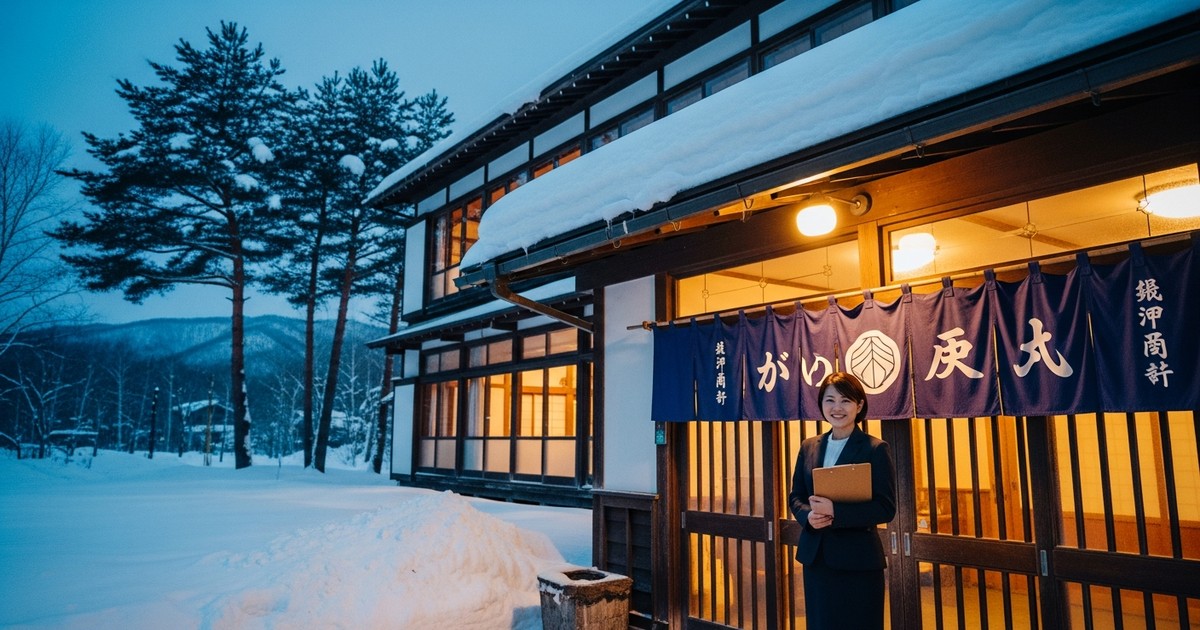
When you’re considering outsourcing the management of a licensed inn (ryokan-gyo) business in the Asahikawa area, it’s not uncommon to feel unsure about which company to trust with the job. As Hokkaido’s second-largest city, Asahikawa enjoys steady tourism demand from both domestic and international visitors, serving as a gateway to Asahiyama Zoo and the Daisetsuzan mountain range. However, handling everything from obtaining a ryokan business license to day-to-day operations on your own requires far more time and money than most people expect. This article offers a detailed guide for anyone considering outsourced management for a licensed accommodation business in Asahikawa—covering how to find a service provider, key points to consider when choosing one, typical costs, and the specific services on offer.
Operating a facility under Japan’s Inns and Hotels Act (ryokan-gyo hō) involves a wide range of responsibilities, including fire safety equipment maintenance, front-desk services, and hygiene management. For owners who live far from their property, or who run the business as a side venture alongside a full-time job, handling daily guest interactions and complaints personally simply isn’t practical. This is where outsourced management services come in.
Compared to Sapporo, the number of management companies operating in the Asahikawa area is more limited, which makes it especially important to understand your options clearly before comparing providers. Below, we’ve organized the key information you’ll need to make an informed decision—please read on to the end.
Why Outsourced Ryokan Management Is in Demand in Asahikawa
Tourism Demand and the Accommodation Market in the Asahikawa Area
Asahikawa City sees roughly 5 million visitors a year, with Asahiyama Zoo alone drawing approximately 1.3 to 1.5 million visitors annually. In winter, the city also serves as a transit hub for nearby ski resorts and Sounkyo Onsen, ensuring a steady volume of accommodation demand year-round. On top of this, Asahikawa functions as a gateway to the Furano and Biei areas, and occupancy rates tend to rise sharply during the summer lavender season.
Against this backdrop of strong tourism demand, an increasing number of owners in Asahikawa are obtaining licenses under the Inns and Hotels Act to operate whole-building rentals and small-scale accommodation facilities. However, coping with Hokkaido’s characteristically large gap between peak and off-peak seasons requires a flexible operational structure. Self-managed operations tend to lock in fixed labor costs, creating a risk of losses during slow periods—which is why demand is growing for outsourced management services with variable-cost pricing.
The Hurdles of Obtaining a Ryokan License and the Operational Burden
Obtaining a license under the Inns and Hotels Act requires several administrative procedures, including confirming the zoning classification, obtaining a fire code compliance certificate, and meeting structural equipment standards. In Asahikawa, applications are submitted to the Asahikawa City Public Health Center, but cases requiring a change of building use under the Building Standards Act can cost anywhere from 1 million to 3 million yen.
Even after obtaining a license, day-to-day operations continue to generate work—front-desk service (or ICT-based alternatives), room cleaning, linen exchange, reservation management, guest messaging, review management, and pricing adjustments. It’s not unusual for the operational workload of a single property to run into dozens of hours per month, making self-management without outsourced support unrealistic for owners with multiple properties.
Key Points to Check When Choosing a Management Company
Service Area Coverage and Local Staff Presence
The first thing to verify when choosing a management company is whether it has an actual operational base or partner staff in the Asahikawa area. Some management companies headquartered in Sapporo include Asahikawa in their service area, but if cleaning staff or trouble-response teams need nearly two hours to travel one way, this can seriously compromise the response speed that directly affects guest satisfaction.
Ideally, you want a company with cleaning teams or emergency response staff based in or near Asahikawa City. Before signing a contract, it’s worth asking how quickly staff can arrive on-site in an emergency—aim for a company that can guarantee arrival within 30 minutes as a benchmark.
Knowledge of the Inns and Hotels Act and Support for License Acquisition
Some management companies provide support starting from the license application stage, while others only take on operations after a license has already been obtained. For those entering the business for the first time, choosing a company that handles everything from licensing to operations can save you the separate cost of hiring an administrative scrivener (typically 150,000 to 300,000 yen).
Another key consideration is whether the company is well-versed in Asahikawa’s specific municipal ordinances and the public health center’s operational rules. For example, the conditions under which a tablet device can be used as a substitute for a staffed front desk vary by municipality. A company with a solid understanding of these local regulations can significantly reduce the risk of post-launch trouble.
Transparency of the Fee Structure
Management fee structures generally fall into two categories: revenue-share and fixed-fee. Under a revenue-share model, the fee typically ranges from 10% to 30% of revenue (depending on the company and scope of services), and this arrangement has the benefit of splitting off-season risk between the owner and the management company. A fixed-fee model, meanwhile, typically runs 50,000 to 150,000 yen per month—since fees stay the same even when revenue rises during peak season, owners of high-occupancy properties often end up with greater take-home earnings under this model.
One thing to watch out for is exactly what’s included in the base fee. Whether cleaning costs, linen costs, OTA fees (for platforms like Airbnb and Rakuten Travel), and consumable supply costs are all bundled in, or billed separately, can make a significant difference to your actual costs. When getting quotes, it’s helpful to ask each company to simulate how much you’d take home on, say, 500,000 yen in monthly revenue—this makes comparisons much easier.
Marketing Strength and OTA Management Expertise
An accommodation’s profitability is heavily influenced by its search ranking and review scores on OTA platforms. On Airbnb, for instance, properties with Superhost status tend to rank higher in search results, and data shows their average occupancy rate runs 10–15% higher than that of regular hosts. Be sure to check how much OTA management experience a prospective company has, and what the average review score is across the properties it manages.
Inbound demand is also not something to overlook in the Asahikawa area. Whether the company can handle guest communication in English, Chinese, and Korean, and whether it has experience creating listings in foreign languages, are both important points to check. Companies with strong multilingual capabilities tend to excel not only on domestic OTAs but also on international platforms like Booking.com and Agoda.
How to Find a Management Company in the Asahikawa Area
Start with Companies Based in Hokkaido
When looking for a management company to handle operations in Asahikawa, the most efficient approach is to first compile a list of companies based within Hokkaido. Many management companies headquartered in Sapporo serve a wide area across the prefecture, and some of them cover the Asahikawa area as well. Try searching keywords like “Hokkaido vacation rental management” or “Hokkaido ryokan business management” and check whether Asahikawa falls within their service area.
Specifically, you can check the locations of managed properties listed on each company’s website, or contact them directly through an inquiry form to ask whether they can handle a property in Asahikawa City. If a company’s portfolio already includes properties in Asahikawa or the wider northern Hokkaido region, that’s a strong sign they have an established local operational structure.
Consider Nationwide Management Companies as Well
Some nationally operating management companies serve a wide range of regions through local partner networks. The advantage of these larger companies is that they can leverage pricing know-how built on data from hundreds of properties across the country, along with strong marketing power derived from large-scale OTA management experience. That said, the quality of on-the-ground service ultimately depends on the capabilities of the local partner company, so it’s essential to verify the quality of the actual staff who would be handling your Asahikawa property.
With larger companies, an initial setup fee of 100,000 to 300,000 yen is common, but because they typically have well-developed manuals and systems in place, the lead time to launch tends to be shorter. Since they often handle everything from property photography to listing creation as a package, this can offer peace of mind to owners entering the accommodation business for the first time.
Referrals from Local Real Estate and Property Management Companies
Some real estate agencies and rental property management companies within Asahikawa City also handle—or partner with others to handle—ryokan business management. A key strength of local companies is their ability to provide one-stop support, from property sourcing to license acquisition and ongoing operations. Because they’re well-versed in local circumstances, they can also be expected to offer careful, detailed handling of matters like consideration for neighboring residents and coordination with local neighborhood associations.
That said, if managing accommodation businesses isn’t their core specialty, their OTA operation skills and revenue-maximization know-how may fall short of what a dedicated specialist company can offer. It’s important to find out whether accommodation management is handled as a side activity alongside their main property management business, or whether they have a dedicated team focused specifically on the hospitality side.
A Cost Simulation for Outsourced Management
Revenue-Share Model: A Sample Financial Breakdown
Let’s consider an example: operating a whole-building rental property in Asahikawa City (a 2LDK unit accommodating up to 6 guests). Assuming an average nightly rate of 12,000 yen and a monthly occupancy rate of 60% (18 nights booked), monthly revenue comes to approximately 216,000 yen. If the management fee is 20% of revenue, that’s about 43,200 yen; if cleaning costs 5,000 yen per turnover across 18 turnovers per month, that’s 90,000 yen; and if linen and amenity costs run about 15,000 yen per month, the owner is left with a take-home amount of roughly 67,800 yen. From there, rent, utilities, and loan repayments are subtracted to arrive at the final profit.
During peak season (July–August and December–February), if occupancy rises above 80%, monthly revenue can exceed 288,000 yen, substantially improving take-home earnings. Conversely, you should also plan for the possibility that occupancy could drop to around 40% during the off-season (April–May and October–November). Running a full-year revenue simulation before signing a contract is an essential step to avoid costly surprises.
Fixed-Fee Model: A Sample Financial Breakdown
Under a fixed-fee model with a monthly management fee of 80,000 yen, using the same conditions as above (216,000 yen in monthly revenue), the owner’s take-home amount ends up roughly comparable to the revenue-share model. However, if revenue reaches 350,000 yen during peak season, the management fee under the fixed model stays at 80,000 yen, meaning the owner’s take-home earnings increase substantially.
On the other hand, in months when revenue drops to just 120,000 yen during the off-season, the 80,000 yen management fee still applies, increasing the risk of a loss. In a region like Asahikawa with significant seasonal fluctuation, the revenue-share model tends to offer better risk mitigation—though for well-located properties that can expect high occupancy year-round, a fixed-fee arrangement may actually work out more favorably.
Important Points to Confirm Before Signing a Contract
Contract Term and Cancellation Terms
Many management companies set contract terms of six months to a year, and canceling early can trigger a penalty fee (typically equivalent to one to three months of management fees). To ensure you can switch providers smoothly if the service quality doesn’t meet your expectations, it’s essential to confirm the cancellation terms in writing before signing.
Ideally, look for a contract structure that includes an initial three-month trial period during which you can cancel without penalty. A company willing to offer this kind of flexible arrangement is also demonstrating confidence in the quality of its own service.
Payout Timing and Financial Reporting Systems
OTA revenue is typically deposited first into the management company’s bank account. From there, after deducting the management fee and cleaning costs, the remaining amount is transferred to the owner—but the frequency of these payouts (once or twice a month) and the number of business days after the billing cutoff date before funds are transferred vary from company to company. Since this directly affects your cash flow, be sure to confirm that these terms are clearly spelled out in the contract.
The frequency of revenue and occupancy reporting is equally important. Companies that provide a real-time dashboard for checking booking status, in addition to monthly reports, allow owners to make business decisions quickly. Be cautious of companies with opaque reporting practices, as this is often a source of disputes down the line.
Considering Outsourced Ryokan Management in Asahikawa? Talk to Stay Buddy Inc.
Stay Buddy Inc. is a specialist company handling outsourced management for licensed accommodation businesses, including ryokan operations. We provide one-stop support covering everything a hospitality business needs—from licensing consultation, to OTA listing and management, guest communication, cleaning arrangements, and revenue reporting.
Drawing on OTA management expertise built up across numerous managed properties, we pursue revenue maximization for our owners through improved average review scores and effective dynamic pricing strategies. We also offer multilingual guest support, giving us a strong edge in capturing inbound demand.
Whether you’re interested in launching a licensed accommodation business in the Asahikawa area, already hold a license and want to hand off operations, or are considering switching from your current management provider, please feel free to reach out to us at any stage. We offer a free revenue simulation tailored to your property’s location and scale.
To get started, please contact us through the inquiry form or by phone via the Stay Buddy Inc. official website. Our specialist staff will take the time to carefully understand your needs and propose the management plan best suited to you.