For anyone considering starting a lodging business (simple accommodation) in Otaru, this city’s potential is truly significant. Known for its canal and historic buildings, Otaru enjoys enduring popularity among both domestic and international tourists, and as inbound demand continues to recover, expectations for accommodation facilities are rising accordingly. This article explores the benefits of opening a lodging business in Otaru, the process of obtaining the necessary permits, revenue simulations, and the current state of inbound demand—backed by concrete figures and real-world examples.
Among Hokkaido’s cities, Otaru stands out for its excellent accessibility—just about 30 minutes from Sapporo by rapid train—while offering its own distinctive tourism resources. With attractions like the Otaru Canal, Sakaimachi Shopping Street, and the night view from Mount Tengu, the city draws approximately 8 million visitors annually. Whether this drawing power can be successfully converted into a lodging business is likely the biggest question for anyone considering opening a facility here.
Below, we’ll walk through Otaru’s advantages as a location, the specific steps for obtaining a lodging business permit, expected initial costs and revenue, and key operational points for success.
Otaru’s Advantages as a Location for Starting a Lodging Business
Tourism Drawing Power: Approximately 8 Million Visitors Annually
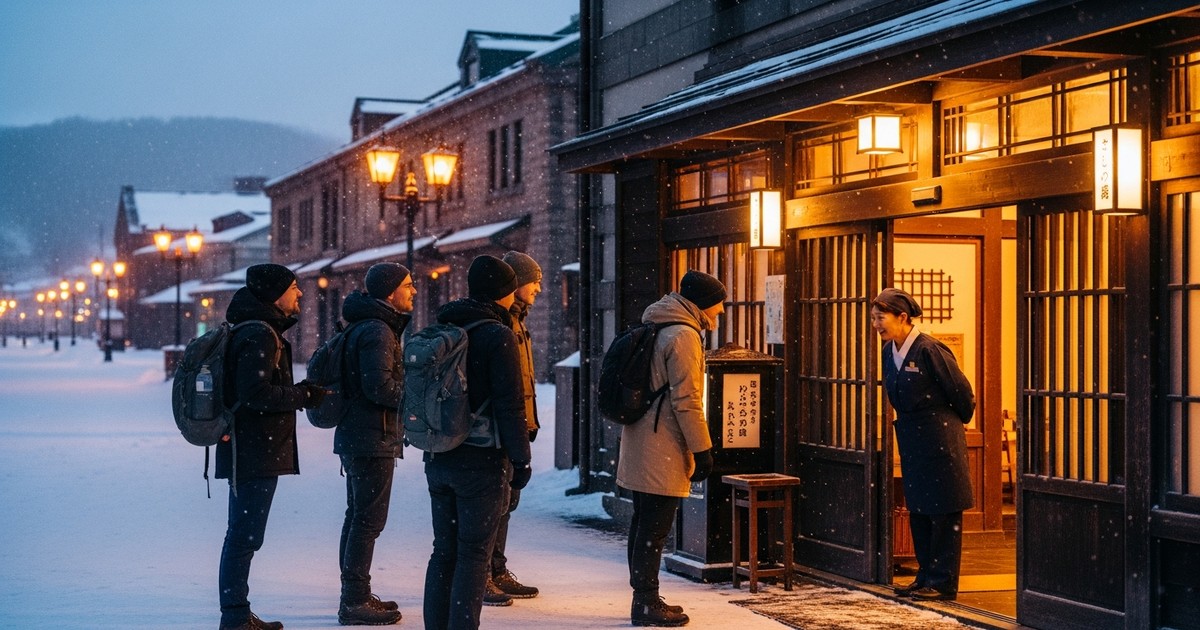
Before the pandemic, Otaru’s annual number of tourist visits reached approximately 8 million. Travelers from both Japan and abroad flock to the city’s main attraction, the Otaru Canal area, throughout the year, with lodging demand surging particularly during events like the summer “Otaru Shiomatsuri Festival” and the winter “Otaru Snow Light Path.” During these peak periods, it’s not unusual for accommodation facilities across the city to sell out completely, with room rates climbing to 1.5 to 2 times their normal levels.
Otaru is also known as a cruise ship port of call, with dozens of large cruise ships docking at Otaru Port each year. While most cruise passengers stay aboard their ships, demand for pre- and post-cruise accommodation does exist, making this a stable customer acquisition channel for operators running simple accommodation facilities near the port.
30 Minutes from Sapporo and a Hub for Wide-Area Tourism
Using the JR Hakodate Main Line’s Rapid Airport service, Otaru is about 70 minutes from New Chitose Airport and roughly 30 minutes from Sapporo Station. Thanks to this high level of transport convenience, while many visitors take day trips from Sapporo, there is also solid demand for overnight stays from travelers who want to “spend a relaxed night in Otaru.” International visitors in particular tend to stay longer, and an increasing number are choosing itineraries that include one or two nights in Otaru to enjoy the canal-side night views and dining along Sushi-ya Dori.
Otaru also functions as a gateway to the Niseko and Shakotan areas. Inbound travelers skiing in Niseko during winter often stay in Otaru before or after their trip, and visitors heading to see the spectacular scenery of the Shakotan Peninsula in summer often use Otaru as their base—both forms of demand that help boost occupancy rates as part of the broader regional tourism flow.
Current Inbound Demand and the Otaru Lodging Market
Trends Among Foreign Visitors to Hokkaido
Hokkaido is highly popular among inbound visitors, particularly those from other parts of Asia, and before the pandemic, its visitation rate among foreign tourists to Japan ranked among the highest nationwide. Travelers from Taiwan, South Korea, China, Hong Kong, and Thailand are especially numerous, drawn by uniquely Hokkaido experiences such as snowy landscapes, fresh seafood, and hot springs. According to statistics from the Hokkaido District Transport Bureau, the total number of foreign visitor room-nights in Hokkaido reached approximately 9 million at its peak, and mid- to long-term recovery and growth are expected going forward.
In Otaru as well, the number of foreign tourists has been steadily increasing year by year. Multilingual signage has been put in place, and many souvenir shops and glass workshops along Sakaimachi Street now have foreign-language-speaking staff on hand—reception infrastructure is steadily improving. This kind of environment works in favor of anyone opening a simple accommodation business.
Accommodation Supply and Competitive Landscape in Otaru
Compared to Sapporo, the number of hotel and ryokan rooms in Otaru is relatively limited. While there are several large hotels, business hotel chains have not expanded here as aggressively as in Sapporo, and accommodation shortages tend to occur during peak seasons. This supply-demand gap represents a significant opportunity for operators entering the market with simple accommodation facilities.
In particular, lodging facilities created by renovating Otaru’s historic stone warehouses and wooden houses tend to receive high ratings on OTAs (online travel agencies). On Airbnb, whole-house rental properties that emphasize “authentic Otaru character” often achieve average ratings of 4.5 or higher. Per-night room rates typically range from ¥15,000 to ¥25,000 during peak season and ¥8,000 to ¥12,000 even in the off-season—a market where sound management can secure solid profitability.
The Specific Process for Obtaining a Lodging Business (Simple Accommodation) Permit
Checking Zoning Districts and Building Standards
To obtain a lodging business permit, you must first confirm the zoning district in which your property is located. Under the City Planning Act, lodging businesses are generally not permitted in exclusively residential zones. If you plan to open a simple accommodation facility in Otaru, eligible zones typically include commercial districts, neighborhood commercial districts, quasi-residential districts, and Category 1 or Category 2 residential districts. Since areas around the Otaru Canal and Sakaimachi Street are largely designated as commercial districts, opening a business in these tourist-heavy locations tends to be relatively straightforward from a zoning perspective.
Under the Building Standards Act, simple accommodation facilities fall under the category of “special-use buildings,” meaning that converting an existing residential property may require a formal use-change procedure. If the floor area is 200 square meters or less, a building confirmation application is not required; however, fire safety equipment requirements under the Fire Service Act—such as automatic fire alarm systems, evacuation guide lights, and fire extinguishers—must be met regardless of the facility’s size.
Applying to the Public Health Center and Required Documents
In Otaru, applications for lodging business permits are handled by the Otaru Public Health Center (Public Health Division). Applicants must demonstrate that the facility’s structure and equipment meet the standards set out in the Hotel Business Act and applicable Hokkaido prefectural ordinances. For simple accommodation facilities, key requirements include a total guest room floor area of at least 33 square meters, adequate ventilation, natural lighting, and lighting equipment, as well as washroom and toilet facilities appropriately sized for expected guest numbers.
Required documents typically include a lodging business license application, floor plans and site layout diagrams, documentation confirming compliance with the Building Standards Act, a fire code compliance certificate, and water quality test results (if using well water). The application fee for a simple accommodation permit is approximately ¥16,500. If all documents are in order, the process from application to permit approval generally takes about 2 to 4 weeks; however, if renovation work is involved, it’s realistic to allow 2 to 3 months overall.
Working with the Fire Department and Neighboring Residents
To obtain a fire code compliance certificate, an on-site inspection by the local fire department is required. Installation work for automatic fire alarm systems and evacuation guide lights is typically contracted out to businesses holding fire equipment technician qualifications, with costs generally ranging from ¥300,000 to ¥800,000 depending on the size of the property.
In Otaru, applicants for lodging business permits may also be asked to provide advance explanations to neighboring residents. This is especially important when opening a facility near residential neighborhoods—clearly establishing rules around noise and garbage disposal, and explaining your management system, can go a long way toward preventing disputes before they arise. Practical measures include posting guest guidelines in multiple languages and preparing a response manual for handling late-night noise issues.
Initial Costs and Revenue Simulation for Opening Your Business
Estimated Initial Costs from Property Acquisition to Opening
Initial costs for opening a simple accommodation facility in Otaru vary considerably depending on the property’s condition and size, but assuming a typical whole-house rental (with a total floor area of roughly 50 to 80 square meters), the following cost breakdown applies: property acquisition costs of ¥5 million to ¥15 million (for an older secondhand house), renovation costs of ¥3 million to ¥8 million, fire safety equipment installation costs of ¥300,000 to ¥800,000, furniture, appliances, and supplies costing ¥500,000 to ¥1.5 million, and permit application-related costs of ¥200,000 to ¥500,000. In total, an investment of roughly ¥9 million to ¥25.8 million is typically required.
One major advantage of Otaru is that real estate prices are significantly lower than in Sapporo. Depending on location and condition, there is a wide selection of secondhand houses available in Otaru for ¥3 million to over ¥10 million. Even in prime locations near the canal, properties can sometimes be purchased for the low ¥10 millions—allowing operators to keep initial investment relatively low while still benefiting from Otaru’s strong drawing power for tourists, which is one of the city’s unique strengths.
Annual Revenue and Yield Simulation
Assuming a whole-house rental simple accommodation facility with an average per-night rate of ¥12,000 and an annual occupancy rate of 65%, annual revenue would come to approximately ¥2.84 million (¥12,000 × 365 days × 0.65). If occupancy can be raised to 75%, revenue would reach approximately ¥3.28 million, and factoring in higher rates during peak season, annual revenue exceeding ¥3.5 million is well within reach.
Subtracting annual operating expenses—OTA commissions (roughly 15% of revenue), utility costs (¥20,000 to ¥30,000 per month), cleaning fees (¥5,000 to ¥8,000 per turnover), consumables, property taxes, and fire insurance premiums—leaves an estimated net annual profit of ¥1 million to ¥1.8 million. For a facility opened with an initial investment of ¥10 million, this translates to a gross yield of approximately 28%, with a net yield of roughly 10% to 18%. Naturally, yields will be lower if property acquisition costs are higher, but given Otaru’s real estate price levels, these are highly favorable investment conditions compared to other tourist destinations.
Key Operational Points for Success in Running a Simple Accommodation Facility in Otaru
Designing a Facility That Captures the Spirit of Otaru
To earn strong ratings on OTAs and secure a steady stream of bookings, it’s effective to create a space that reflects Otaru’s local character. Elements that make guests feel they’re having an experience “only available here”—such as interior lighting fixtures made from Otaru glass, renovations that showcase the exteriors of stone warehouses, or interiors using Hokkaido-sourced timber—can serve as powerful differentiators. In fact, accommodations that reflect local history and culture tend to receive higher review scores on Airbnb, and many properties awarded Superhost status incorporate exactly these kinds of touches.
Investing in high-quality bedding and amenities is also worthwhile. Simply upgrading to down comforters and premium towels can significantly boost guest satisfaction. If an additional investment of ¥100,000 to ¥200,000 leads to better reviews and repeat bookings, the return on that investment is extremely high.
Introducing Multilingual Support and Self Check-In
To successfully attract inbound guests, it’s essential to provide facility guides and house rules in English, Chinese (both traditional and simplified), and Korean. Translation tools can help keep costs down, but for critical information such as stay rules and emergency contact details, it’s safer to work with a professional translator. Translation costs typically run ¥20,000 to ¥50,000 per language.
Introducing a self check-in system is also an effective way to reduce labor costs while improving guest convenience. Combining a smart lock with a check-in app allows guests to check in without worrying about arrival times, while significantly reducing the front-desk workload for operators. Smart lock installation typically costs ¥20,000 to ¥50,000 per unit, with monthly system usage fees running just a few thousand yen—making this an ideal setup for sole proprietors or small operating teams.
Addressing Seasonal Fluctuations and Maintaining Year-Round Occupancy
Tourism demand in Otaru tends to concentrate in summer and winter, so maintaining occupancy during the quieter spring and autumn months is key to stable revenue. Effective countermeasures for the off-season include early-bird discount plans offering 10% to 20% off standard rates, multi-night stay discounts, and participation in OTA promotional campaigns.
Capturing workation demand is another promising option. By setting up reliable Wi-Fi and desk space, and offering long-stay plans (priced at roughly ¥5,000 to ¥7,000 per night for stays of one week or longer), operators can reach guest segments beyond traditional tourists. With its excellent balance of natural surroundings and urban convenience, Otaru has real potential as a remote-work destination.
For Consultations on Starting or Operating a Lodging Business in Otaru, Contact Stay Buddy Inc.
For anyone considering opening a simple accommodation facility in Otaru, handling everything on your own—from permit applications and property selection to renovation planning, OTA listings, and day-to-day guest support—can be a heavy burden. This is especially true for those living far from Otaru or juggling a full-time job elsewhere; having a reliable local partner to handle on-the-ground operations can make a major difference in your business’s success.
Stay Buddy Inc., a vacation rental management company, provides one-stop support for everything your lodging business needs—from helping you obtain your lodging business permit to full facility management. Our specialized staff support every aspect of operations, including profitability analysis for your property, scheduling management leading up to opening, multilingual guest support, cleaning coordination, and review management.
Whether you’re thinking, “I want to start a lodging business in Otaru but don’t know where to begin,” or “I already own a property but want advice on how to make it profitable,” please feel free to reach out to us at any stage. Our experienced staff will propose the optimal plan tailored to your specific situation.
Why not take the first step toward a lodging business that captures the true charm of Otaru, together with Stay Buddy Inc.? Please don’t hesitate to get in touch via our website.