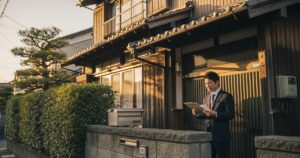
To operate a ryokan (traditional Japanese inn) business in Hokkaido, you must satisfy the hygiene standards set out under the Ryokan Business Act and obtain approval from your local health center. While Hokkaido enjoys high tourist demand, it also faces unique challenges such as harsh winter cold and heavy snowfall, which make hygiene management far from straightforward. Hygiene standards for ryokan businesses in Hokkaido are fundamentally based on the nationwide Ryokan Business Act, but in many cases additional requirements are layered on through Hokkaido’s own ordinances and health center operational guidelines.
This article provides a comprehensive overview of the hygiene standards you need to understand to obtain and maintain a ryokan business license in Hokkaido, along with the specific checkpoints health centers actually verify. Whether you’re planning to open a new business or are already operating and want to prepare for your next on-site inspection, this guide will be valuable.
Basic Knowledge for Understanding Ryokan Hygiene Standards in Hokkaido
The Relationship Between the Ryokan Business Act and Hokkaido Ordinances
Ryokan business licenses are issued by prefectural governors (or mayors in the case of designated cities and core cities) under the Ryokan Business Act (Act No. 138 of 1948). In Hokkaido, Sapporo, Asahikawa, and Hakodate qualify as core cities or above, each operating its own health center. Other areas fall under the jurisdiction of health centers established by Hokkaido’s regional promotion bureaus. While basic structural requirements and hygiene standards are defined under the Order and Regulations for Enforcement of the Ryokan Business Act, Hokkaido has established its own “Ryokan Business Act Enforcement Ordinance” that adds supplementary standards regarding guest room size and ventilation equipment, among other matters.
For example, while the Order for Enforcement of the Ryokan Business Act stipulates that guest room floor area for ryokan/hotel operations must be at least 7 square meters per room (or 9 square meters or more for Western-style rooms), Hokkaido’s ordinance adds cold-climate-specific requirements, such as a clear obligation to install heating equipment. Before applying for a license, it’s essential to check the latest ordinance details with your local health center.
Differences in Hygiene Standards by Business Category
The Ryokan Business Act broadly classifies business formats into two categories: “ryokan/hotel operations” and “simple lodging operations” (or three, if boarding house operations are included). While ryokan/hotel operations no longer have a minimum number of guest rooms, they are subject to relatively strict standards regarding front desk facilities and bathing facilities. Simple lodging operations, on the other hand, have relaxed standards—such as a minimum total floor area of 33 square meters (or 3.3 square meters per guest if accommodating fewer than 10 guests)—but place greater emphasis on hygiene management in shared spaces.
In recent years, Hokkaido has seen an increasing number of cases where old private homes and pensions are converted into simple lodging facilities. Since the required equipment investment differs significantly depending on which business category you choose, it’s important to consult with your local health center in advance to determine the best category for your facility. Generally speaking, renovation costs to obtain a simple lodging license range from around ¥1 million to ¥3 million, while ryokan/hotel operations often exceed ¥5 million.
Key Hygiene Standard Checkpoints Verified by Health Centers
Guest Room Structure and Ventilation Equipment
During on-site health center inspections, the first thing checked is whether the guest room structure meets the required standards. Specifically, inspectors check the guest room’s floor area, ceiling height (generally 2.1 meters or higher), and whether adequate lighting and ventilation are provided. Since windows can’t be left open for long periods during Hokkaido’s winters, the presence and performance of mechanical ventilation systems receive particular scrutiny. A general benchmark is achieving at least two air changes per hour in guest rooms.
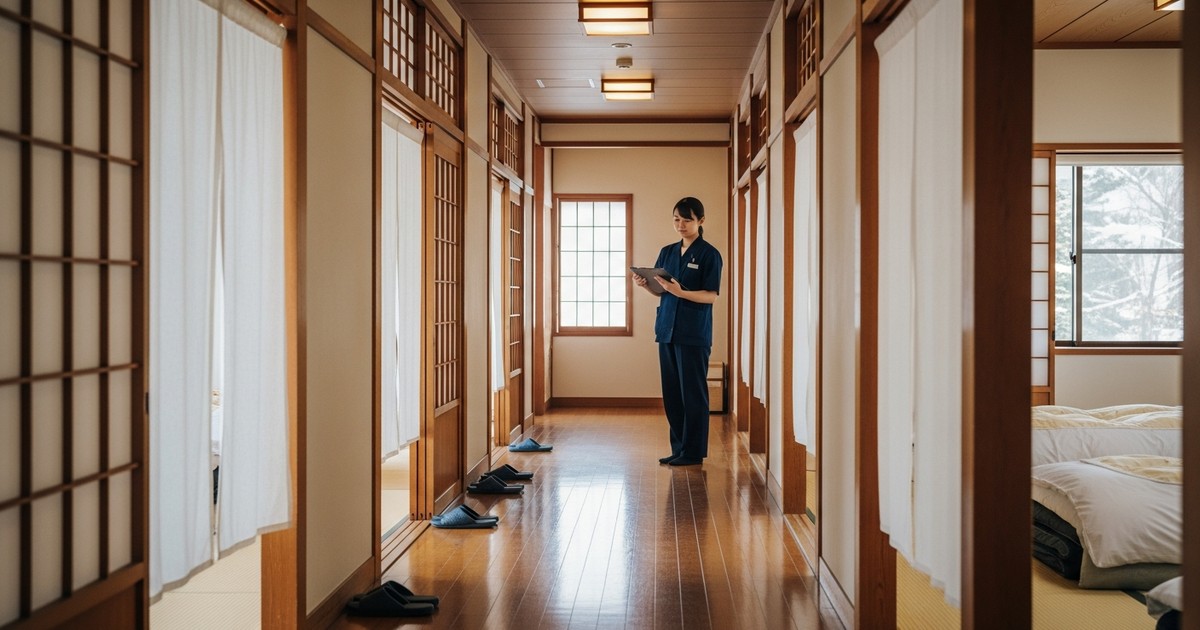
Partitions between guest rooms are also checked—specifically whether dividing walls reach the ceiling and whether adequate soundproofing is provided. Even for dormitory-style simple lodging facilities, structures that balance privacy with hygienic conditions are required, rather than relying solely on curtains or partitions. Peeling wallpaper and mold growth are also flagged as issues, making regular maintenance essential.
Bedding Management and Laundering Frequency
The Regulations for Enforcement of the Ryokan Business Act require that sheets and pillowcases be replaced for each new guest. Health centers may check laundering records for linens and contracts with linen supply companies. Some Hokkaido health centers also verify whether futons are sun-dried or machine-dried at least once a month, and maintaining a record log for this is recommended.
Specifically, mattress pads and comforters should be professionally cleaned or fully laundered at least once every six months, and pillows should ideally be washed or replaced at least once a year. Inadequate management in this area can lead to mite and allergen problems, resulting in guest complaints and lower online review ratings. Linen management is one of the most cost-effective investments you can make, both for hygiene compliance and customer satisfaction.
Water Quality Management and Drinking Water Standards
Facilities connected to municipal water supply typically face no issues, but many ryokans in Hokkaido’s outlying areas rely on well water or simplified water supply systems. In such cases, water quality testing under the Water Supply Act must be conducted at least once a year, with results reported to the health center. Testing typically covers around 11 basic items, including general bacteria, E. coli, pH level, and residual chlorine concentration, costing approximately ¥15,000–¥30,000 per test.
If a facility uses a storage tank with an effective capacity exceeding 10 cubic meters, annual cleaning and water quality testing are legally required. Even for smaller tanks of 10 cubic meters or less, similar management may be required under Hokkaido’s ordinance. Since winter brings the risk of water quality deterioration due to frozen pipes, it’s practically important to implement freeze-prevention measures and routinely check residual chlorine levels after any pipe thaw.
Hygiene Management for Bathrooms and Bathing Facilities
With its abundance of hot spring resorts, Hokkaido places particular emphasis on bathroom hygiene management during health center inspections. Legionella prevention is the primary focus—facilities using circulating bath systems are required to conduct Legionella testing at least once a year, at a cost of approximately ¥5,000–¥10,000 per sample. If Legionella is detected, operations must be suspended immediately, and pipes must be cleaned and disinfected before a re-test can be passed.
Specific management standards include maintaining free residual chlorine concentration in bathwater at 0.4 mg/L or higher, completely draining and refilling bathwater at least once a week, and backwashing filters at least once a week. Even for flow-through (kake-nagashi) style baths, the tub must be cleaned daily, with cleaning records kept on file. Since mineral scale buildup from hot spring components can become a breeding ground for bacteria, regular acid cleaning should also be performed.
Toilet and Washroom Facility and Cleaning Standards
Toilets must be provided in sufficient numbers relative to guest capacity—as a general guideline, at least one toilet fixture per approximately 5 guests. Flush toilets are the standard requirement, and handwashing stations must be equipped with liquid soap and disinfectant (or paper towels). Hokkaido health centers also check cleaning frequency, sometimes requiring records showing cleaning and disinfection at least once a day.
For shared washrooms, inspectors check whether the number of faucets is adequate for guest capacity. Slimy buildup or foul odors from drains are flagged as hygiene deficiencies, so cleaning drain traps at least once a week is recommended. Since condensation-related mold growth is more likely to occur during winter, exhaust fan operation and anti-mold measures on walls may also be subject to inspection.
Pest and Rodent Control Measures
The Ryokan Business Act requires operators to implement measures to control rodents and insects. In Hokkaido, there’s a risk of flies and cockroaches appearing during summer, and in some areas, large numbers of stink bugs invade in early autumn. Health centers may check the installation status of insect screens, pesticide usage records, and the implementation status of regular pest control services by professional contractors.
Generally, professional pest control treatment at least twice a year is recommended, with costs per treatment ranging from approximately ¥30,000 to ¥100,000, depending on facility size. Basic self-managed measures include sealed garbage storage, prompt disposal of food waste, and sealing gaps in exterior walls. Since pest control records may be requested during health center inspections, it’s advisable to maintain a log documenting dates, actions taken, and chemicals used.
The Process from License Acquisition to Business Launch, and Key Precautions
Prior Consultation and Application Procedures
To obtain a ryokan business license in Hokkaido, you must first consult with your local health center before applying. During this preliminary consultation, you’ll bring facility drawings to confirm whether your plans are likely to meet structural and hygiene standards. If major issues are identified at this stage, they can be addressed through design changes—which is why consulting before construction begins is essential. Application fees are typically ¥22,000 for ryokan/hotel operations and ¥11,000 for simple lodging operations (amounts may vary by municipality).
Application documents typically include an overview of the facility’s structural equipment, layout and floor plans, a map of the surrounding area, and a fire code compliance certificate. The fire code compliance certificate is obtained from the fire department and confirms items such as fire alarms, fire extinguishers, and evacuation routes. The process from document preparation to license approval typically takes one to two months, so it’s important to build sufficient buffer time into your opening schedule.
Common Points of Non-Compliance During On-Site Inspections
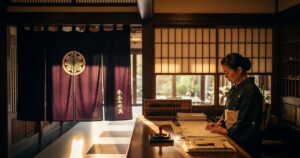
Knowing in advance which items commonly fail on-site inspections after application can help you avoid costly rework. Common non-compliance issues include insufficient ventilation capacity (particularly in guest rooms and bathrooms), inadequate guest room floor area (effective space falls below standard once furniture is placed), and deficiencies in front desk facilities (structure doesn’t allow face-to-face identity verification).
Hokkaido-specific issues also arise, such as insufficient heating capacity or inadequate freeze-prevention measures. In areas where outdoor temperatures can drop below -20°C, installing freeze-prevention heaters on water pipes is effectively mandatory; if these are missing, operators may receive improvement guidance citing concerns about stable water supply during winter. If an inspection reveals non-compliance, a re-inspection is required after improvements are made, which can delay the opening date.
Ongoing Hygiene Management Required After Business Launch
Regular Self-Inspections and Record Keeping
Once a ryokan business license is obtained, it renews automatically, but compliance with hygiene standards must be maintained throughout the entire operating period. Health centers may conduct unscheduled on-site inspections, during which you may be asked to present your daily hygiene management records. These typically include cleaning logs, bedding replacement records, water quality test results, bathwater chlorine concentration measurement logs, and pest control records.
Creating a self-inspection checklist that organizes items by daily, weekly, monthly, and annual frequency can help ensure nothing is missed. For example, daily items might include guest room cleaning, sheet changes, bathtub cleaning, toilet cleaning, and residual chlorine measurement; weekly items might include filter backwashing and drain cleaning; monthly items might include futon drying and storage tank inspection; and annual items might include water quality testing, Legionella testing, and pest control.
Guest Registry Management and Infectious Disease Countermeasures
The Ryokan Business Act requires that guest registries record each guest’s name, address, occupation, and date of stay, and be retained for three years. For foreign guests, nationality and passport number must also be recorded. Since this registry is used for epidemiological investigations in the event of an infectious disease outbreak, health centers place particular emphasis on checking the accuracy and preservation of these records.
Infectious disease countermeasures include providing hand sanitizer in guest rooms and common areas, keeping vomit cleanup kits on hand, and managing employee health (encouraging handwashing and gargling, restricting work when unwell). If an infectious disease such as norovirus occurs on the premises, operators are obligated to report it to the health center immediately and carry out disinfection procedures according to instructions received. Preparing a response manual in advance and training staff regularly are key to preventing outbreaks from spreading.
For Minpaku Management Consultations, Contact Stay Buddy Inc.
If you’re struggling with obtaining a ryokan business license or meeting hygiene standards in Hokkaido, please consult Stay Buddy Inc., a minpaku (private lodging) management company. Our experienced staff provide comprehensive support—from preliminary consultations with health centers and preparation of application documents to building your facility’s hygiene management system.
Stay Buddy Inc. offers one-stop management services covering everything you need after obtaining your license, including day-to-day cleaning management, linen arrangements, and guest registry management. We can also help set up regular inspections and checklists to help you continuously meet hygiene standards.
We’re also happy to help before you even open, starting from the property selection and financial simulation stages. If you’re feeling uncertain—whether it’s “I’m not sure if I can get approved” or “I don’t know how to set up a hygiene management system”—please feel free to reach out to Stay Buddy Inc. for a consultation.