Leave Your Minpaku Management to the Experts
Free Online Consultation[Warning] That Property Will Never Become a Hotel: The Absolute Wall of the “2-Meter Road Access Requirement” Blocking Your Ryokan Business License
“There’s a charming old house near the station, full of character, selling well below market price. Let’s renovate it into a hotel for inbound tourists!”
If you’re currently drawing up plans like this and about to submit a letter of intent to purchase a property, stop right now. There’s an extremely high chance that property can never become a hotel.
Let me give you the conclusion of this article upfront.
No matter how great the location or how excellent the building’s condition, a property that fails to satisfy the “road access obligation” set out in the Building Standards Act (frontage of at least 2 meters on a road at least 4 meters wide) cannot, as a general rule, obtain a license under the Hotel Business Act (for hotels, ryokan, or simple lodgings). In real estate investment or new business ventures, signing a contract on a property without investigating this “legal wall” beforehand is a fatal mistake that can leave tens of millions of yen in investment capital completely frozen and unusable.
This article provides a thorough explanation of the terrifying reality of the “road access obligation” that can shatter your dream of opening a hotel at its very foundation, why it becomes an absolute wall blocking hotel business licenses, and the “legal remedies” that remain available if you’re considering such a property.
What Exactly Is the “Road Access Obligation”? An Absolute Rule to Protect Human Life
When searching for real estate, you may come across terms like “cannot be rebuilt” or “inadequate road access.” These all relate to the “road access obligation” set out in Article 43 of the Building Standards Act.
The Building Standards Act establishes a fundamental principle: **”A building’s site must have frontage of at least 2 meters on a road with a width of at least 4 meters.”**
Why does this rule exist? It’s so that, in the event of a fire, earthquake, or other disaster, fire trucks and ambulances can smoothly reach right in front of the property, and occupants inside the building can safely and quickly evacuate to the road. In other words, the road access obligation is an “absolute minimum standard for protecting human life.”
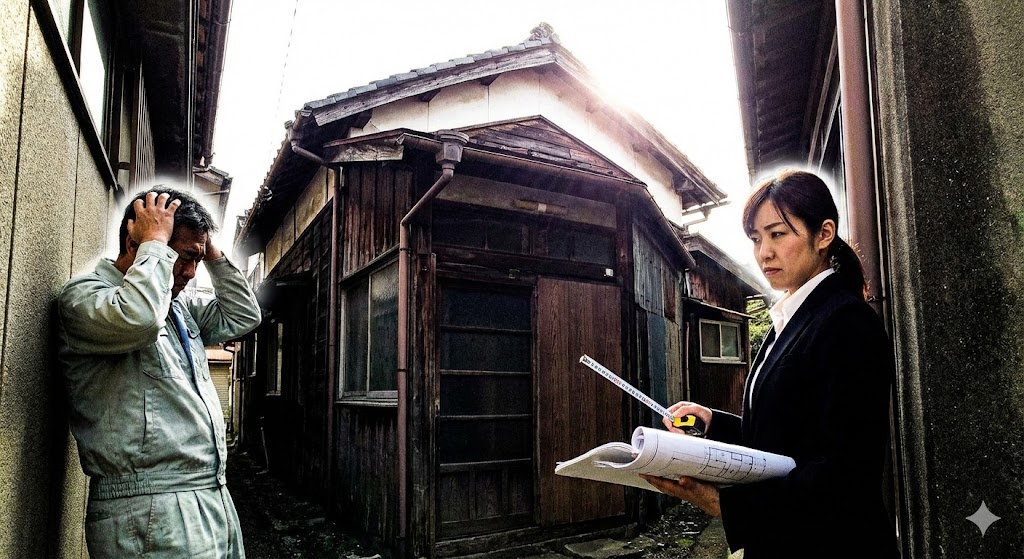
Houses located deep down a narrow alley (flag-shaped lots) or houses that can only reach a public road by crossing someone else’s land do not meet this condition of “at least 2 meters of frontage on a road.” Once the building on such a property is demolished, a new house can never be built again, since doing so would violate current rules. This is why such properties are called “properties that cannot be rebuilt.”
Why “Violating the Road Access Obligation” Means a Property Can’t Become a Hotel (Ryokan Business)
“Okay, I understand you can’t build a new house. But what if I just renovate the existing old building as-is and turn it into a hotel? Wouldn’t that be fine?”
A great many people think this way, but this is precisely where amateurs fall into the biggest trap of all.
Current Regulations Bare Their Teeth During “Change of Use”
When operating an ordinary detached house or apartment as a hotel or simple lodging under the Hotel Business Act, you must go through a procedure called **”change of use,”** which legally converts the building’s designated purpose from “residence” to “hotel/ryokan.”
When you submit an application for confirmation of this change of use to the local government office, the building is required to comply with “the current, strict Building Standards Act.” Even if a house was built legally (or was tacitly permitted) in the past, at the moment you apply for a change of use, it will be strictly checked against the current “road access obligation.” If it’s discovered at this stage that the frontage is less than 2 meters, the property will be branded “non-compliant with current law,” and the change of use will absolutely not be approved.
Even Stricter Regulations for “Special-Use Buildings”
Furthermore, hotels and ryokan are classified as “special-use buildings” that are used by an unspecified number of people and involve overnight stays. As such, they are subject to far stricter safety standards than ordinary residences.
Many local municipalities further strengthen regulations on special-use buildings through their own ordinances. For example, quite a few municipalities explicitly state that “hotels may not, in principle, be built on sites accessed through a narrow lane-like passage.”
Inadequate road access that might have been overlooked for an ordinary residence suddenly becomes “an insurmountable wall” the moment you try to convert the property into a hotel.
The Terror of Jumping In Because “It’s Cheap”: What Happens If You Buy a Property with Inadequate Road Access
If you purchase a property carelessly, thinking “the yield looks high,” without knowing about this road access obligation trap, what kind of fate awaits you?
Complete Collapse of the Hotel Plan and Frozen Capital
You’ll discover that “change of use is impossible” at the stage where you’ve already signed the contract and had an architect draw up plans. Not only is the design cost wasted, but the entire hotel business plan gets scrapped.
The business plan that anticipated revenue (cash flow) from the hotel collapses, and the purchase capital becomes completely frozen.
Unable to Secure Financing, Difficult to Resell
Properties with inadequate road access that cannot be rebuilt receive extremely low collateral valuations from financial institutions, making it very difficult to secure a standard mortgage or unsecured bank loan. As a result, in most cases you have no choice but to purchase in cash.
Even if you try to resell (exit) immediately after your hotel plan falls through, only a limited number of investors will buy “a property that can’t use a loan and can’t be rebuilt.” As a result, you’ll be left with no choice but to cut your losses by discounting the price far below what you paid, or to rent it out modestly as a cheap residential lease.
Overcoming the Seemingly Hopeless Wall: 3 Approaches to Clear or Circumvent Inadequate Road Access
So, is it absolutely impossible to turn a property with inadequate road access into an accommodation facility? While the hurdles are extremely high, three approaches exist to legally clear or circumvent this obstacle.
1. Purchase (or Lease) Part of the Neighboring Land
This is the most fundamental solution: physically widening the road frontage.
If the frontage is only 1.5 meters, you can negotiate with the owner of the adjacent land to purchase, or lease long-term (such as by establishing an easement), the missing 0.5 meters of land, artificially creating the legally required “at least 2 meters of road frontage.” However, this only works if the neighbor agrees, so it requires negotiating skill and a corresponding cost (settlement payment).
2. Utilize the Exceptional Approval Provisions of the Building Standards Act (Article 43, Paragraph 2, etc.)
If there is a wide open area surrounding the site, or if it’s determined that there are no safety concerns, obtaining the consent of the special administrative agency (the local government office) and the building review board may, in exceptional cases, allow construction or a change of use to be approved.
However, this is strictly a “special exception,” and the review process requires an enormous amount of time (six months to over a year) along with highly specialized documentation, with absolutely no guarantee that approval will be granted.
3. [The Ultimate Workaround] Switching to the Private Lodging Business Act, Which Lets You Operate While Remaining a “Residence”
The most realistic and strategic workaround is to give up on obtaining a Hotel Business Act license and instead utilize the **”Private Lodging Business Act” (Minpaku Shinpo)**.
The Private Lodging Business Act is a system that allows you to legally run a lodging business while keeping the building classified as a “residence,” without ever changing its designated use to “hotel/ryokan.” Because no change of use is required, you can bypass the road access obligation review under the Building Standards Act entirely.
While there is a restriction limiting annual operation to 180 days or fewer, by adopting a hybrid operating model—renting the property out as private lodging at high rates during peak season, and as a monthly rental (fixed-term lease) during the off-season—it’s entirely possible to transform a property with inadequate road access, purchased at a bargain price, into a high-yield income property.
Summary: 90% of Success or Failure in a Hotel Business Is Determined by Research Conducted “Before Signing the Property Contract”
In the hotel and lodging business, legal walls can never be overcome through “willpower and determination” alone.
- A property that doesn’t have at least 2 meters of frontage on a road at least 4 meters wide cannot undergo a change of use and therefore cannot become a hotel.
- Hotels, as special-use buildings, are subject to road access rules far stricter than those applied to ordinary residences.
- If you want to run a lodging business on a property with inadequate road access, the “Private Lodging Business Act,” which doesn’t require a change of use, becomes a realistic option.
It’s often said that “a cheap property has hidden problems,” and this couldn’t be truer in real estate investment—ignorance is the greatest cost of all. Before you sign a purchase and sale contract on a property, having an expert’s eye confirm whether that property can truly realize your business model is an absolute condition for business success.
From Thorough Legal Risk Investigation to Legally Compliant High-Yield Operations—Leave It All to Stay Buddy
“I found a well-located old house, but I can’t tell on my own whether it meets the road access obligation.”
“I’ve already bought a property that can’t be rebuilt, but I want to somehow legally monetize it as an accommodation facility.”
“I want to hand off everything—from building an operating scheme that combines the Private Lodging Business Act with monthly rentals, to guest acquisition.”
Leave that critical decision-making and operation entirely to us.
We at Stay Buddy Co., Ltd. are a team of professionals specializing in hospitality business consulting and management services focused exclusively on the Osaka City area.
We know the gaps in the law and the true value of real estate inside and out.
- Meticulous legal compliance investigation and risk identification before you sign a property contract, conducted by our partner first-class registered architects and administrative scriveners
- Development of business plans that legally revive “problematic properties” ineligible for change of use, by leveraging the Private Lodging Business Act
- Direction for installing safe equipment that complies with fire service laws
- Space design that captivates inbound guests, plus a full management system that thrives regardless of the 180-day restriction
Before you take on the risk of losing tens of millions of yen, consult with true professionals first.
Stay Buddy is the ultimate management partner, turning “impossible” into “possible” and maximizing the value of your real estate. Please feel free to contact us right now for a free property assessment and business consultation.