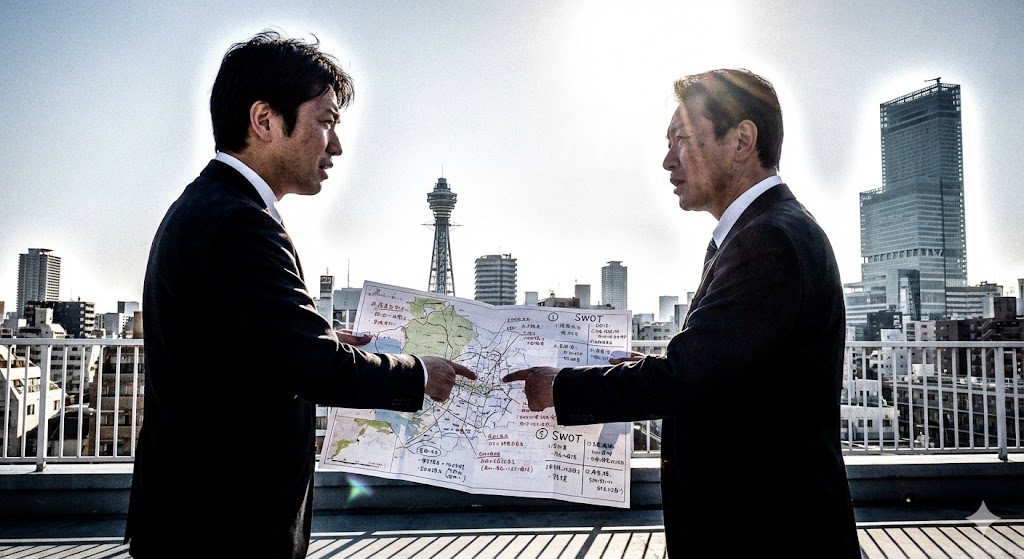
[Osaka Market] A Full SWOT Analysis of the Opportunities and Risks of Entering the Hotel Business
With the curtain now drawn on the historic mega-event that was the Osaka Expo, Osaka’s lodging market has shifted gears—from an era of “special demand where anything you build will sell” to a new, more mature era in which genuine value is what actually matters. Now that the initial frenzy has settled down, this is precisely the right moment for companies to consider entering the hotel and lodging business as a new venture.
However, a maturing market also means that any entry made without a solid strategy will be dragged straight into price competition and weeded out.
Let’s start with the conclusion of this article.
Osaka’s current hotel market is blessed with powerful “opportunities”—namely, firmly established inbound demand and a next-generation growth driver in the form of the IR (Integrated Resort)—but it also carries “threats and weaknesses” such as soaring construction costs and a severe labor shortage. The absolute prerequisite for successful market entry is to avoid the crowded, undifferentiated competition of standard business hotels dominated by major chains, and instead develop tightly targeted, “high-value-added, large-group-friendly” facilities. On top of that, operators must minimize running costs and human-resource risk to the fullest extent possible by embracing technology-driven operations and outsourcing to professional partners.
In this article, we thoroughly dissect Osaka’s hotel market using SWOT analysis—a fundamental framework for business strategy formulation covering Strengths, Weaknesses, Opportunities, and Threats—to derive the concrete winning strategies that new entrants should adopt.
Strength: The Structural Drawing Power of the Osaka Market
First, let’s confirm the structural “strengths” that the Osaka area itself possesses as a lodging market—strengths that no other city can match.
Overwhelming Transportation Convenience as Asia’s Gateway
Kansai International Airport functions as a powerful hub connecting to destinations across Asia, driven largely by LCCs (low-cost carriers). What’s more, Osaka sits right at the center of access routes to some of Japan’s most iconic tourist destinations, including Kyoto, Nara, and Kobe.
For foreign tourists, booking a hotel in Osaka means securing the ideal base camp for exploring the entire Kansai region efficiently. This geographic advantage is the single greatest strength underpinning long-term lodging demand.
The Appeal of “Food and Culture” That Creates Repeat Visitors
Many foreign tourists who visited Osaka for the first time on the occasion of the Expo were captivated by the city’s distinctive food culture and its friendly, lively atmosphere—and have since returned as repeat visitors.
Against “historic Kyoto,” Osaka has firmly established a clear positioning of its own as “the city of entertainment and food.” The sheer richness of its offerings—content that never grows stale no matter how many times you visit—is driving both longer stays and higher occupancy rates.
Weakness: Internal Challenges Facing New Entrants
On the other hand, there are “weaknesses” that companies entering the hotel business from other industries commonly encounter.
A Severe Shortage of Operational Staff (On-Site Personnel)
Japan’s lodging industry as a whole is currently facing a serious labor shortage. Securing staff for front-desk duties, multilingual support, and above all, housekeeping, is far from easy.
If a company tries to build its hiring, training, and shift-management operations entirely from scratch in-house, it will incur enormous time and recruitment costs. And if staff turnover remains high, service quality declines—directly and immediately translating into worse reviews and weaker customer acquisition. This is a real vulnerability.
A Business Structure Prone to Commoditization (Losing Distinctiveness)
Facilities developed under the naive assumption that “clean rooms alone will sell” quickly become commoditized—indistinguishable from all the rest.
Osaka already has an enormous number of business hotels. A new hotel without a clear concept ends up competing on price alone in OTA (booking site) search results. This is a weakness that severely squeezes profit margins.
Opportunity: The Growth Engines Driving the Market Forward
The Osaka market has clear, positive “opportunities” (favorable factors in the external environment) that point decades into the future.
The Massive Wave Brought by the IR (Integrated Resort) Plan
The biggest growth driver for post-Expo Osaka is the IR (Integrated Resort, including a casino) project moving forward in the bay area.
Once the IR opens, it will bring a massive influx of “high-net-worth travelers” and “business travelers” attending MICE events (international conferences, exhibitions, and the like)—an entirely different customer segment from the tourists Osaka has seen to date, arriving from all over the world. As a result, demand is virtually certain to explode—not for budget accommodation, but for high-quality lodging facilities capable of catering to luxury travelers and long-stay business guests.
The Shift Toward “Experience Consumption” and “Large-Group Stays”
Travelers’ values are shifting from “where to stay” to “what you can do there”—so-called experience-based consumption.
Additionally, inbound travelers show a very strong tendency to travel in groups of three to six people or more—families and friends traveling together. Yet the vast majority of Osaka’s existing hotels offer only small rooms designed for one or two guests, and facilities where large groups can stay together in a single room (or an entire property) remain in extremely short supply. This is where a huge blue-ocean opportunity (an untapped market) awaits new entrants.
Threat: External Risks That Could Shake Up Business Plans
Finally, let’s analyze the “threats” that must absolutely be hedged against when planning a business.
Ballooning Initial Investment Due to Rising Construction Materials and Labor Costs
The construction costs of building a new hotel—or fully renovating a used building—have risen sharply compared to just a few years ago.
When calculating ROI, an overshoot in initial costs can be fatal. If you try to cut the budget by skimping on soundproofing or the quality of plumbing and fixtures, it will become a breeding ground for complaints after opening. What matters is whether you can maintain proper cost control while setting an ADR (average daily rate) high enough to match it.
Tightening Regulations and the Risk of Neighborhood Disputes
To open a hotel, you must clear the strict legal hurdles set by the Hotel Business Act, the Building Standards Act (change of use), and the Fire Service Act. If you neglect due diligence and discover after acquiring the property that “permission won’t be granted,” the entire project can collapse.
Disputes with local residents over noise and garbage disposal around the facility also pose a threat to continued operations. A compliance-driven operating structure that coexists harmoniously with the local community is essential.
The “Cross-Analysis Strategy” for Winning in Osaka, Derived from SWOT
By cross-referencing the four elements above, the concrete strategies new entrants should pursue come into focus.
[Strength × Opportunity] Developing Experience-Based Facilities Targeting Groups and Families
Combine Osaka’s drawing power (strength) with the growing demand for group stays (opportunity).
Develop facilities that major hotel chains simply can’t touch: spacious rooms where four to eight guests can stay together, homelike properties fully equipped with kitchens and washing machines, and experience-driven facilities featuring saunas or private theater rooms. By doing so, you can sidestep competitors entirely and command premium room rates ranging from tens of thousands to over a hundred thousand yen per night.
[Weakness × Threat] “Asset-Light Management” Through Technology and Specialist Partners
To counter the labor shortage (weakness) and risks such as soaring construction costs (threat), abandon the “do-it-all-in-house” mindset entirely.
Introduce smart locks and automated check-in kiosks to eliminate or minimize the need for front-desk staff, cutting down fixed labor costs. Beyond that, fully outsource sophisticated operations—guest acquisition, dynamic pricing (revenue management), housekeeping, and 24-hour guest support—to a specialized management company.
This approach eliminates human-resource risk while maximizing profitability through professional expertise.
Conclusion: Osaka’s Hotel Market Is Entering a Phase Where Only “The Real Deal” Wins
What this SWOT analysis reveals is both the tremendous potential of the Osaka market and the need for a “meticulous strategy” to unlock it.
- Avoid the crowded red ocean dominated by major players, and target the niche market for large-group, high-value-added stays.
- Design a concept that can command higher rates, with an eye on future demand drivers like the IR.
- Clear the hurdles of staffing and legal compliance by leveraging technology and professional partner companies.
The era of “just build a box and it’ll make money” is over. But a lodging facility built strategically—one with a genuine “reason for guests to choose it”—stays resilient even against inflation, continuing to deliver returns as a powerful, long-term revenue foundation for the company.
From Market Analysis to Opening and Operations—Stay Buddy Is Your Partner for Hotel Business Success
“We want data on what kind of hotel concept can win in the area we’re considering.”
“With construction costs rising, we want to create a business plan that delivers strong returns on an appropriate budget.”
“We’re looking for a management company that can handle everything from housekeeping to guest acquisition, so we never have to worry about staffing shortages.”
Whatever your concerns, leave them all to us.
We at Stay Buddy Inc. are a team of professionals specializing in lodging business consulting and management representation focused exclusively on the city of Osaka.
We have an intimate command of real, on-the-ground data from the Osaka market.
- Concept design and revenue simulations optimized for location and target guests, grounded in SWOT analysis
- Property surveys and development support from a team of specialists who navigate the complexities of Hotel Business Act permits and Fire Service Act compliance
- Support for implementing unmanned/low-staff front-desk systems using the latest IT tools
- Full management representation, including hotel-grade housekeeping and revenue management to maximize sales
Minimize risk. Maximize opportunity.
Stay Buddy will be the strongest management partner in guiding your new venture to certain success. Feel free to reach out to us for a free business feasibility assessment and market report consultation.