Leave Your Vacation Rental Management to the Experts
Completely Free Online ConsultationRegulatory Hurdles in Entering the Hotel Business (Ryokan Business Act) and How to Clear Them
With the historic Osaka Expo now behind us, Japan’s tourism market—and Osaka’s inbound demand in particular—has shifted from a temporary boom to a “stable, mature phase.” Against this backdrop of solid accommodation demand, a growing number of companies are considering entering the “hotel business,” whether to utilize idle real estate or as a new business venture.
However, the hotel business is not so simple that you can open your doors just because you’ve “found a property with a great location” or “come up with a wonderful concept.” For companies entering from other industries, there exists a first and largest hurdle that determines the success or failure of the venture. That is **the wall of legal regulations, beginning with the Ryokan Business Act (Hotel and Ryokan Business Act)**.
Let us share the conclusion of this article up front.
The one and only shortest path to clearing the regulatory hurdles of entering the hotel business is to correctly understand the three legal walls—”zoning district,” “Building Standards Act,” and “Fire Service Act”—and to always conduct a “preliminary investigation (legal compliance check)” by specialists (architects or administrative scriveners) before signing any lease or purchase agreement for a property. Taking a lax attitude toward these legal walls, thinking “it’ll work itself out later,” can lead to a fatal outcome in which an investment of tens of millions of yen is completely wasted.
In this article, we will thoroughly explain the specific regulatory hurdles that new entrants inevitably face, along with practical approaches to overcoming them and opening a hotel legally and smoothly.
Why Are Such Strict Regulations Imposed on the Hotel Business?
To begin with, why are so many layers of strict laws imposed on the accommodation business, unlike ordinary real estate leasing?
Laws to Protect the “Lives and Health of Unspecified Numbers of People”
Residential properties such as condominiums and apartments are premised on specific individuals living there for extended periods. It’s assumed that residents are familiar with the building’s structure and evacuation routes.
Hotels and ryokan, on the other hand, are facilities where “an unspecified number of people stay temporarily, repeatedly, and for a fee.” Can travelers unfamiliar with the building’s layout evacuate safely in the event of a fire? Is ventilation and sanitation management thorough enough to prevent the spread of infectious disease? The Ryokan Business Act sets an extremely high bar precisely to protect the “lives and health” of guests in these ways.
The Decisive Difference from the Private Lodging Business Act (Minpaku New Law)
Some of you may have heard that “the Minpaku New Law (Private Lodging Business Act) makes it easy.” It’s true that the Minpaku New Law sets a lower bar compared to the Ryokan Business Act. However, the Minpaku New Law comes with a powerful restriction: “operation is limited to 180 days per year.”
If a company aims to recover its initial investment and secure stable profits (maximizing revenue through 365-day operation) as a full-fledged business, this 180-day cap becomes a fatal constraint on the business plan. Therefore, if you’re entering the market as a serious business, you cannot avoid obtaining a license under the Ryokan Business Act (either as a “simple lodging business” or “ryokan/hotel business”).
The “Three High Walls” Blocking Hotel Openings, and Their Reality
To obtain a ryokan business license, you must clear not only the Ryokan Business Act overseen by the public health center, but also other important laws in their entirety. These are the “three walls.”
1. Can You Even Build There? The “Zoning District” Wall (City Planning Act)
Across Japan, land is subject to detailed rules under the City Planning Act specifying “what kind of buildings may be built for what purpose.” This is called the “zoning district” system.
Hotels and ryokan can operate in commercial districts and neighborhood commercial districts, among others, but as a rule, they cannot operate a ryokan business in districts designed to protect quiet residential neighborhoods, such as “Category I Low-Rise Exclusive Residential Districts,” “Category II Low-Rise Exclusive Residential Districts,” and “Category I Medium-to-High-Rise Exclusive Residential Districts.”
No matter how beautiful the interior of a property is, if the zoning is a “no,” the hotel plan is completely dead in the water at that point.
2. The Trap of Repurposing Existing Buildings: The “Change of Use” and “Certificate of Inspection” Wall (Building Standards Act)
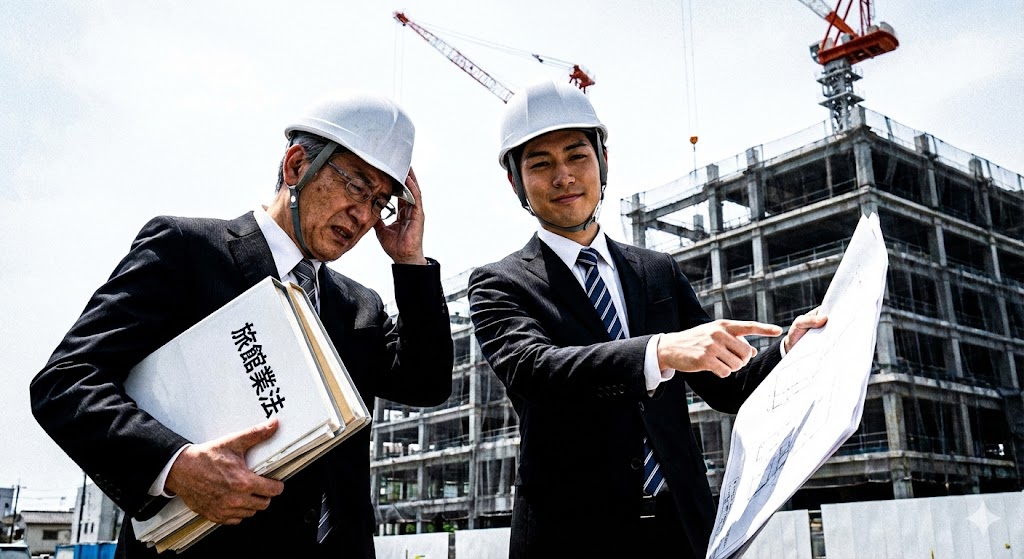
For companies entering the market by converting an existing office building or apartment into a hotel, the Building Standards Act presents the highest hurdle.
When changing a building’s use from “office” or “apartment building” to “hotel/ryokan,” if the floor area exceeds 200 square meters, an “application for confirmation of change of use” must be filed with the local government.
The problem here is **whether a “Certificate of Inspection” (kensa-zumi-sho) exists**. In many older buildings, the certificate proving the building was legally constructed at the time of completion was never obtained, or has since been lost. Properties without a Certificate of Inspection generally cannot have their change-of-use application accepted. Clearing this hurdle requires an extensive legal compliance survey by a first-class registered architect, adding several million yen in additional costs and several months of time.
3. Strict Rules to Protect Lives: The “Fire Service Act” Wall
Accommodation facilities are required by law to have overwhelmingly stricter fire safety equipment than ordinary homes or offices.
Depending on the building’s structure and scale, equipment such as “automatic fire alarm systems,” “guide lights,” “fire extinguishers,” and “flame-resistant materials (curtains, carpets, etc.)” is mandatory. For larger-scale facilities, “indoor fire hydrants” or “sprinkler systems” may also be required.
There are no shortage of cases where an operator who thought “I can just repaper the walls and put in some beds and open up” is hit with instructions from the fire department demanding several million yen worth of fire safety equipment work, driving them into a cash-flow crisis.
Concrete Steps to Clear the Regulatory Hurdles
What steps should be taken to overcome these high walls and successfully launch a hotel business?
Step 1: Thorough “Preliminary Investigation (Due Diligence)” Before Signing the Property Contract
It’s no exaggeration to say this step is everything.
Before signing any lease or purchase agreement, always share the property information with a first-class registered architect experienced in hotel construction, or an administrative scrivener specializing in ryokan business licensing.
Is the zoning acceptable? Is there a Certificate of Inspection? Does the building significantly violate current Building Standards Act requirements? Only after obtaining a specialist’s confirmation that “this property can obtain a ryokan business license” should you proceed to contract negotiations.
Step 2: Preliminary Consultation with the Relevant Authorities (Public Health Center, Fire Department, Building Guidance Division)
Once floor plans and other drawings are ready, go with your designer for a preliminary consultation with the relevant government offices.
In addition to nationally set standards, the Ryokan Business Act allows each local municipality (such as Osaka City) to establish its own supplementary ordinances. It’s not uncommon for “standards that were fine in Tokyo” to be “not acceptable in Osaka.” Visiting the public health center, fire department, and building guidance division with your drawings in hand, and getting a clear indication of what construction and equipment will be required, is the single best defense against costly rework down the line.
Step 3: Taking Advantage of Relaxed Front Desk Requirements
Traditionally, the Ryokan Business Act required the installation of a “front desk” (genkan-choba) for in-person check-in, which posed a significant space and cost barrier for operators of small-scale facilities.
However, recent deregulation has made it possible, upon meeting certain requirements (such as facial recognition via video camera, ICT equipment like smart locks, and an emergency response system), to omit or fully unstaff the front desk.
By making full use of these relaxed rules and designing your facility with technology built in, it becomes possible to build a space-efficient, low-cost operational structure.
Lessons from Failure: What Happens When Regulations Are Overlooked
Finally, let’s share some common failure cases showing what happens to companies that neglect to check regulations.
- A Case Where “Change of Use Denied” Was Discovered After Signing: Company A jumped at a great location and leased an entire building without any preliminary investigation. Once design work began, it was discovered that the building exceeded the legal building coverage ratio, making it an illegal structure. The change-of-use application was rejected, and the hotel plan was scrapped entirely. All that remained was massive rent and penalty fees.
- A Case Where “Hidden Fire Safety Costs” Blew the Budget: Company B had budgeted 10 million yen for interior construction. However, after consultation with the relevant fire department, it was determined that renovation of the automatic fire alarm system across the entire building, plus additional smoke control equipment, was required—adding an extra 8 million yen for fire safety work alone. The company found itself deeply in the red before even opening.
Conclusion: Clearing Regulations Is “the Foundation of Business Success”
Regulations in the hotel business are certainly complex and cumbersome. But looking at it another way, this means “only the operators who clear this high hurdle get to reap the rewards of a stable, high-profit business.”
- Understand how the Ryokan Business Act, City Planning Act, Building Standards Act, and Fire Service Act interact.
- Always conduct a legal compliance survey (preliminary consultation) with specialists before signing any property contract.
- Incorporate the latest deregulation measures into your business plan by leveraging ICT equipment.
Legal walls cannot be overcome through willpower or determination alone. What’s needed is correct knowledge and a trustworthy team of specialists. Taking the “right steps” from the earliest stage is truly the shortest path to success in the hotel business.
From Clearing Complex Regulations to Achieving High-Profit Operations—Leave It to Stay Buddy
“I want to find out whether the building we own can obtain a ryokan business license.”
“We have a property without a Certificate of Inspection, but we want to find a way to convert it into a hotel.”
“We want to outsource everything—from building a system that meets the unstaffed front desk requirements to full-scale operations.”
Whatever your concern, leave it all to us.
We at Stay Buddy Inc. are a team of professionals specializing in accommodation business consulting and operational management, focused exclusively on Osaka City.
We have extensive experience clearing highly challenging regulatory hurdles.
- Detailed legal compliance surveys and representation in negotiations with authorities, carried out by our partner first-class registered architects and administrative scriveners
- Construction and renovation planning to overcome hurdles such as “change of use” and “non-conforming existing structures”
- Support for introducing smart systems that meet unstaffed front desk requirements
- Complete post-opening operational management, including 24-hour guest support, cleaning, and revenue management
There’s no need to get stuck in the maze of regulations.
Stay Buddy provides one-stop support for your hotel business launch, from property investigation and licensing through to maximizing profits after opening. Please feel free to contact us for a free property assessment and business consultation to get started.