Leave Your Vacation Rental Management to the Experts
Free Online ConsultationDon’t Give Up on “Unrebuildable” Properties: Revive Old Houses That Fail the Road Access Requirement with Japan’s Minpaku Law
In 2026, in the wake of the Osaka Expo, inbound demand has shifted from purely quantitative growth to something more qualitatively mature.
Guests from overseas are no longer looking for hotels as mere “places to sleep.” They want experiences that let them genuinely feel Japan’s history and culture.
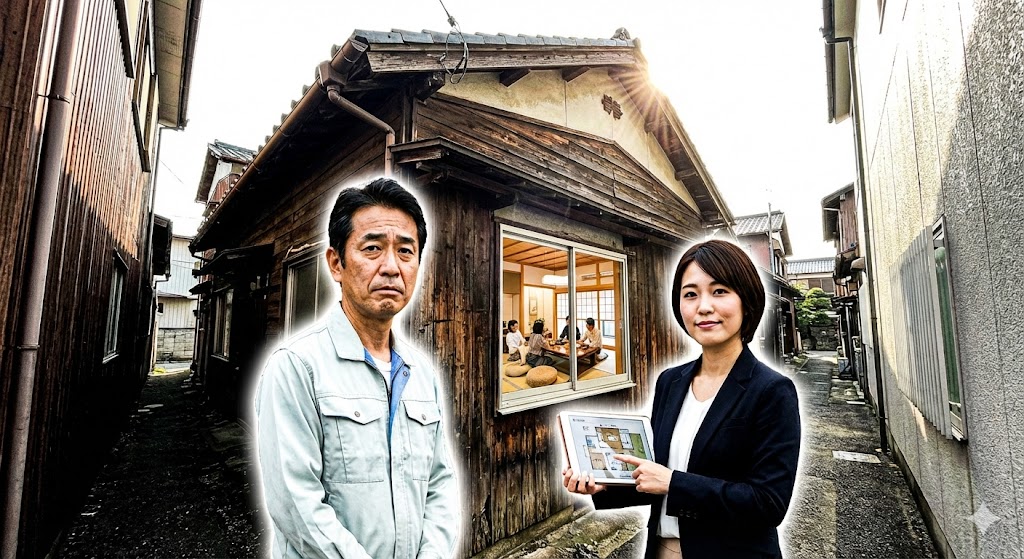
Amid this shift, a quietly growing focus among investors and property owners has emerged: **”unrebuildable properties” (old houses that fail the road access requirement) tucked away in Osaka’s back alleys.**
In the conventional real estate market, these properties are typically written off as low-value—”can’t be rebuilt, so it’s not worth much”—and sold for a fraction of their surrounding market prices. Yet with the right approach, these very properties can be transformed into cash-cow assets delivering exceptional yields.
Let’s get straight to the conclusion of this article.
Old houses that fail to meet the road access requirement face a very high bar for obtaining a Ryokan Business Act license. However, by leveraging the Private Lodging Business Act (Japan’s “Minpaku Law”), it’s entirely possible to sidestep this legal constraint and operate the property as a lodging facility, legally. Buy cheap, sell “authentic Japan” at a premium—this is the niche yet powerful real estate revival strategy for winning in Osaka’s increasingly mature market.
In this article, we’ll explain why unrebuildable properties are actually well-suited to minpaku operations, unpack the legal mechanics behind this, and lay out concrete strategies for generating solid returns even within the 180-day operating limit.
Why Can’t “Unrebuildable” Old Houses Become Regular Hotels?
First, let’s understand the legal barrier standing in the way.
Under Japan’s Building Standards Act, any structure being built must satisfy the **”road access requirement”**: the lot must face a road at least 4 meters wide, with at least 2 meters of frontage.
Countless old traditional houses and rowhouses in Osaka’s downtown neighborhoods and back alleys fail to meet this standard. Because these buildings can never be rebuilt once demolished, they’re labeled “unrebuildable.”
The “Change of Use” Barrier
To turn such a property into a full-fledged hotel under the Ryokan Business Act, you legally need to file for a change of use—from “residence” to “hotel/inn.”
But filing for a change-of-use confirmation requires the building to comply with current Building Standards Act rules. Herein lies the contradiction: because the property fails the road access requirement, it doesn’t comply with current law—so the confirmation application can never be approved.
In other words, it’s common knowledge in the real estate industry that **obtaining a Ryokan Business Act license (a hotel operating 365 days a year) for an unrebuildable property is essentially impossible.**
The Game-Changer: How the Minpaku Law Clears This Hurdle
This is where the Private Lodging Business Act (“Minpaku Law”) comes in. This law was designed specifically to make use of Japan’s existing housing stock (including vacant homes), and it takes a completely different approach from the Ryokan Business Act.
The Power of Operating While Remaining a “Residence”
The biggest advantage of the Minpaku Law is that it allows you to **run a lodging business without changing the building’s use classification—it stays a “residence.”**
Because the property is treated as a “residence,” it doesn’t need to clear the strict compliance requirements of the Building Standards Act (like the road access requirement). The legal framework is simply that guests are staying in a home where someone lives (or is intended to live)—nothing more.
This means that a property once considered a “negative asset”—one you couldn’t demolish, couldn’t sell, and could only pay taxes on—can be revived as an inbound-focused lodging facility with minimal upfront investment.
How to Overcome the “180-Day Limit” Drawback
“But isn’t the Minpaku Law capped at 180 operating days a year? Can you even turn a profit with that?”
You might well ask that. And yes, the cap on operating days is a real constraint. But combine it with the unique “cheapness” of unrebuildable properties and the right strategy, and the odds are firmly in your favor.
1. Secure Yield Through Rock-Bottom Acquisition Costs
Unrebuildable properties often sell for less than half of market rate—sometimes for just a few million yen.
Because acquisition costs are so extremely low, even with operations capped at roughly half the year (180 days), the return on investment (ROI) timeline often beats that of a newly built hotel or an ordinary condo-based minpaku operation.
2. Command Premium Prices as an “Authentic Old Japanese House Experience”
To Japanese people, an old house in a back alley might look like an “inconvenient old building.” But to guests from the US, Europe, or Australia, it’s “cool traditional Japanese architecture.”
Exposed ceiling beams, tatami rooms, an engawa veranda—renovate to highlight these features and offer the property as a whole-house rental, and you can command 30,000 to 50,000 yen or more per night. Operating just 15 nights a month (180 days ÷ 12 months) is enough to build a solidly profitable structure.
3. Fill the Remaining 185 Days with Monthly Rentals
There’s an operating format that isn’t counted against the Minpaku Law’s 180-day cap: monthly (fixed-term lease) rentals.
Run the property as a premium minpaku during peak seasons (cherry blossom season, summer vacation, autumn foliage, etc.), then switch to monthly leasing during the off-season or once you’ve hit your day limit—renting to mid-to-long-term foreign residents or people temporarily displaced while their homes are being rebuilt. This “hybrid operation” is the gold standard for making the most of the new minpaku framework.
Points to Watch When Reviving a Property: Where You Should Never Cut Corners
Even though you can start cheap, that doesn’t mean you can simply rent out the property as-is, untouched. Because these are unrebuildable properties, there are specific points that demand extra care.
Fire Safety Equipment Is Non-Negotiable (Never Compromise on Safety)
Even though the Building Standards Act bar is lowered, the Fire Service Act still fully applies.
Automatic fire alarm systems (often the simplified version for small-scale specific facilities is acceptable), emergency exit lights, and flame-retardant curtains are all mandatory. Because fire trucks often struggle to access back alleys, you must never cut corners on the safety equipment that protects your guests’ lives.
Bring Plumbing and Bathrooms Fully Up to Modern Standards
“Retro charm” and “run-down” are two very different things.
Guests may love the atmosphere of an old building, but they won’t tolerate a grimy toilet or a chilly bathroom. Installing a washlet toilet and renovating the bathroom into a clean unit bath or a modern custom-built bath is absolutely essential for earning high review scores.
Consideration for Neighbors (Soundproofing Measures)
Old rowhouses often share walls directly with their neighbors, meaning everyday noise travels right through.
Chatter from inbound guests or the rattle of suitcase wheels can easily spark neighborhood disputes. Alongside measures like installing sound-dampening wall materials or double-glazed windows, you’ll need a management company that enforces strict house rules and can respond quickly on-site when needed.
Conclusion: Old Houses in Back Alleys Are Diamonds in the Rough
Unrebuildable properties may have been written off by real estate agents. But combine an inbound-tourism mindset with the Minpaku Law, and there’s hardly a more attractive investment opportunity out there.
- Properties that fail the road access requirement can be made legal not through the Ryokan Business Act, but through the Minpaku Law.
- Acquire the property at a rock-bottom price, and you can still achieve strong yields even within a 180-day operating limit.
- Turn “inconvenience” into the value of a “hidden-gem authentic Japanese experience.”
Let go of the assumption that “unrebuildable means worthless.” That old house tucked away in an Osaka back alley might just be the “real Japan” that guests around the world are searching for.
Leave the Toughest Old-House Revivals and Legal Compliance Checks to Stay Buddy
“I’ve inherited a vacant, unrebuildable house and want to know if it could work as a minpaku.”
“I want to understand the renovation costs and run a profit-and-loss simulation for 180-day operations.”
“I’m looking for a professional who can handle everything in one place, including a hybrid setup with monthly rentals.”
Whatever your concern, leave it all to us.
We at Stay Buddy Inc. are a team of professionals specializing in minpaku management and real estate utilization throughout Osaka City.
We have a strong track record reviving even the most challenging old houses.
- Assessment of Minpaku Law eligibility and fire safety compliance, conducted with our partner architects and administrative scriveners
- Inbound-focused renovations that blend Showa-era retro charm with modern comfort
- Marketing and operational schemes that seamlessly switch between minpaku (180 days) and monthly rentals (185 days)
- Full-service management, from coordinating with neighbors to handling every aspect of guest support
Turn a burdensome asset into a thriving one.
Stay Buddy is your partner for navigating the gaps in regulation and maximizing your property’s asset value. Get in touch today for a free property assessment and consultation on how to make the most of your property.