Leave Your Vacation Rental Management to Us
Free Online ConsultationComparing the Numbers: How Business Hotel and Resort Hotel P&L Models Differ
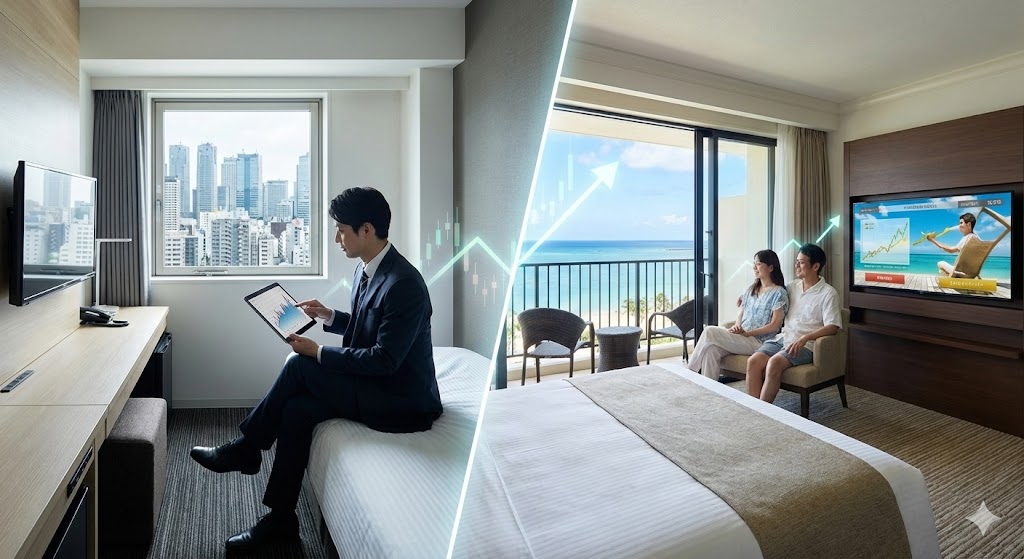
When considering entering the hotel investment or accommodation business, the first question you’ll face is “which category of hotel should I choose?” In particular, the “business hotel” model that leverages urban convenience and the “resort hotel” model that maximizes the appeal of a tourist destination have completely different revenue structures.
Let’s start with the conclusion of this article.
Business hotels are characterized by “stability through high occupancy rates and low-cost operations,” while resort hotels are characterized by “explosive earning potential driven by high average spend per guest and ancillary revenue.”
The question isn’t which model is superior, but rather which P&L model best matches your investment style and risk tolerance. In this article, we’ll compare each P&L model through concrete simulations and thoroughly explain the key points for generating profit.
The Business Hotel P&L Model: Pursuing Stability and Efficiency
As the name suggests, business hotels focus their revenue source squarely on “accommodation.” By cutting out waste and turning over rooms efficiently, they build up profit.
Revenue Characteristics: RevPAR Stability
Since business hotels are built on a base of weekday demand from business travelers, their strength lies in maintaining stable occupancy (OCC) throughout the year. In urban areas like Osaka, it’s not uncommon to maintain occupancy rates above 80%. While the average daily rate (ADR) tends to fluctuate with market conditions, it’s underpinned by solid, resilient demand.
Cost Characteristics: Thorough Labor-Saving
Since business hotels don’t have facilities like restaurants, banquet halls, or pools, they can keep facility maintenance costs and labor costs low. Leveraging IT and outsourcing—such as self-check-in kiosks and outsourced cleaning—for “low-cost operations” is the backbone that supports the bottom line.
P&L Simulation (Business Hotel, 100-Room Scale)
- Revenue: ADR ¥9,000 × 100 rooms × 85% occupancy × 30 days = Monthly revenue: ¥22.95 million
- Expenses:
- Labor costs (front desk, management): ¥4 million
- Cleaning/linen costs (variable): ¥5 million
- Utilities/supplies: ¥2.5 million
- OTA commissions/advertising: ¥3 million
- Total expenses: ¥14.5 million
- Operating profit (GOP): ¥8.45 million/month (profit margin approx. 37%)
The Resort Hotel P&L Model: The Power of High Spend Per Guest and Ancillary Revenue
Resort hotels offer accommodation itself as an “experience.” Because guests stay longer and spend more within the property, revenue beyond room sales significantly influences overall profitability.
Revenue Characteristics: “Ancillary Revenue” Beyond Accommodation
While the room rate itself is set high (ADR), “ancillary revenue”—from restaurant dining, spa services, activities, and gift shop purchases—accounts for a large share of the total. The key to success is how effectively you can raise the per-guest spend.
Cost Characteristics: High Cost Ratios and Hospitality Costs
To provide high-quality service, resorts require many skilled staff members—concierges, bellhops, culinary staff, and more. Additionally, food costs and the upkeep of expansive facilities (gardens, pools, hot springs, etc.) add up, meaning the break-even point tends to be higher than for business hotels.
P&L Simulation (Resort Hotel, 50-Room Scale)
- Revenue:
- Room revenue: ADR ¥40,000 × 50 rooms × 65% occupancy × 30 days = ¥39 million
- Ancillary revenue (F&B, spa, etc.): ¥15 million
- Total monthly revenue: ¥54 million
- Expenses:
- Labor costs (all departments): ¥18 million
- Food/material costs: ¥6 million
- Facility upkeep/utilities: ¥5 million
- Cleaning/linen costs: ¥3 million
- OTA commissions/advertising: ¥4 million
- Total expenses: ¥36 million
- Operating profit (GOP): ¥18 million/month (profit margin approx. 33%)
Which Should You Choose? The Deciding Factors in Your Investment Decision
Comparing the simulations, business hotels tend to win on “profit margin,” while resort hotels tend to win on “absolute profit amount.”
When a Business Hotel Is the Right Fit
- You prefer a steady, conservative approach: If you want to build a portfolio that’s relatively resistant to economic fluctuations and unlikely to suffer major downturns.
- You want to minimize management workload: Because services are standardized, it’s easier to automate and outsource operations, reducing the burden on the owner.
When a Resort Hotel Is the Right Fit
- You want to build a brand: If you want to establish a truly unique concept, cultivate passionate loyal guests, and achieve a premium rate that isn’t dictated by market pricing.
- You want to savor the essence of hospitality management: If you’re motivated to grow the business itself through guest service, cuisine, and creating experiential value.
A Modern Trend: Getting “the Best of Both Worlds”
Recently, “lifestyle hotels” and “luxury whole-property rentals” that combine the efficiency of business hotels with the experiential value of resort hotels have been attracting attention.
These properties feature:
- Luxurious, distinctive hardware (resort-like qualities)
- Labor-saving operations powered by IT (business hotel-like qualities)—and by combining this structure, they achieve high spend per guest alongside high profit margins simultaneously. Particularly in central Osaka, “luxury vacation rentals” that make the most of expansive floor space are achieving remarkable results with this revenue model.
Conclusion: Understand the Financial Reality and Make the Optimal Choice
Business hotels are a “highly efficient asset-based industry,” while resort hotels are a “high-value-added experience industry.”
- Business hotels cut fixed costs and build up occupancy.
- Resort hotels increase ancillary value and maximize spend per guest.
Understanding the critical points of each P&L model, and then choosing the one that matches your financial capacity, location conditions, and your vision for “what kind of business you want to run,” is the fastest route to success.
Regardless of which model you choose, what ultimately determines your bottom-line take-home profit is “operational execution on the ground.” Build a meticulous financial plan and put in place the system needed to make it a reality.
Leave Your P&L Model Development and Operational Optimization to Us
“I want someone to assess whether the property I’m considering is better suited for a business hotel or a resort hotel model.”
“I want to achieve resort-hotel-level pricing with business-hotel-level low-cost operations.”
“I want advice on analyzing my current P&L model and improving my profit margin.”
Please feel free to bring these concerns to us.
Stay Buddy Inc. is a team of professionals providing one-stop support—from developing hotel and vacation rental P&L plans through to full operational management.
We’re not just a management outsourcing company.
- Highly accurate P&L simulations built on local area data
- Labor-saving, low-cost operational models built with DX tools
- Branding strategies that maximize your property’s appeal and achieve premium pricing
We leverage all of this to walk alongside you as a partner, guiding your investment toward “maximum profitability.”
Let’s back your ideal hotel management vision with real numbers and grow it into a reliable business. Get started with a free, individual consultation and P&L assessment—reach out to us anytime.