Leave Your Vacation Rental Management to Us
Free Online ConsultationF&B? Public Baths? A Thorough Analysis of High- and Low-Margin Departments in Hotel Business
When considering hotel management or ryokan revitalization, many owners focus intensely on maximizing “revenue.” However, the lodging business is a composite operation made up of multiple departments, and the profit margin structure varies dramatically from one department to another.
“Our restaurant is always full, yet almost no profit remains at the end of the month.”
“We’re promoting our public bath as a selling point, but I feel like the maintenance costs are squeezing our management.”
These concerns stem from a failure to accurately grasp the profitability characteristics of each department.
Let’s start with the conclusion of this article.
In hotel business, the “lodging department (guest rooms)” overwhelmingly boasts the highest profit margin. On the other hand, “F&B” and “public bath/spa departments” tend to have extremely low standalone profit margins due to heavy burdens from labor costs, cost of goods, and utility expenses.
In hotel management going forward, it’s essential to adopt a strategic perspective: rather than expecting low-margin departments to “earn profit on their own,” think of how to leverage them as a “spice” that boosts the average daily rate and occupancy rate of the lodging department.
In this article, we thoroughly analyze the real profit structure of each hotel department and explain the essential management insights needed to maximize overall revenue.
The King of Profit Margins: The Revenue Structure of the Lodging Department (Guest Rooms)
The pillar of hotel revenue has always been, and remains, the lodging department. It’s not uncommon for the lodging department’s GOP (Gross Operating Profit) margin to reach 70%–80% or higher.
The Overwhelmingly Low Cost Ratio
The lodging department’s biggest characteristic is that “direct costs” relative to revenue are extremely low. The variable costs incurred per guest stay are limited to items like amenities, linen cleaning, housekeeping, and a small amount of utilities. Once the building is constructed, the structure is such that the majority of revenue remains as profit.
Reducing Fixed Costs Through IT
The lodging department is also the area most likely to benefit from efficiency gains through IT adoption. By introducing self-check-in kiosks and smart locks, you can cut front desk labor costs and further boost profit margins. The reason modern smart hotels and whole-building vacation rentals boast such high profitability is that they specialize in this lodging department while cutting fixed costs to the bone.
A Double-Edged Sword: The Real Profitability of the F&B Department
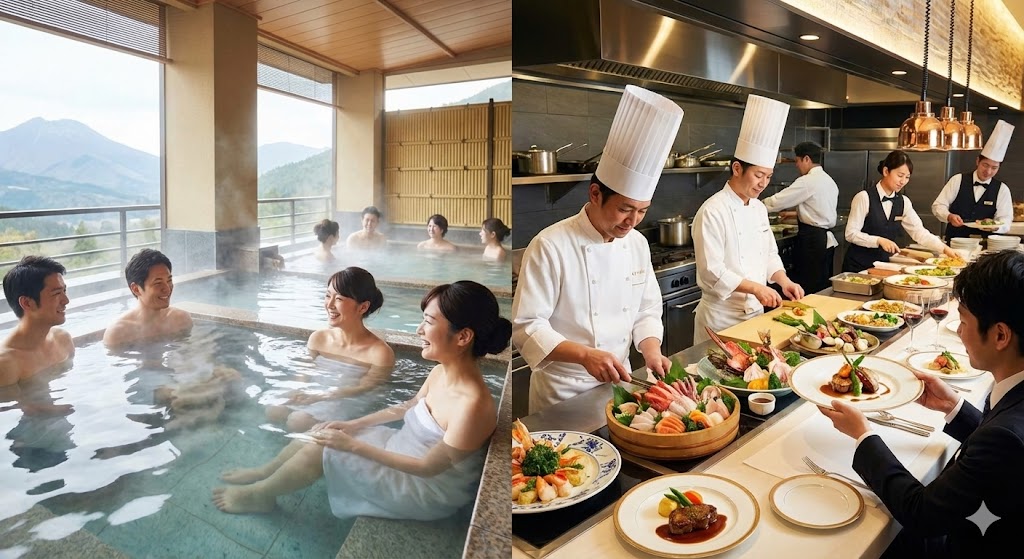
Even in today’s era of growing “room-only, meals-separate” plans, many ryokans and hotels still offer meals. However, the F&B department’s profit margin is far lower than that of the lodging department — typically around 10%–20%, and at some properties, it’s not uncommon for this department to operate at a loss.
The “Double Punch” of Cost of Goods and Labor
F&B carries “food cost” (roughly 30%). On top of that, you must continuously secure skilled staff such as cooks and servers, driving up labor cost ratios significantly. There’s also the ever-present risk of food waste losses.
Strategic Positioning: Is F&B a “Customer Draw” or “High Value-Add”?
Generating substantial profit from the F&B department alone is an uphill battle. For this reason, one of the following strategies is necessary:
- Customer Draw Hook: Create a signature menu item that makes guests think, “I want to stay at that inn because I want to eat that dish,” thereby maximizing room bookings (positioning F&B as a marketing expense).
- Dinner as an Optional Add-On / Directing Guests to Local Restaurants: Make dinner a separate optional charge from the room rate, and partner with nearby restaurants to boost guest satisfaction without taking on your own F&B cost burden.
A Cost Sink: Analyzing the Expenses of Public Baths and Shared Facilities
In the Japanese lodging market, where “no public bath means no guests” is a common sentiment, shared facilities are an unavoidable element — but from a profitability standpoint, they represent the department that eats into profit the most.
Utility Costs and Cleaning/Maintenance Expenses
Maintaining a public bath requires a 24-hour filtration and heating system, which drives up gas, electricity, and water costs enormously. Recent surges in energy prices have become a matter of survival for properties with public baths. On top of that, legally mandated costs for specialized cleaning, water quality management, and Legionella countermeasures cannot be ignored.
Zero Revenue Per Square Foot
If the space used for the public bath, sprawling lobby, or banquet hall had instead been used for guest rooms, it would have generated revenue. But shared facilities themselves generate no direct revenue (sales) on their own.
When installing a public bath, it’s essential to run a simulation asking: “How much can having a public bath allow us to raise our average daily rate (ADR)?”
The “Departmental Portfolio” Optimization Practiced by Smart Operators
So what’s the right way to combine high-margin and low-margin departments? The common thread among successful properties is “selection and concentration.”
1. Outsourcing/Leasing Out F&B and Spa Operations
This is a strategy of avoiding the risk of operating an unfamiliar F&B business in-house by leasing the space to a professional restaurant tenant, or fully outsourcing cleaning and public bath management — converting fixed costs into variable costs. This allows owners to focus on the high-margin business of “lodging management.”
2. Shifting to a “Room-Only + Local Partnership” Model
Especially in urban areas and tourist destinations, more properties are specializing in “room-only” plans that don’t include meals. By positioning nearby restaurants as “the hotel’s dining venue,” you eliminate the risk of losses in your own F&B department while maximizing the profit margin of the lodging department.
3. Automating Ancillary Revenue Through Digital Tools
By stacking up “ancillary revenue” that generates profit without requiring staff — such as in-property vending machines, coin laundry, and paid options offered via mobile ordering — you can lift overall profit margins.
Summary: An “Overall Optimization” Perspective to Maximize Lodging Department Profit
The secret to successful hotel management is not looking at each department’s “numbers” in isolation, but finding the combination that maximizes the final bottom-line profit as a whole.
- Lodging Department: The source of profit. Sharpen it further through IT and efficiency gains.
- F&B Department: Clarify its role. Are you pursuing profit from it, or treating it purely as a customer draw?
- Shared Facilities: Recognize that they are a cost center, and continually verify whether they’re generating value-add beyond their maintenance costs.
Building your operation around the high-margin “lodging department” as the core, while wisely trimming or streamlining everything else — this is the judgment call that will determine winners and losers in the new era of hotel management.
We Support Improved Revenue Structures and Highly Profitable Operations Management
“I want an analysis of my current financial situation to diagnose where the waste is.”
“I want to optimize F&B and cleaning costs to improve overall profit margins.”
“I want to introduce a highly profitable operating model that specializes in lodging.”
Please feel free to consult with us about these concerns.
We at Stay Buddy Inc. are professionals in improving hotel and vacation rental profitability and providing operational management services.
We’re not just a management outsourcing company.
- Thoroughly dissecting the costs of each department and proposing profitability improvements to maximize profit
- Reducing staffing needs and costs for front desk and administrative work through the introduction of DX tools
- Strategic concept design and pricing that enhance the value of the lodging department
We leverage all of these capabilities to walk alongside owners as a partner dedicated to generating the “maximum bottom-line profit” from their assets.
Let’s move away from rough, guesswork-based management and build a strong hotel business grounded in solid numbers. Please feel free to reach out for a free financial diagnosis and individual consultation to get started.