Leave your minpaku management to us
Completely Free Online ConsultationWhat Is the Break-Even Point (BEP) for a Hotel Business? Calculating Profitability from Room Count and Rates
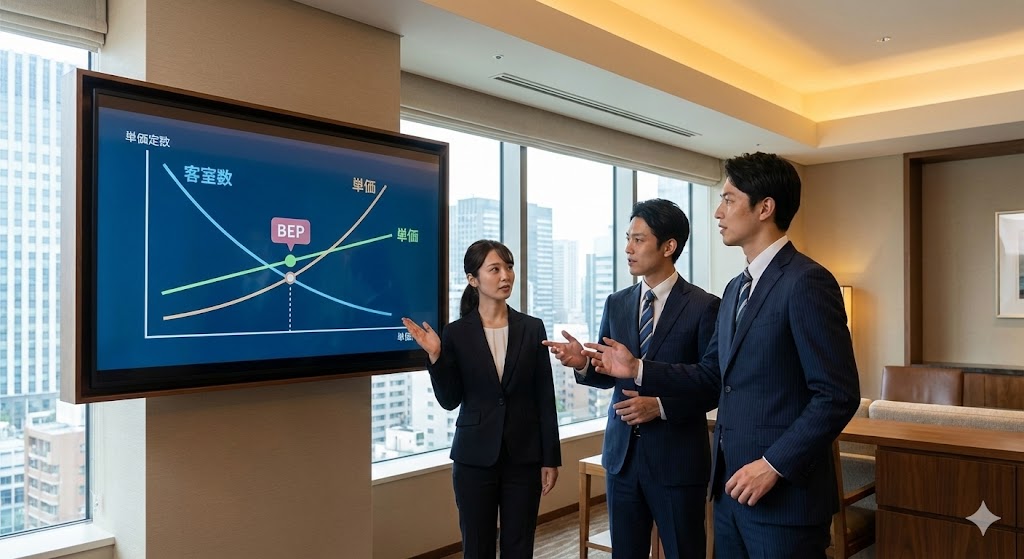
When considering a hotel investment or ryokan management venture, one of the most critical metrics is the “Break-Even Point” (BEP). No matter how luxurious your interiors or how outstanding your service, your business cannot survive long-term unless it clears this profitability threshold.
Let’s start with the conclusion of this article.
The break-even point for a hotel business is typically set around an “occupancy rate of 50%–60%.” However, for today’s small hotels and minpaku (vacation rental) properties, it’s entirely possible to dramatically lower this threshold by balancing room count with pricing and, crucially, by compressing fixed costs.
“How many rooms do I need to turn a profit?” “What nightly rate do I need to charge to avoid running in the red?”
In this article, we’ll break down the revenue structure of hotel management and walk you through exactly how to calculate a realistic break-even point based on room count and average rate—along with strategies to maximize your profits.
Understanding “Fixed Costs” vs. “Variable Costs” for Break-Even Analysis
To calculate a hotel’s break-even point, you first need to separate your expenses into “fixed costs” and “variable costs.” Compared to standard real estate rental businesses, the cost structure for lodging operations is considerably more complex.
1. “Fixed Costs” That Occur Regardless of Occupancy
These are expenses you must pay whether your rooms are full or empty.
- Rent (or loan repayments): Typically your single largest fixed cost.
- Personnel costs (fixed portion): Salaries for front desk and management staff.
- Communication and maintenance fees: Wi-Fi, elevator inspections, fire safety equipment checks, etc.
- Advertising expenses: OTA (booking site) listing fees and monthly system usage fees.
2. “Variable Costs” That Increase with Occupancy
These expenses only arise once a guest actually stays at your property.
- Cleaning costs: Actual expenses incurred per stay.
- Linen costs: Cleaning and rental fees for sheets and towels.
- Utilities: The portion that fluctuates based on usage.
- Amenities and consumables: Toothbrushes, shampoo, etc.
- OTA commission fees: Typically around 10%–15% of revenue.
The Break-Even Point Formula: Finding Your Property’s “Profitability Line”
Tracking your break-even point in terms of “occupancy rate” or “number of guests”—rather than a raw dollar figure—makes it far more useful as a day-to-day operational metric.
The Basic Calculation Concept
Break-even revenue can be calculated using the following formula:
Break-Even Revenue = Fixed Costs ÷ {1 − (Variable Costs ÷ Revenue)}
However, in the lodging industry, a more intuitive metric is the **”break-even occupancy rate.”**
For example, if your monthly fixed costs total ¥1,000,000 and the “contribution margin” per room (the room rate minus variable costs) is ¥10,000, then you’d need to sell 100 room-nights (¥1,000,000 ÷ ¥10,000) to break even. For a 30-room hotel offering 900 room-nights per month, 100 room-nights would represent roughly an 11% occupancy rate as your break-even point—an extreme example, but this is exactly the kind of calculation you use to determine “how many nights of occupancy are needed to recover fixed costs.”
How Room Count and Pricing Affect Your Break-Even Point
The strategy you should adopt—and the nature of your break-even point itself—varies significantly depending on the scale (number of rooms) of your hotel.
Small Properties (Up to 10 Rooms) / Minpaku: A High-Rate, Low-Fixed-Cost Strategy
With fewer rooms, the fixed cost burden per room tends to be heavier. However, by outsourcing cleaning and leveraging IT solutions (such as smart locks) to enable unmanned or low-staff operations, you can effectively convert the massive fixed cost of labor into a variable cost.
- Strategy: With fewer rooms, sharpen your concept to justify raising your Average Daily Rate (ADR).
- Profitability line: If fixed costs are kept low, profitability is achievable even at a 30–40% occupancy rate.
Mid-Sized Properties (20–50 Rooms): Balancing Efficiency and Occupancy
Once you reach a certain scale, fixed costs jump significantly—for instance, you’ll likely need front desk staff on-site at all times.
- Strategy: Leverage economies of scale to reduce per-unit linen and cleaning costs.
- Profitability line: Consistently maintaining an occupancy rate above 50% becomes an absolute requirement. A defining feature of this scale is that once you cross this threshold, profits accelerate rapidly.
Three Secrets to Lowering Your Profitability Threshold
There are only two paths to profit: “increase revenue” or “lower your break-even point.” The latter, in particular, builds a resilient business model that can withstand economic downturns and slow seasons.
1. Convert Fixed Costs into Variable Costs (Outsourcing)
If you directly employ your own cleaning staff, you’ll be paying salaries even on days with zero guests. By switching to a specialized cleaning contractor on a per-job (pay-as-you-go) basis, you can minimize the risk of running at a loss.
2. Reduce Staffing Through IT Adoption
Replacing traditional front desk operations with a self-check-in system can dramatically cut labor costs. In urban areas like Osaka, simply replacing round-the-clock staff coverage with technology can lower your break-even occupancy rate by 10–20 percentage points.
3. Leverage Dynamic Pricing
Charging a “flat rate at all times” locks your break-even point in place. If you can maximize your rate during high-demand periods, you’ll be able to recover your monthly fixed costs with fewer occupied nights.
Conclusion: Your Break-Even Point Is Your “Safety Net”
Understanding your break-even point acts as a “safety net”—it prevents you from running your business blind, like walking through the dark without a light.
- Calculate your exact fixed costs and the variable cost per room.
- Determine, at your current rate, how much you need to sell each month just to break even.
- Cut fixed costs through IT adoption and outsourcing to lower your break-even threshold.
By thoroughly following these steps, you can build a resilient hotel business that continues generating reliable profits—even after major events like Expo 2025 wrap up, or when market conditions shift.
Leave Your Profitability Simulation and High-Yield Operations to Us
“I want to know exactly where the true break-even point lies for the property I’m considering.”
“I want to optimize fixed costs like labor and cleaning to lower my profitability threshold.”
“I need expert advice on an appropriate pricing strategy tailored to the Osaka market.”
Whatever your concern, we’d love to hear from you.
At Stay Buddy Inc., we’re a team of professionals offering end-to-end support—from hotel and minpaku profitability simulations to low-cost, high-yield property management services.
We’re not just another management agency.
- Precise BEP (break-even point) calculations grounded in local area data
- Operational models designed to minimize fixed costs, leveraging smart locks and DX tools
- Expert-driven rebranding strategies to maximize your ADR (average daily rate)
We deliver all of this to transform your investment into a business that reliably generates profit.
Get started with a free profitability assessment and personalized consultation—reach out to us anytime.