Leave your vacation rental management to us
Free Online ConsultationLearning from Failed Hotel Acquisitions: Critical Due Diligence Items You Cannot Afford to Overlook
Against the backdrop of recovering inbound tourism demand and soaring construction costs, “hotel M&A”—the acquisition of existing hotels and ryokan—has become increasingly active. Acquiring a facility and organization that is already operational allows for far speedier business expansion than building from scratch over an extended period.
However, hotel M&A carries risks that are incomparably greater than those of typical corporate acquisitions or real estate investments such as condominiums. Failure stories are all too common: investors judge a deal based solely on surface-level yield or the building’s exterior appearance, only to discover fatal defects after the purchase—ultimately withdrawing from the business after losing hundreds of millions of yen.
Let us state the conclusion of this article upfront.
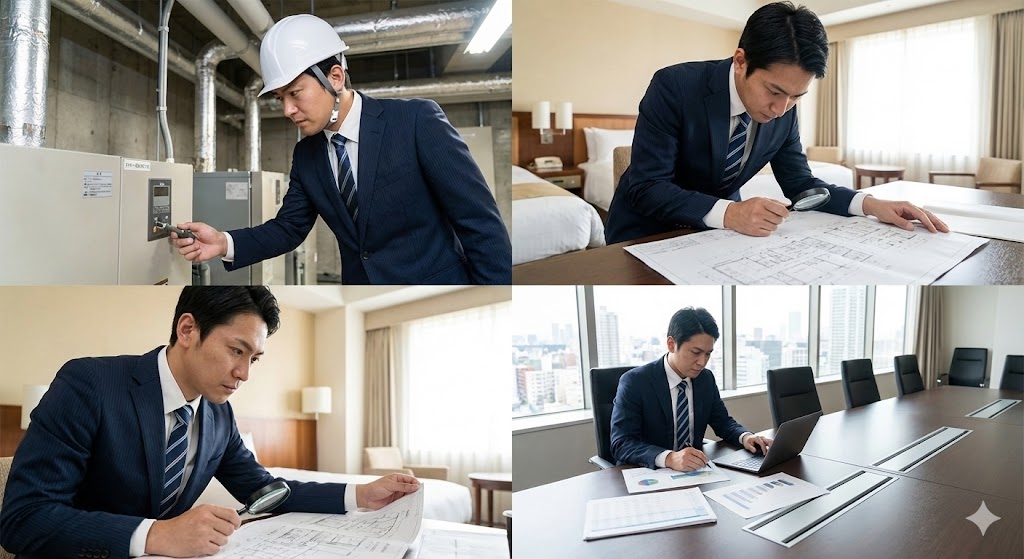
The success or failure of a hotel M&A deal is determined entirely by the precision of the detailed pre-acquisition investigation—namely, **”due diligence (DD).”**
In particular, three hotel-specific factors—**”compliance with building regulations,” “concealed repair costs,” and “risks in employee transition”**—are the three major issues that, if mishandled, can prove irreversible.
In this article, we use real-world failure cases as cautionary examples to thoroughly explain the critical due diligence items that investors and operators must never overlook when acquiring a hotel.
Why Hotel M&A Failures Become “Fatal Wounds”
Before diving into specific checklist items, it is important to understand the unique nature of hotels as an asset class.
A hotel only generates value when its “real estate (hardware)” and “operating business (software)” function together as one.
- Real estate risk: If the building violates the law, operating permits may not be granted, or financing may not be approved.
- Business risk: If employees leave, service quality collapses, negative reviews spread, and revenue disappears.
Because both of these aspects must be scrutinized, the difficulty of due diligence for hotels is extremely high. Even if you think you got a good deal, if it later turns out that corrective construction will cost hundreds of millions of yen, you have simply purchased a “liability.”
Let’s now examine specific checklist items, organized by real-world failure patterns.
Failure Case 1: [Hardware Trap] Discovering “Illegal Construction” After Purchase, Leading to a Business Suspension
[Case Study]
An investor acquired a long-established hot spring inn in a regional area. The yield looked attractive, and the building had already been renovated, appearing pristine. However, after the acquisition, when the investor applied to the local government office for further renovation permits, they were informed: “This building has an unauthorized extension and does not comply with current regulations.”
As a result, not only did the corrective construction incur enormous costs, but the operating license could not be renewed until that construction was completed—putting the entire operation at a standstill.
[Due Diligence Checklist Items]
Among all the risks in hotel M&A, this issue of “legal compliance” is the most frightening.
- Presence of a Certificate of Inspection: Does the building have a “certificate of inspection” issued upon its completion? For older ryokan and hotels, this document is often lost—or was never obtained in the first place. Without it, renovations or changes in building use are generally not permitted.
- Verification of unauthorized construction: Does the floor area on the property register match the actual floor area of the building? If a rooftop prefab structure, connecting corridor, or banquet hall expansion was built without permits, this constitutes illegal construction.
- Deficiencies in fire safety equipment: Do automatic fire alarm systems, sprinklers, and other equipment meet the latest Fire Service Act standards? Because the Fire Service Act has strict retroactive application requirements (new rules apply even to older buildings), a corrective order can result in expenses running into the tens of millions of yen.
Failure Case 2: [Financial Trap] Illusory Profits and “Hidden Repair Costs”
[Case Study]
An investor acquired a high-yield hotel showing a “headline yield of 15%.” The books showed a profit, but immediately after the change of ownership, the boiler broke down, and the entire air conditioning system needed to be replaced.
In reality, the previous owner—anticipating the sale—had halted necessary repairs and capital investments for several years, compressing expenses to make the property’s “profits look good.” After the acquisition, repair costs devoured all the profits, and the real yield turned negative.
[Due Diligence Checklist Items]
In financial due diligence, you must never take the submitted profit and loss statement (P&L) at face value.
- History of repair and maintenance costs: Review the maintenance history (CAPEX) for the past several years to check whether proper upkeep has been performed. If repair costs appear unusually low, that shortfall remains as a “future debt.” An Engineering Report (ER) should be obtained to estimate the repair costs expected over the next 10 years.
- Calculating “normalized earning power”: Check whether the figures include the previous owner’s personal entertainment expenses, or unreasonably low labor costs (such as unpaid family labor). These items should be excluded and adjusted to estimate the property’s realistic earning potential under new ownership.
- OTA commissions and advertising costs: Is the majority of revenue coming through high-commission OTAs (booking sites)? If the ratio of direct bookings is low, customer acquisition costs risk remaining persistently high.
Failure Case 3: [HR Trap] “Mass Staff Resignations” the Day After the Acquisition
[Case Study]
A city hotel was acquired via a stock transfer, including its entire operating company. The new owner took over management and introduced a strict, proprietary operations manual to cut costs, which sparked backlash on the ground.
The general manager and head chef—both key personnel—resigned, triggering a chain reaction of staff departures. As institutional knowledge was lost, service quality declined, and reviews rapidly turned negative.
[Due Diligence Checklist Items]
A hotel’s product is its people. If HR due diligence is neglected, you may end up with an empty shell—the building remains, but the substance is gone.
- Identifying key personnel and their intentions: Who are the general manager and head chef actually running the property? Will they stay after the acquisition? Consider including key-person retention (lock-up) provisions in the M&A contract terms.
- Unpaid overtime wages: The hotel industry is prone to normalized long working hours, and attendance management can be sloppy. Conduct a thorough labor audit to check for any risk of being billed for past unpaid wages after the acquisition.
- Organizational culture and salary levels: Are wages too low compared to competing hotels in the area? If so, there is a risk of continued staff turnover unless wages are raised after the acquisition.
Failure Case 4: [Contract/Rights Trap] Contracts Terminated “Before You Know It”
[Case Study]
In one case, part of a hotel’s land was leased. Following the change of ownership through the M&A, the landowner demanded either “contract termination” or a “significant increase in ground rent.” Because the lease agreement had not been reviewed beforehand, the new owner had no leverage to resist and was forced to accept unfavorable terms.
[Due Diligence Checklist Items]
Contracts related to real estate and operations may lose effect—or trigger a “change of control” clause—when ownership changes.
- Reviewing lease agreements: If the land or building is leased, is transfer approval required, and what are the terms for renewal fees?
- Tenant agreements: Check the term and conditions of any restaurant or spa operating within the hotel. Consider the revenue impact if they withdraw, or conversely, the penalty risk if you wish to terminate their tenancy.
- Neighborhood agreements: Are there any independent agreements with local residents regarding operating hours or noise? Failure to honor these can lead to community disputes after the acquisition.
Avoiding Failure: Due Diligence Is Not a “Cost” but an “Insurance Policy”
As we have seen, the risks involved in hotel M&A are wide-ranging and varied.
It is impossible for a buyer to check all of these factors alone.
While it involves expense, assembling a professional team—lawyers, certified public accountants, real estate appraisers, and licensed architects—to conduct a thorough investigation ultimately provides the best possible defense.
Issues uncovered during due diligence do not simply serve as reasons to “walk away from the deal.”
They can also become powerful leverage for price negotiations, such as saying:
“Since these repairs will cost 30 million yen, we would like that amount deducted from the purchase price.”
The choice comes down to this: skimp on a few million yen in investigation costs and end up losing hundreds of millions—or invest in proper due diligence and acquire a safe asset at a fair price. This is a moment that truly tests an owner’s judgment.
Conclusion: A “Business Viability Assessment” by Operations Professionals Is Essential
While legal and structural risks can be identified by specialists, questions like “Will this hotel actually be profitable?” and “Is there room for operational improvement?”—in other words, **”business (commercial) due diligence”**—can only be properly answered by operations professionals with deep, hands-on hotel industry experience.
- Is the current occupancy rate appropriate compared to the market average?
- Are linen and cleaning costs too high?
- What kind of rebranding could raise the average daily rate?
Carefully examining these “future possibilities” is truly the final key to a successful M&A deal.
Leave Your Pre-Acquisition Business Viability Assessment to Us
“I’m considering acquiring a hotel, but I’m not sure whether the proposed revenue forecast is realistic.”
“I want to understand not just the building risks, but the potential for operational improvement.”
“I want support with the PMI (Post-Merger Integration) process after the M&A deal closes.”
If any of these concerns sound familiar, please reach out to us.
Stay Buddy Inc. is a professional team specializing in hotel and vacation rental (minpaku) operations management, and we have been involved in the launch and turnaround of numerous accommodation facilities.
We support due diligence grounded not in theoretical assumptions, but in on-the-ground operational reality.
- Business due diligence from an operational perspective (profitability and cost assessment)
- Development of post-acquisition rebranding and value-enhancement strategies
- Dispatch or outsourcing of an operations team to cover key-personnel departure risk
An M&A deal is not the finish line—it is the start of operations.
Rigorous checks to avoid “drawing the short straw,” combined with an operational strategy to “turn it into a treasure.”
As your partner in guiding your hotel investment to success, please feel free to start with a free, individual consultation.