Leave Your Vacation Rental Management to Us
100% Free Online ConsultationWant to Boost Vacation Rental Profits? Target Long-Term Guests
Have you started running a vacation rental only to find yourself thinking, “Bookings keep coming in, but there’s nothing left in profit,” or “I’m exhausted from constant cleaning and check-in duties every single day”?
If so, your property may be relying too heavily on “short-stay” guests (1–2 nights).
Let’s cut to the conclusion of this article right away.
In the vacation rental business, targeting “long-term guests” is the single solution that simultaneously stabilizes revenue and improves operational efficiency.
Cycling through guests staying just a few days each may generate a solid top line (total revenue), but rising expenses squeeze your bottom line (profit margin). On the other hand, if you can attract guests staying anywhere from a week to a month, your expenses drop dramatically, and the owner’s take-home profit reliably increases.
In this article, we’ll thoroughly explain—from a professional property management perspective—why targeting long-term guests leads to greater profitability, and exactly what amenities and strategies you need to attract them.
Why Is “Long-Term Stay” the Ultimate Profit Model?
Many hosts become fixated on filling as many single-night bookings as possible. However, from a business management perspective, the constant turnover of short-term guests tends to create a “high-cost structure.” Let’s break down the three key economic advantages that long-term stays deliver.
1. Dramatic Reduction in Cleaning and Linen Costs
The biggest variable (running) cost in vacation rental operations is cleaning and linen laundering. These expenses occur every time a guest turns over.
Let’s simulate one month (30 days) of operation as an example.
- Short-stay guests (15 groups × 2 nights each): Cleaning occurs 15 times. At ¥5,000 per cleaning, that’s ¥75,000 in monthly expenses.
- Long-stay guest (1 group × 30 nights): Cleaning happens just once, after checkout. Total cost: ¥5,000.
That ¥70,000 difference goes straight into the owner’s pocket as net profit. This is exactly why accepting long-term guests—even at a somewhat lower nightly rate—can leave you with more money in hand at the end of the day.
2. Eliminating “Vacancy Loss” and “Calendar Gaps”
When short-term bookings pile up back-to-back, you inevitably end up with awkward single-day gaps between reservations (like an orphaned weekday). Filling these gaps is notoriously difficult.
If only Friday and Saturday get booked in a given week, leaving Monday through Thursday vacant, your occupancy rate hovers around just 30%.
Long-term guests, on the other hand, fill your calendar in solid blocks.
Secure a booking for two weeks or a month, and your occupancy for that period is 100%. There’s no need to stress over filling the calendar, and reducing missed opportunities (vacancy loss) to zero brings real peace of mind as well.
3. Major Reduction in Operational Workload
Guest-related tasks occur on a “per booking” basis, regardless of how long the stay is.
Pre-arrival messaging, check-in instructions, explaining house rules, posting a review after checkout—these happen once whether the stay is one night or thirty.
The difference in labor between handling 15 separate bookings versus just one is enormous for owners and management staff alike. Since the risk of trouble scales with the number of guest turnovers, fewer turnovers also make day-to-day operations far less stressful.
Who’s Actually Booking Long-Term Vacation Rental Stays Right Now?
So who exactly is seeking out long-term stays? Understanding your target audience clarifies exactly what kind of room setup will resonate with them.
Digital Nomads and Remote Workers
This is a demographic that solidified after the pandemic—people who work from anywhere.
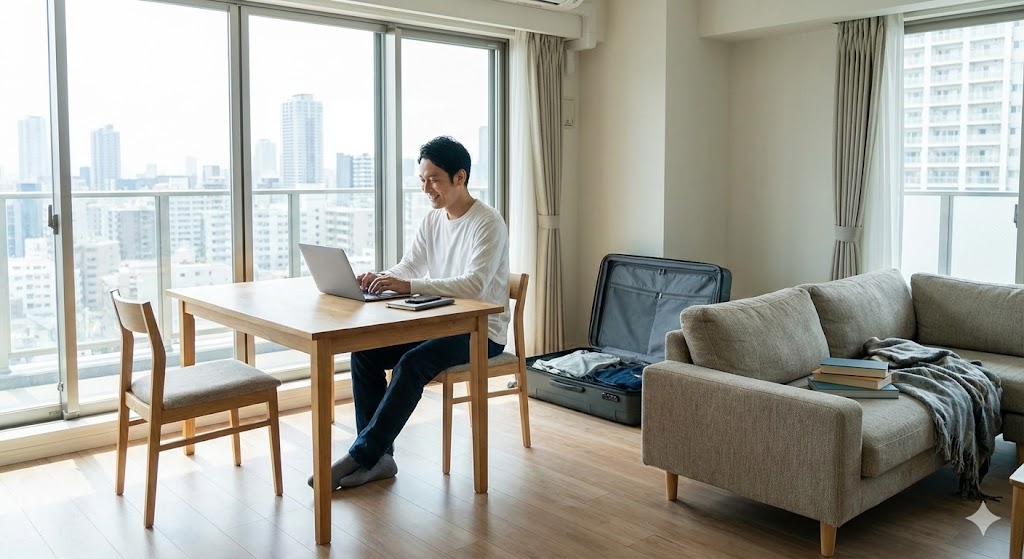
Their purpose isn’t purely “sightseeing” but rather “living and working.” Whether from Japan or abroad, they seek a comfortable work setup combined with an authentic, home-like experience, and typically stay anywhere from a week to several months. With the weaker yen, an increasing number of nomad workers from the US, Europe, and Australia are choosing to stay long-term in Japan.
Temporary Housing During Home Renovations or Return Trips
A surprisingly large segment consists of Japanese residents needing “temporary housing.”
- Temporary return trips from overseas postings
- Temporary housing during home renovation or rebuilding
- A bridge while waiting for a new residence to become available
- Caring for or accompanying a family member
These guests want to avoid the hassle of a traditional lease—deposits, key money, and furniture purchases. A vacation rental where you can start living immediately with just a suitcase is the ideal choice for them.
“Slow Tourism” — Traveling Like You Live There
Rather than rushing through major tourist sites, “slow tourism”—basing yourself in one town and enjoying the local everyday rhythm—is becoming an emerging trend.
Buying groceries at the local supermarket, cooking meals, becoming a regular at a nearby café—travelers seeking this kind of experience specifically seek out vacation rentals equipped with a kitchen and washing machine, rather than hotels.
5 Essential Amenities to Win Over Long-Term Guests
Long-term guests evaluate properties from a completely different angle than short-stay guests. The standard isn’t “can I sleep here?” but “can I actually live here?” Providing the following amenities is an absolute prerequisite for being chosen.
1. Fast, Reliable Wi-Fi and a Dedicated Workspace
For today’s long-term travelers, internet access is a utility as essential as electricity or water.
A pocket Wi-Fi router alone won’t cut it. Install a fast, unlimited fiber-optic connection.
Additionally, providing a dedicated desk for laptop work (separate from the dining table) along with an office chair comfortable enough for long sitting sessions will significantly boost bookings from business travelers.
2. A Kitchen Set Up for Real Cooking
Being able to boil water isn’t enough to actually live somewhere.
- At least two stovetop burners
- Microwave, rice cooker, toaster
- Frying pan, pot, knife, cutting board
- Basic seasonings (salt, pepper, oil, soy sauce, etc.)
- Dishware and cutlery for the maximum occupancy
Provide all of these so guests can prepare a proper meal with groceries from the supermarket. A larger refrigerator with a freezer compartment is also a must.
3. A Hassle-Free Laundry and Drying Setup
Long-term guests will do laundry every few days. A washing machine is a given, but what really matters is where they can dry their clothes.
Ideally, provide a balcony for hanging laundry, or better yet, a bathroom dryer or a combined washer-dryer unit. Also stock a folding hanger rack, clothespins, and an iron with an ironing board—these small touches are much appreciated by business travelers and long-term guests alike.
4. Storage Space (Closets and Hangers)
For a short stay, keeping clothes packed in a suitcase is fine, but long-term guests need space to hang clothes and put belongings away.
If there’s no closet, install a hanging rack and provide plenty of hangers—roughly 10 per person.
5. Extra Touches That Enrich the Stay
- A larger trash bin: Everyday living produces more garbage, and a small bin will overflow quickly.
- Vacuum cleaner and cleaning supplies: Long-term guests clean their own rooms, so provide an easy-to-use stick vacuum and a lint roller.
- A smart TV with streaming access: A smart TV that supports Netflix, Amazon Prime, and similar services is highly valued as in-stay entertainment.
A Pricing Strategy to Maximize Profit
Once your amenities are in place, the next step is pricing. Your greatest weapon for attracting long-term guests is a well-structured discount policy.
Set Bold Weekly and Monthly Discounts
OTAs (booking platforms) like Airbnb let you set a weekly discount for stays of 7+ nights and a monthly discount for stays of 28+ nights.
Don’t hold back here and settle for a discount of just a few percent.
As a benchmark, we recommend a weekly discount of 10–15% and a monthly discount of 20–30% or more.
You might think, “Is it really okay to discount that much?” But remember the cleaning-cost savings and the 100% occupancy effect we discussed earlier.
For example, renting a room priced at ¥10,000/night for 30 nights at a 30% discount (¥7,000/night) generates ¥210,000 in revenue.
If instead you list it at the full ¥10,000 with no discount and achieve only a 50% occupancy rate (15 nights), you’d bring in just ¥150,000—and your cleaning costs would double on top of that.
Think of a long-term discount not as a “price cut,” but as a **”necessary expense for locking in profit.”**
Reconsider Your Cleaning Fee Structure
When targeting long-term guests, you can set a slightly higher cleaning fee without losing bookings.
For a guest staying 30 nights, the difference between a ¥5,000 and a ¥10,000 cleaning fee amounts to just a few hundred yen per night in added cost.
A smart strategy is to lower your nightly rate to create a sense of value while recouping your actual costs through the cleaning fee.
Risks Unique to Long-Term Stays—and How to Manage Them
Finally, let’s cover the risks that come with accepting long-term guests, along with how to address them.
Apply a Stricter Cancellation Policy
If a month-long booking gets cancelled at the last minute, you risk losing an entire month’s worth of revenue.
Apply a stricter-than-usual cancellation policy (such as “Strict” or a long-stay-specific policy) to your long-term plans, so you can secure a certain amount of revenue even if the worst happens.
Establish Clear Rules for Restocking Consumables
It’s standard practice to provide roughly a week’s worth of consumables—toilet paper, dish soap, etc.—and state clearly in the house rules that “guests are responsible for restocking beyond this point.”
Without this in place, you’ll end up fielding frequent requests like “we’re out of shampoo, can you bring more?”—which adds unnecessary response costs.
Offer Periodic Mid-Stay Cleaning
For stays exceeding a month, it’s a good idea to offer “mid-stay cleaning” roughly every two weeks to help maintain hygiene.
This not only prevents the room from becoming excessively dirty, but also serves as a useful check-in opportunity to confirm the equipment is functioning properly and that house rules (such as no pets) are being followed.
Conclusion: Shift Your Target Guest, and Running a Vacation Rental Gets Much Easier
Letting go of the assumption that “vacation rentals are for short-term tourists” opens up an entirely new revenue stream.
- Cut cleaning costs and increase your take-home profit.
- Fill in calendar gaps and stabilize your occupancy rate.
- Reduce your operational workload and free up your own time.
A long-term stay strategy is what makes all of this possible.
Start by adding a desk and proper cookware to your property, and revisit your discount settings. That alone could dramatically change how your bookings come in.
Let Us Help You Build a Property That Attracts Long-Term Guests
“I’d like someone to assess whether my property is suited for long-term stays.”
“I want to set up a workspace but don’t know what furniture to choose.”
“I’d like help creating house rules and a guidebook geared toward long-term guests.”
Bring these concerns to the vacation rental management professionals.
At Stay Buddy Co., Ltd., we have extensive operational know-how for capturing not just short-term demand, but mid-to-long-term stay demand as well.
We offer:
- **”Interior coordination and equipment installation”** tailored to resonate with your target guests
- **”Pricing (discount) strategy simulations”** to maximize your profit
- **”Inquiry response and trouble support”** specific to long-term guest needs
We provide all of this as a one-stop solution to help stabilize and grow your revenue.
If you feel stuck with your current operations, or simply want to earn more efficiently, we invite you to sign up for a free consultation. We’ll propose a plan designed to unlock your property’s full potential.