Leave Your Minpaku Management to the Experts
Free Online ConsultationWhat Is a Fire Safety Compliance Certificate for Minpaku? An Overview and Step-by-Step Guide to Obtaining One
Whether you’re filing a notification under the Minpaku New Law (Private Lodging Business Act) or obtaining a license under the Hotel Business Act, there’s one “major hurdle” you absolutely must clear before starting your minpaku business.
That hurdle is obtaining a “Fire Safety Compliance Certificate” (消防法令適合通知書).
“It’s just my own home I’m renting out, so a regular household smoke detector should be fine, right?”
“I figured I’d just submit the application paperwork and get approved right away.”
If you’re thinking along these lines, your opening plans could go seriously off track. That’s because minpaku facilities are treated differently from ordinary residences—they’re classified as “fire-protected buildings” responsible for guests’ lives, which means you must install fire safety equipment as required by law and pass an on-site inspection by the fire department.
In this article, we’ll thoroughly explain everything you need to know about the Fire Safety Compliance Certificate—essentially your required passport to opening a minpaku business—covering what it is, what equipment is needed, and the specific steps to obtain it, all in plain, easy-to-understand language.
What Exactly Is a “Fire Safety Compliance Certificate”?
Put simply, a Fire Safety Compliance Certificate is **an official document issued by the local fire chief certifying that a building meets the fire safety standards set out under the Fire Service Act**.
This certificate is one of the documents you must submit to your local municipal office or public health center when filing your minpaku notification (or license application). In other words, without this certificate, you cannot legally open a minpaku business, regardless of the format you choose.
Why Is It Necessary? How It Differs from Ordinary Residences
While it’s similar to an ordinary residence in that “people sleep there,” the treatment under fire safety law is entirely different.
Minpaku facilities are used by an unspecified number of guests, including foreign visitors unfamiliar with the local area. Because the risk of being unable to escape in time during a fire is higher than in a typical household, stricter safety standards apply—covering fire safety equipment, the use of flame-retardant materials, and more.
Whether it’s a single room in a studio apartment or a vacant standalone house, if you’re accepting payment to host guests there, you must undergo a fire department inspection and demonstrate that the property is safe.
Key Fire Safety Equipment Required for Minpaku Facilities
So what specific equipment do you need to install in order to receive the compliance certificate?
Requirements vary depending on the building’s size (total floor area) and structure, but here we’ll introduce what could be called the “three essentials” required for most standalone houses or single apartment units used for minpaku.
1. Automatic Fire Alarm System
This is by far the most costly and labor-intensive requirement.
Unlike the standard “residential smoke alarm” found in ordinary homes, this is a system that sounds an emergency alarm throughout the entire building when heat or smoke is detected.
Traditionally this required extensive wiring work, but for smaller minpaku properties (generally under 300㎡ of total floor area, with certain conditions), a **”wireless automatic fire alarm system for small-scale facilities”**—a simplified, wireless-interlinked type—is increasingly being approved.
This type requires no wiring work and can be installed at relatively low cost, making it a strong ally for minpaku owners. That said, installation must be performed by a licensed fire equipment technician.
2. Emergency Exit Signs
These are the green lights indicating emergency exits and evacuation routes.
They contain built-in batteries so they remain lit even during a power outage. For very small facilities—such as ones where the front door opens directly onto the street—exemptions from installing exit guide lights are sometimes granted, or “glow-in-the-dark signage” may be accepted instead. As a general rule, though, you should plan to install these.
3. Fire Extinguishers and Flame-Retardant Items
- Fire Extinguishers: Commercial-grade fire extinguishers are required. The number needed depends on floor area, but one to two units is typically sufficient for an average-sized property.
- Flame-Retardant Items: All fabric items—curtains, rugs, noren (door curtains), etc.—must carry a “flame-retardant label.” When purchasing from stores like Nitori or IKEA, always check for a flame-retardant tag.
Depending on the building’s condition, additional equipment such as sprinklers or emergency lighting systems may also be required.
5 Steps to Obtaining a Fire Safety Compliance Certificate
You can’t simply walk into the fire department and receive the compliance certificate on the spot. From the initial consultation through construction and inspection to the final issuance, the process typically takes at least a month—and can extend to two or three months.
Let’s walk through the standard process for obtaining the certificate smoothly.
Step 1: Preliminary Consultation with Your Local Fire Department
Before signing a lease on a property—or immediately after—you should visit your local fire department’s Fire Prevention Division for a consultation.
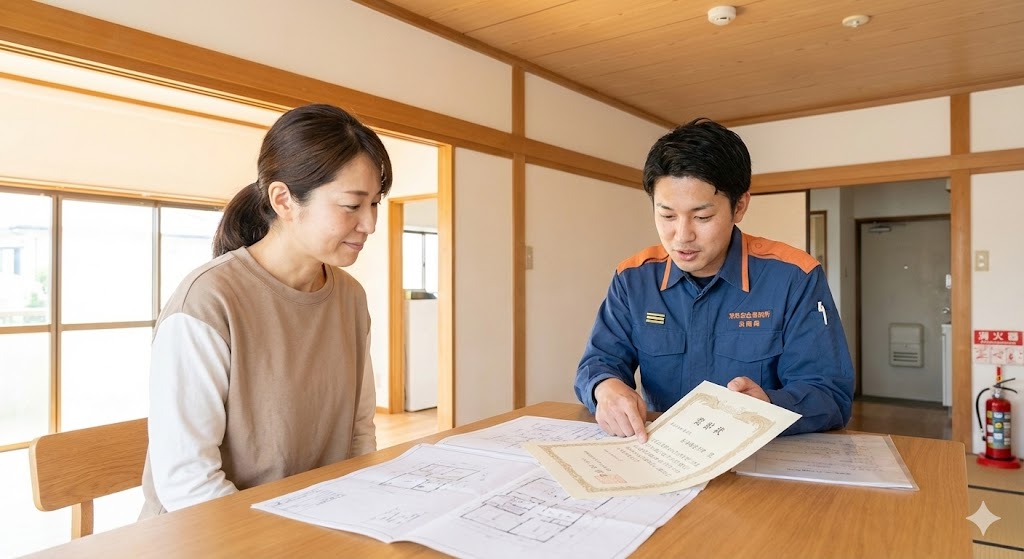
Bring the building’s floor plan and confirm exactly what equipment will be required for your intended minpaku use.
[Important] This is the single most critical point!
If you install equipment purchased online based on your own judgment, and it doesn’t meet the required standards, it will all be wasted effort. Interpretations can vary between fire department staff, so always follow the guidance of the fire department that has jurisdiction over your specific property.
Step 2: Installation of Fire Safety Equipment
Install the equipment based on the requirements confirmed during your preliminary consultation.
You can install fire extinguishers and curtains yourself, but installing an automatic fire alarm system or emergency exit signs requires hiring a nationally licensed **”fire equipment technician” (消防設備士)**.
Get quotes from specialized contractors and proceed with the installation work. At this stage, you should also begin preparing the “Installation Notification” document to be submitted to the fire department.
Step 3: Submit the Certificate Application
Once installation is complete, submit the following documents to the fire department:
- Fire Safety Compliance Certificate Application: The formal request for the certificate itself.
- Notification of Commencement of Use for Fire-Protected Building: A declaration that you’re beginning to use the building as a minpaku facility.
- Notification of Installation of Fire Safety Equipment (or Specialized Fire Safety Equipment): A report confirming that equipment has been installed as instructed.
Once these documents are accepted, you’ll move on to scheduling the on-site inspection.
Step 4: On-Site Inspection by the Fire Department
Fire department inspectors (typically two) will visit the property in person.
They will thoroughly check whether the equipment matches the submitted floor plan, whether the smoke/heat detectors function properly, and whether flame-retardant labels are attached to curtains and other items.
If any deficiencies are found, you’ll be issued a list of “corrective points” and required to undergo a re-inspection. To pass on the first attempt, it’s common practice to have a specialized contractor present during the inspection.
Step 5: Issuance of the Certificate
Once you pass the inspection, the Fire Safety Compliance Certificate will typically be issued within a few days to about a week.
A small fee (typically a few hundred yen) may apply when receiving the certificate. With this in hand, you can finally proceed to filing your minpaku business notification (or license application).
Common Pitfalls Beginners Should Watch Out For
Let’s look at some common troubles that trip up many first-time minpaku owners when obtaining the Fire Safety Compliance Certificate. Knowing about these ahead of time can save you unnecessary costs and delays.
Pitfall 1: Increased Costs from “Windowless Floor” (無窓階) Classification
This is by far the most alarming scenario.
Even if a room has windows, it can still be classified under fire safety law as a “windowless floor” (無窓階) depending on the size, shape, or presence of security bars/grilles on those windows.
If a floor is classified as windowless, it’s deemed to present greater evacuation risk, triggering requirements for far more expensive fire safety equipment and stricter overall standards.
Don’t assume you’re safe just because your room has windows—always confirm the effective opening size of your windows during your preliminary consultation.
Pitfall 2: Approval from Building Management Associations or Landlords
When running a minpaku business in a rented property or condominium unit, attaching a “letter of consent from the property owner” or “copy of the management regulations” to your fire department application is not strictly required (since the Fire Service Act is concerned purely with building safety).
However, if you carry out construction work without permission—installing detectors, drilling holes in walls, and so on—you’re likely to run into disputes when you eventually move out. Always obtain approval from the property owner or management association before proceeding with any fire safety equipment installation work.
Pitfall 3: Schedule Delays
Fire departments operate by appointment. In areas with a high concentration of minpaku properties, or during busy periods such as fiscal year-end, it’s common to find that preliminary consultation slots are fully booked, or that inspections are scheduled two weeks or more out.
To minimize the period during which you’re paying rent but unable to operate, it’s crucial to move quickly the moment you secure a property.
Conclusion: Investing in Safety Is the First Step Toward Building Trust
Obtaining a Fire Safety Compliance Certificate may feel like a tedious and costly procedure. But it’s far more than a mere legal requirement—it’s one of the most important investments you can make to protect your guests’ lives.
If a fire were to break out and proper equipment weren’t in place, the results could be catastrophic—not just for your guests, but for neighboring residents as well. Conversely, holding this certificate serves as official proof that “this facility is safe,” which directly builds trust with your guests.
If handling this process on your own feels overwhelming, consider bringing in professional support. Building a safe, secure facility is the foundation of a minpaku business that guests will keep coming back to for years to come.
Let Us Handle All the Complicated Fire Safety Procedures for You
“I’m anxious about the preliminary consultation with the fire department—it’s all so full of technical jargon.”
“I have no idea which fire equipment contractor is affordable and trustworthy.”
“I want a one-stop solution covering everything from construction to paperwork to inspection attendance.”
If any of these concerns sound familiar, we’d love to help.
At Stay Buddy Inc., we’re minpaku management professionals offering comprehensive support from property setup through ongoing operations.
Here’s what we provide:
- ① Cost-effective equipment recommendations through our network of partnered fire equipment technicians
- ② Complete management of complex fire department consultations and paperwork on your behalf
- ③ Full support from inspection attendance through certificate delivery, so you don’t have to lift a finger
We handle all of this quickly and efficiently, helping you open for business in the shortest time possible.
We’re also happy to hear from you even if you’re still at the stage of wondering, “Can this particular property even get approved?”
As your partner in building a successful minpaku business, please don’t hesitate to reach out to us.