Leave Your Vacation Rental Management to Us
Free Online ConsultationBreaking the Language Barrier: What Does True Hospitality Look Like for International Guests?
With the rapid recovery of inbound demand, it’s now completely normal to spot international travelers in hotel lobbies or at the entrance of a vacation rental.
Full occupancy is certainly something to celebrate, but owners and staff on the front lines are often crying out with concerns like these:
“I can’t speak English, so serving guests feels terrifying.”
“I couldn’t explain the house rules properly, and it led to a problem.”
“I want to share the charm of Japan, but the words just won’t come out.”
The language barrier can be a major source of stress for both hosts and guests alike. But this is not a reason to give up.
What travelers around the world are looking for isn’t fluent English delivered like a speech. What they truly want is **”an environment where they can stay with peace of mind” and “a genuine sense of being welcomed.”**
Let’s start with the conclusion of this article.
The essence of hospitality that satisfies international guests isn’t about relying too heavily on “verbal” communication—it’s about maximizing your total communication power through three complementary approaches: “Visual,” “Technology,” and “Heart.”
In this article, we’ll thoroughly explain practical strategies and know-how that anyone can put into practice—even without confidence in a foreign language—to break through the language barrier and win over your guests’ hearts.
“Perfect English” Isn’t Necessary! What Guests Truly Want
First, let’s let go of the “English complex” that many of us Japanese tend to have.
Most travelers—including those from non-English-speaking countries—don’t expect “perfect English.” What actually worries them is whether their requests will be understood, and whether they’ll get help if something goes wrong.
Even clumsy English delivered with genuine effort and a warm smile leaves a far better impression than fluent but cold service. What matters most is showing your guest “I want to communicate with you.”
[The Visual Approach] Creating an Environment That “Speaks for Itself”
To minimize the need for verbal explanations, make the most of visual information. This ties in closely with the concept of “universal design.”
Make Full Use of Pictograms and Photos
Uniquely Japanese customs—like “please take off your shoes” or “please sort your trash”—are hard to convey through lengthy written explanations.
- A shoe icon with an X mark: This makes no-shoes areas instantly recognizable.
- Real photos of trash items: Posting actual photos of burnable trash, plastics, cans, and bottles above the trash bins eliminates confusion about sorting.
- Remote control operation guides: Japan’s multi-function air conditioners and washlets can be baffling to foreign guests. Add English labels to key buttons, and place a photo-illustrated step-by-step guide in the room.
Introducing Video Manuals
For instructions that involve physical actions—like “how to lay out a futon” or “how to open the key box”—video is the ideal format.
By posting a QR code in the room that guests can scan with their smartphone to instantly access a video explanation, guests can learn at their own pace, and inquiries to staff drop dramatically.
[The Technology Approach] Let Technology Be Your “Interpreter”
We’re now surrounded by convenient tools designed to break down language barriers. Let’s actively adopt them to ensure accurate communication.
Utilizing Translation Tools and Devices
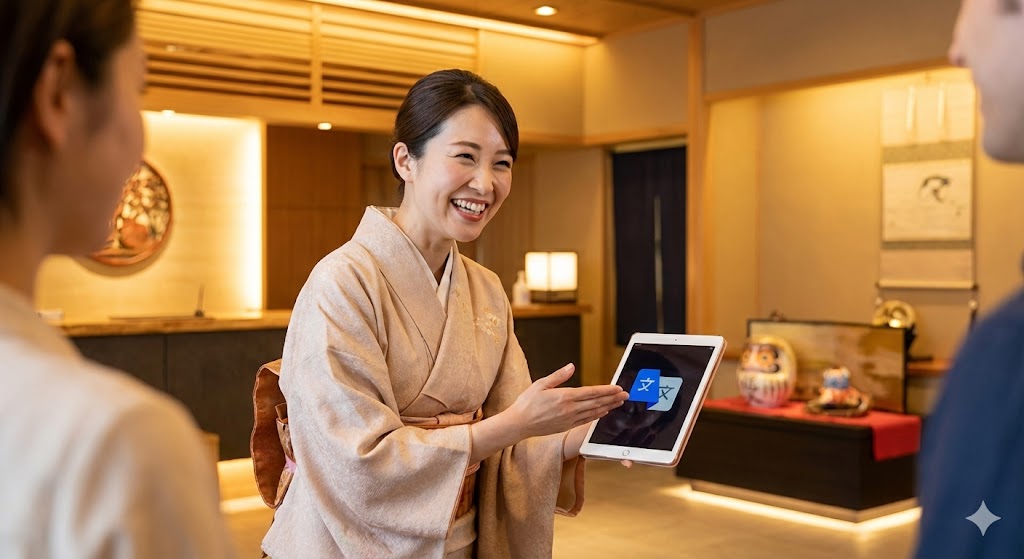
Keeping a translation device like “Pocketalk” at the front desk is a basic must. It’s also effective to install “Google Translate” or “DeepL” on a tablet and converse using voice input.
What matters most is demonstrating a proactive attitude of “let’s communicate, even if it means using a tool.” Conversing while sharing a screen together can even create a surprising sense of connection.
Introducing Digital Guidebooks
Rather than a paper binder, create a digital guidebook that can be viewed online.
Compile recommended restaurants, transportation guidance, and emergency contact information, then send the link at the time of booking confirmation or before check-in. With a browser’s automatic translation feature, guests can read the information in their native language, ensuring a stress-free stay.
Templating Your Message Responses
Create templates for frequently asked questions in your OTA and email exchanges.
By preparing messages for each phase—”before check-in,” “during the stay,” and “after check-out”—in natural, native-checked English (or Chinese/Korean), you’ll be able to respond promptly and courteously every time.
[The Heart Approach] Understanding and Respecting Cultural Differences
Behind every language barrier lies a “cultural barrier.” By understanding your guests’ cultural backgrounds, you can prevent trouble before it happens and boost their overall satisfaction.
From a “Culture of Inference” to a “Culture of Explicit Communication”
Japan is a “high-context culture” (where things are understood without being said), while much of the Western world operates as a “low-context culture” (where things must be clearly stated).
Let go of assumptions like “surely they’ll be quiet, it’s just common sense.” Instead, state rules clearly and specifically—for example, **”Please be quiet after 10 pm”**—for everyone’s benefit.
Explaining the “Why” Behind Japanese Customs
Rather than simply saying “you can’t do that,” explain the cultural reasoning behind a rule. Guests will not only understand—they’ll often enjoy it as a genuine cross-cultural experience.
- Why we take off our shoes: “Because it’s a clean culture where we sleep on futons laid directly on the floor.”
- Why we don’t wash our bodies in the bathtub: “Because the whole family shares the same clean bathwater.” Adding a positive reason like this transforms a rule from a restrictive burden into a doorway to Japanese culture.
Surprises and Personal Touches
You don’t need words to create a truly memorable moment.
- Leave an origami crane along with a handwritten message card (even just “Welcome!” is enough).
- Learn “hello” and “thank you” in your guest’s native language and greet them with it.
- Prepare a map of nearby restaurants that accommodates dietary restrictions such as halal or vegan options. The fact that “someone prepared this just for me” speaks volumes about your hospitality—far more eloquently than any fluent English ever could.
Conclusion: The Language Barrier Is a Chance to Bridge Hearts
The “language barrier” is far from being purely a negative.
The time spent trying to reach each other—wanting to convey something and wanting to understand—can sometimes create a deeper form of communication than ordinary service ever could.
Visual ingenuity, the smart use of technology, and a heart that respects others—combine these three elements, and the language barrier transforms into a “door” that connects you with people from all over the world.
Have the confidence to deliver hospitality that’s uniquely Japanese—and uniquely yours—to the world.
Let Us Professionals Handle That “Multilingual Support” For You
“I don’t have the time or resources to implement new technology or create guidebooks…”
“Realistically, handling trouble in English 24/7, 365 days a year is just not feasible.”
“I want proven know-how to prevent cultural misunderstandings before they happen.”
Please feel free to bring these concerns to us.
Stay Buddy Co., Ltd. is a team of professionals specializing in inbound-focused vacation rental and hotel management.
We’re not just a translation service.
- A 24/7, 365-day multilingual call center that instantly resolves guests’ concerns
- House manuals and digital guides created from a native speaker’s perspective that communicate intuitively
- Precise rule communication and communication strategies that prevent cultural friction before it starts
We provide all of this as a one-stop solution, building an environment where owners can maximize both revenue and guest satisfaction without ever being held back by the language barrier.
All you need to focus on is welcoming your guests with a smile.
We’ll take care of all the troublesome multilingual support and issue handling.
To create a property that guests from around the world will say “I want to come back!” about—start with a free consultation. We look forward to hearing from you.