Leave Your Minpaku Management to the Experts
Completely Free Online ConsultationFor Those About to Start a Simple Lodging Business: A One-Stop Guide from Licensing to Launch
As inbound demand makes a full-fledged recovery, “minpaku” (private lodging) is drawing attention as a new standard for real estate utilization. Among the available options, more and more people are considering entering the market not through the “Private Lodging Business Act,” which limits operations to 180 days a year, but through **”Simple Lodging” (a category under the Hotel Business Act), which allows 365-day-a-year operation and maximizes profitability.**
However, opening a simple lodging facility involves far more than just renting out rooms. It is a major undertaking that requires obtaining strict legal permits—just as hotels and ryokan must—and building a professional operational structure as a licensed “accommodation facility.”
Let us give you the conclusion of this article up front.
The success or failure of a simple lodging business hinges on **”making the right legal judgments at the property-selection stage” and “seamlessly connecting the process from licensing to the start of operations.”** If you treat these steps as separate, disconnected tasks, you’ll end up wasting time and money—and in the worst case, you may not be able to open your business at all.
In this article, we’ll walk you through the entire process—from finding a property, to obtaining the necessary permits, to welcoming your first guest—from a professional’s perspective, so you can understand it all as one seamless journey.
Why Choose “Simple Lodging” Now?
Before diving into the specific steps, let’s revisit the advantages of choosing Simple Lodging (under the Hotel Business Act).
1. Overwhelming Revenue Potential with “365 Days”
The biggest weakness of the Private Lodging Business Act is the 180-day annual operating limit. This makes it difficult to cover rent, loan payments, and fixed costs while generating solid profits. Simple Lodging, on the other hand, allows operation 365 days a year. You won’t lose a single day of peak-season revenue during Golden Week, summer vacation, or the New Year holidays, allowing you to maximize your earnings.
2. Increased “Asset Value”
A property that has obtained a hotel business license carries the value of an “income-generating property (hotel)” rather than a mere residence. When it comes time to sell, properties with an operating license tend to be more highly valued by investors.
3. Trust and Guest Appeal
Because your property clears strict legal standards, you can offer guests genuine peace of mind and safety. In addition, properties are more likely to rank higher on hotel-oriented OTAs (booking platforms) like Booking.com and Expedia, giving your marketing reach a significant boost.
[Phase 1: Property Selection & Preliminary Research] The Biggest Hurdle
This is the most critical—and most failure-prone—phase in opening a simple lodging facility. Your ability to identify a “property that can obtain a license” is put to the test here.
Clearing the “Zoning” Hurdle
Hotel businesses cannot be operated just anywhere. They are subject to restrictions under the “use zones” designated by the City Planning Act.
As a general rule, you cannot operate in a “residential-only zone” (such as Category 1 or 2 Low-Rise Exclusive Residential Zones). When searching for a property, always check the municipality’s zoning map first to confirm the location falls within an area where hotel operation is permitted, such as a “commercial zone,” “neighborhood commercial zone,” or “quasi-industrial zone.”
Estimating “Fire Safety Equipment” Costs
Aside from the property acquisition cost itself, fire safety equipment represents the largest initial investment.
Simple lodging facilities are subject to stricter fire safety standards than ordinary residences. Depending on the size and structure of the building, you may be required to install an “automatic fire alarm system,” which alone can cost anywhere from around ¥1 million to several million yen. A common cautionary tale is: “I thought I got a great deal on the property, only to have to give up the plan because the fire safety construction costs blew way past my budget.”
Confirming the “Certificate of Inspection”
In principle, a “certificate of inspection” proving that the building complies with the Building Standards Act is required for the license application. If this document has been lost for an older property, obtaining a replacement or having a compliance survey conducted can be very costly and time-consuming.
[Phase 2: Licensing Application & Construction] Negotiating with Authorities and Building the Space
Once you’ve secured a property, you’ll need to move forward simultaneously on preparing your government applications and building the physical space to welcome guests.
“Preliminary Consultations” with Three Government Offices
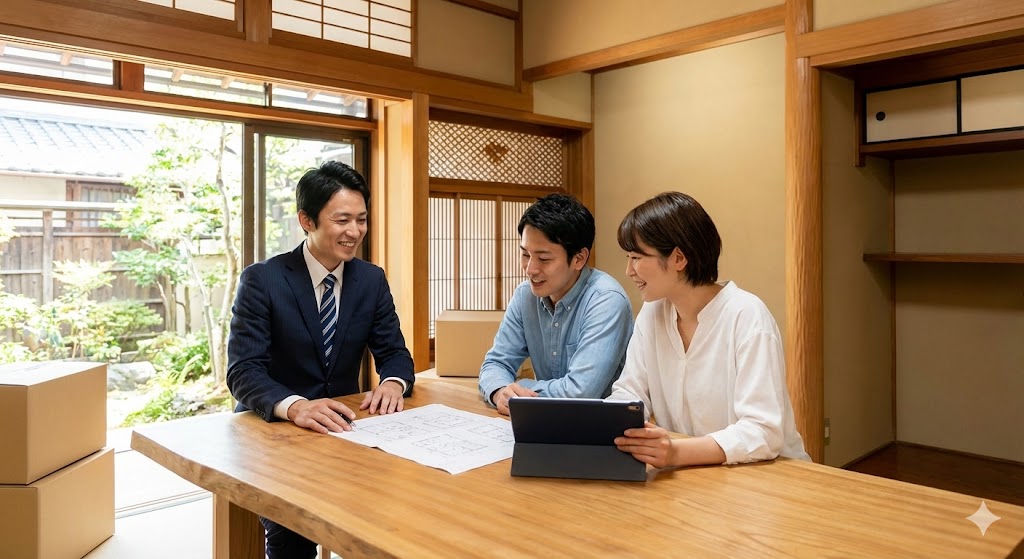
Before starting construction, always bring your floor plans to consult with the following offices:
- Public Health Center: Regarding Hotel Business Act standards (guest room size, number of toilets/washrooms, whether a front desk is required, etc.).
- Fire Department: Regarding the types of fire safety equipment required and their installation locations.
- Building Guidance Division: Regarding change-of-use requirements under the Building Standards Act and ensuring proper evacuation routes.
Use the guidance you receive from these preliminary consultations to finalize your design plans. Any misunderstanding at this stage can lead directly to costly rework later, so we strongly recommend having a specialist (an administrative scrivener or architect) accompany you.
Construction and Fire Safety Inspection
Based on the finalized plans, you’ll carry out interior renovations and install fire safety equipment. After construction is complete, a fire department inspector will conduct an on-site inspection, and upon passing, a “Certificate of Fire Safety Compliance” will be issued. Without this document, you cannot submit your official application to the public health center.
Formal Application to the Public Health Center and License Approval
Gather the required documents—including the fire safety certificate, floor plans, and (depending on the municipality) a report on neighborhood notification—and submit your application to the public health center. Following this, a health center inspector will conduct an on-site inspection, and if there are no issues, a “Hotel Business Operating License” will be issued a few weeks later.
[Phase 3: Operational Preparation & Launch] Becoming a Facility Guests Choose
Obtaining your license is not the finish line—it’s the starting point of your business.
Crafting Your “Photos” and “Listing”
When it comes to attracting guests on OTAs (Airbnb, Booking.com, etc.), photos are everything. Rather than relying on amateur smartphone shots, hire a professional photographer to capture bright, appealing images using a wide-angle lens. Your listing description should also incorporate keywords that resonate with your target audience (inbound travelers, families, etc.) while being crafted with SEO in mind.
Building Your Operational Workflow
- Cleaning & Linen: Arrange for a cleaning company that can maintain hotel-level cleanliness.
- Guest Support: Establish a system that can handle inquiries 24/7 in multiple languages.
- Pricing Strategy: Implement “dynamic pricing,” adjusting nightly rates based on analysis of nearby competitors and local events.
Establishing a Rapid-Response System
Simple lodging facilities require a system that allows for a swift on-site response in an emergency (either by living nearby or contracting with a management company). Be prepared to respond immediately to neighborhood complaints or equipment breakdowns.
Conclusion: Simple Lodging Is a “Team Effort”—Partnering with Professionals Is the Shortcut to Success
Opening a simple lodging facility requires real estate knowledge, legal expertise, construction and fire safety know-how, and hotel management experience all at once—it’s truly a total team effort.
Trying to handle all of this perfectly on your own will consume enormous amounts of time and energy, and ultimately lead to missed opportunities. The saying goes, “leave it to the experts.” By entrusting the specialized tasks to professionals, you as the owner can focus on the business decisions that matter most—what kind of concept your lodging should have and how to maximize revenue—which is the fastest route to success.
Let Us Be Your “One-Stop” Partner Through It All
“Coordinating separate vendors for property selection, licensing, and operations seems overwhelming…”
“I don’t want to waste my investment because of a mistake in judging fire safety or building codes.”
“I want to entrust marketing and operations after opening to a trustworthy partner, too.”
If any of these concerns resonate with you, please reach out to us.
We at Stay Buddy Inc. are a total-production company for the accommodation business, involved from the property-selection stage through licensing and all the way to post-launch operational management—all under one roof.
We provide:
- ① Failure-proof “property searches” and “legal research” premised on obtaining a hotel business license
- ② Smooth “licensing applications” and “cost-conscious construction” through our team of specialist partners
- ③ “Professional operations” that combine AI with a human touch to maximize post-launch revenue
We support you comprehensively across all of these areas.
By consolidating everything through a single point of contact, we eliminate wasted costs and time lags, getting your business up and running as quickly as possible.
If you’re thinking, “I want to start a simple lodging business,” we’d love to hear about your vision first. In a free consultation, we’ll propose the plan that’s right for you.