Leave Your Minpaku Management to the Experts
100% Free Online ConsultationThe Pros and Cons You Need to Know Before Starting a Minpaku Business
Making use of a vacant room or property, “minpaku” (private lodging) offers the potential for higher returns than standard rental management. With the full recovery of inbound tourism demand and tailwinds like the 2025 Osaka-Kansai Expo, it’s once again attracting attention as an appealing business venture or side hustle.
However, if you focus only on the glamorous side and jump in for the simple reason that “it looks profitable,” you may run into unexpected troubles and costs—and end up regretting it, thinking “this isn’t what I expected.”
Let us share the conclusion of this article upfront.
Minpaku is a business where great potential (advantages) and serious pitfalls (disadvantages) are two sides of the same coin. The key to success is calmly weighing both sides before you begin, and judging whether it truly fits your circumstances and risk tolerance.
In this article, we’ll give you a completely candid, thorough breakdown of the “pros” and “cons” you absolutely must know before taking your first step into the minpaku business.
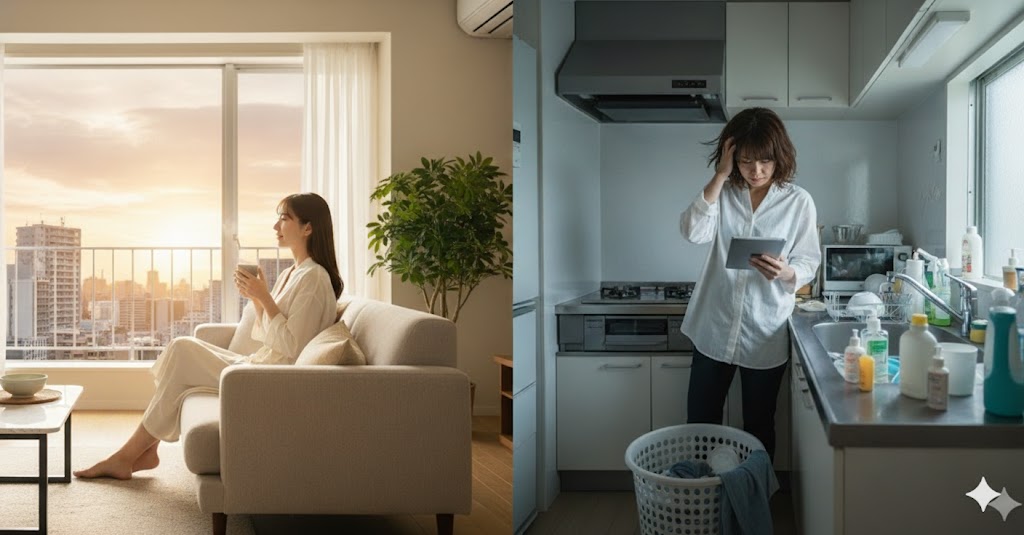
5 “Advantages” of Starting a Minpaku Business (The Bright Side)
1. Overwhelming “Profitability” Potential
This is the biggest draw that attracts most people to this business.
- Achieving high unit prices: While standard residential rentals charge rent on a “monthly” basis, minpaku lets you set accommodation rates on a “per-night” basis. Especially during peak periods like weekends, holidays, and tourist seasons, by raising prices in response to demand (dynamic pricing), it’s possible to earn the equivalent of a full month’s rent in just a few days to a week.
- Achieving high occupancy: Since you can target travelers from all over the world, with the right marketing and pricing strategy, it’s possible to maintain a high occupancy rate throughout the year.
2. Turning “Idle Assets”—Vacant Homes and Rooms—Into Income
A “vacant house” that costs you property tax and maintenance fees just by owning it, or an unused “spare room” in your own home—these are “idle assets” that have never generated income. Minpaku allows you to transform them into a **direct source of revenue (a cash-flow-generating asset)**.
3. Diverse “Exit Strategies” and “Flexibility”
- Easy to exit: Unlike ordinary rentals, minpaku isn’t bound by the Act on Land and Building Leases. Even if the business doesn’t go well, you can relatively easily withdraw or repurpose the property.
- Compatible with personal use: For example, you can rent out a vacation home as a minpaku only during the periods when you’re not using it—a flexible arrangement.
- Added value at resale: A property that has obtained a “hotel business” license allowing 365-day operation can potentially be sold at a higher price than a standard property, as a **”high-yield property.”**
4. “Contributing” to the Local Community and International Society
- Revitalizing the local economy: When guests staying at your property spend money at nearby restaurants and shops, you’re directly contributing to the local economy.
- International and cultural exchange: Through interactions with guests, you can experience different cultures firsthand and share the appeal of Japan directly (especially in host-occupied properties). This provides a sense of fulfillment that money simply can’t buy.
5. “Skill-Building” for Owners
Running a minpaku business is like the ultimate business school, offering hands-on experience in every skill needed to run a business—real estate, law, construction, finance, marketing, IT, language ability, and hospitality service. The experience you gain here becomes a valuable asset for your entire career.
5 “Disadvantages” of Starting a Minpaku Business (The Dark Side)
Wherever there is light, there is also shadow. Whether you can face these disadvantages head-on and take countermeasures against them is what separates success from failure.
1. [The Biggest Hurdle] The “Complexity” and “High Barrier” of Regulations
“Minpaku” doesn’t simply mean “list it on Airbnb and you’re good to go.” To operate legally in Japan, you must complete administrative procedures under one of the following laws:
- Hotel Business Act (Simple Lodging): Allows 365-day operation, but you must clear strict standards regarding zoning (properties in residential-only zones are generally not allowed), the Fire Service Act, and the Building Standards Act, and obtain a “license.”
- Private Lodging Business Act (the “New Minpaku Law”): Limits operation to 180 days per year, and many municipalities further restrict operations with their own additional local ordinances.
- Special Zone Minpaku: Allows 365-day operation, but only in designated special zones such as Osaka City, and comes with a minimum stay requirement (e.g., 2 nights/3 days or more). Many people give up on opening a minpaku business entirely because they can’t meet these legal requirements.
2. [The Biggest Source of Stress] The Risk of “Neighbor Disputes”
This is the most serious risk—one that can threaten the survival of your business.
- Noise: Complaints from neighbors due to guests being loud late at night or the rattling of suitcase wheels.
- Garbage disposal: Guests who don’t follow Japan’s complex waste-sorting rules, causing etiquette violations at garbage collection sites.
- Security concerns: A vague sense of unease among other residents about strangers constantly coming and going in the building. If these disputes escalate, in the worst case, a condominium’s management association may demand that operations be halted, making it difficult to continue the business.
3. The Burden of Tedious “Operational Work” and “24-Hour Support”
Minpaku is not “passive income” that ends once you’ve bought or rented out a property.
- Day-to-day operations: Reservation management, updating OTA listings, price adjustments, restocking supplies, and responding to countless guest inquiries (“What’s the Wi-Fi password?” “How do I unlock the door?”) occur around the clock, 365 days a year.
- Cleaning quality control: Every guest checkout requires hotel-level, spotless cleaning and linen changes. Consistently maintaining and managing this level of quality demands significant effort.
- Handling emergencies: You must respond to urgent issues—like “there’s no hot water” or “I lost my key”—regardless of whether it’s the middle of the night or early morning.
4. “Revenue Instability” and “Cost Structure”
- Fluctuating demand: Revenue is heavily influenced by external factors such as tourist seasons, the economy, global affairs, and pandemics.
- High variable costs: Even when you generate revenue, variable costs tied to sales are deducted—such as OTA fees (approx. 15%), cleaning fees (approx. 10%–30%, depending on the company and scope of service), and property management fees (approx. 10%–30%, depending on the company and scope of service).
- The pressure of fixed costs: Even with zero revenue, fixed costs such as rent, loan repayments, and utility bills are due every single month.
5. The Risk of “Property Damage and Theft” by Guests
- Accidental damage: The risk of guests accidentally breaking furniture or damaging walls.
- Malicious theft: The risk of items like game consoles, small appliances, or stylish decor being deliberately taken. These repair and replacement costs become unexpected expenses that eat into your profits.
Conclusion: Do You Have What It Takes to Be a “Business Owner”?
Now that we’ve compared the pros and cons, do you have a clearer picture?
Minpaku is not an easy business you can profit from casually on the side. It is a full-fledged **”business” that demands wide-ranging expertise—in law, real estate, marketing, and risk management—along with steady, day-to-day effort.**
Can you anticipate all of these disadvantages (i.e., risks) in advance and put concrete countermeasures in place to address them (for example, outsourcing to a property management company, taking out insurance, or setting strict house rules)?
Only for those who have the **mindset of a true “business owner”** can minpaku become an attractive option that delivers substantial returns.
Let Our Professionals Turn That “Mindset” Into a Real “Business”
“The advantages sound appealing, but I’m not confident I can manage the disadvantages (risks) on my own…”
“My main job keeps me too busy—there’s no way I can handle 24-hour guest support and cleaning management.”
“More than anything, I feel like I’d give up right at the start, faced with all those complicated legal procedures…”
If any of these concerns sound familiar, please come talk to us.
We at Stay Buddy Inc. are not just another minpaku property management company. We are professionals in business launch and operations, taking on every disadvantage (risk and hassle) that you might otherwise face, on your behalf as the owner.
We support you by:
- Supporting the “start” of your business—from ①selecting the ideal “legal license” (such as under the Hotel Business Act) for your business plan to fully handling the complex licensing and permit application process on your behalf.
- Taking on all aspects of day-to-day “operations,” including ②24/7 multilingual guest support, hotel-quality cleaning management, and prompt response to neighbor disputes.
- Maximizing your property’s “revenue” through ③data-driven pricing strategy.
You, as the owner, can focus on “business decisions.”
Leave the most difficult and most tedious parts of running a minpaku business entirely to our professional team in Osaka. We’re here to help make your minpaku business a success—in the shortest, most reliable way possible.