Leave Your Minpaku Management to the Experts
Free Online ConsultationPrepare for the Next Pandemic: How to Build a Minpaku That Domestic Guests Will Love
The COVID-19 pandemic had an immeasurable impact on our society, and for the hospitality industry—particularly minpaku operations that relied heavily on inbound demand—it was truly a crisis of survival. You surely haven’t forgotten those days when borders closed and foreign tourists literally vanished overnight.
Today, inbound demand has made a powerful recovery, and many minpaku properties have regained their vitality. But take a moment to consider: “What if a second or third pandemic strikes?” Or what if a sudden shift in global affairs once again brings inbound travel to a halt?
Let’s start with this article’s conclusion.
The absolute condition for building a resilient, adaptable minpaku business that can survive an uncertain future is to move beyond a “one-trick pony” reliance on inbound guests and instead build a rock-solid customer base that also earns passionate loyalty from domestic (Japanese) travelers.
In this article, we’ll take the painful lessons learned from the pandemic and turn them into fuel for the future, thoroughly explaining concrete strategies for creating minpaku properties that domestic guests keep choosing—no matter how external conditions may change.
Why “Shifting Toward Domestic Guests” Is Now a Lifeline for Your Business
You might be thinking, “Inbound demand is strong right now—why bother with domestic guests?” But that very mindset is a dangerous case of learning nothing from past crises.
1. Breaking Free from the Fragility of Inbound Dependence
The pandemic taught us, painfully, just how fragile and vulnerable inbound demand is to external factors—infectious disease outbreaks, international conflicts, currency fluctuations, and more. Running a business where most of your revenue depends on a single unstable market means constantly living alongside significant risk.
2. The Stability and Sheer Scale of the Domestic Travel Market
By contrast, the domestic travel market is far more stable and much less susceptible to economic swings than the inbound market. Its scale is also enormous—larger, in fact, than the inbound market. You may be letting this stable, massive market slip right through your fingers.
3. Risk Hedging and Revenue Maximization Through “Ambidextrous” Management
Of course, there’s no need to abandon inbound demand. The ideal approach is “ambidextrous” management that meets the needs of both inbound and domestic guests. This allows you to maximize revenue during normal times by capturing both markets, while also giving you the strongest possible risk hedge in a crisis—if one market falters, the other can carry your business forward.
Understanding Your Target: How Do Inbound and Domestic Guests’ Needs Differ?
To build a property that domestic guests will love, you first need to understand what they’re looking for in accommodation—and how that differs from what inbound guests want.
Differences in Values
- Inbound guests: Tend to strongly seek out uniquely Japanese “extraordinary experiences” or opportunities for cultural immersion (tatami mats, shoji screens, anime-inspired aesthetics, and so on).
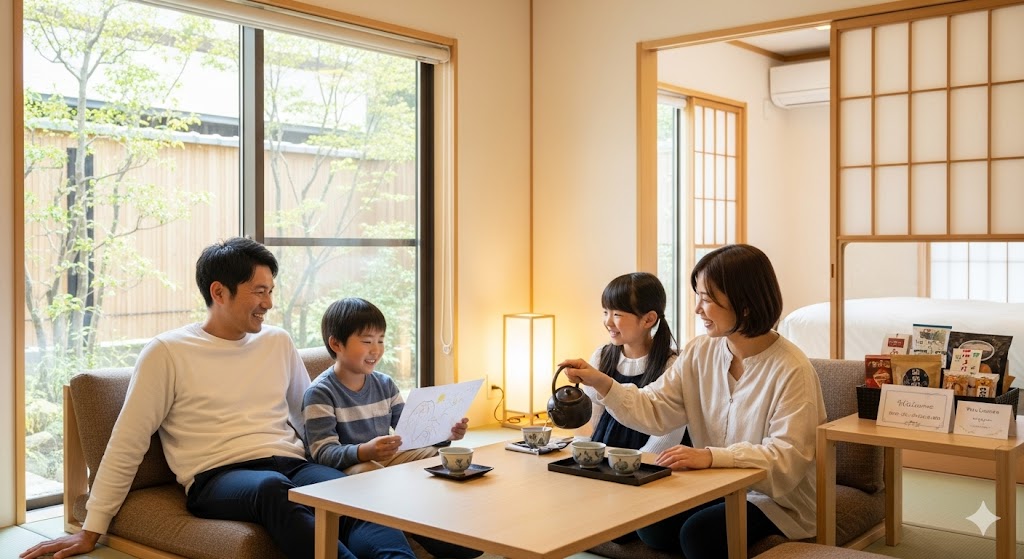
- Domestic guests: Tend to value “a slightly indulgent extension of everyday comfort” and “the relaxation of feeling at home.” Rather than novelty, priority is placed on cleanliness, functionality, and a sense of security.
Differences in Stay Style
- Inbound guests: Often use urban accommodations as a home base, spending their days actively touring sightseeing spots—a “sightseeing hub” style of stay.
- Domestic guests: Increasingly treat the accommodation itself as the destination, wanting to relax and fully enjoy their time within the property—a “full-stay enjoyment” style. Especially since the pandemic, demand for longer stays such as workations and bleisure (business + leisure) trips has also grown.
Differences in Communication
- Inbound guests: Due to language barriers, clear and simple instructions along with visual information (such as pictograms) are essential.
- Domestic guests: More attentive, thoughtful care, personal communication, and in-depth local information have a much greater impact on their overall satisfaction.
[Practical Guide] 7 Secrets to Creating a Minpaku Domestic Guests Will Choose Time and Again
With these differences in mind, let’s look at concrete ways to design a property that wins over domestic guests.
Secret 1: [Most Important] An Almost Obsessive Commitment to Cleanliness
This is the single most important factor that determines how domestic guests will rate your property.
- Wet areas: Enforce a standard of flawless cleaning that tolerates not a single hair or water stain. The cleanliness of the toilet, bath, and sink directly shapes guest ratings.
- Bedding: Sheets and pillowcases should obviously be free of stains and wrinkles, but pay just as much attention to the cleanliness and odor of the futon or mattress itself. Regular cleaning and the use of mattress protectors are essential.
- The whole room: Build and maintain a cleaning operation that catches even the smallest details—dust in floor corners, fingerprints on windows, stickiness on remote controls.
Secret 2: Elevate Your Bathroom to Hotel-Level Comfort
The comfort level of bathrooms in Japanese homes is exceptionally high by global standards. Domestic guests are accustomed to this bar, so there’s no room for compromise.
- Separate bath and toilet: Unit baths tend to be unpopular with domestic guests. If possible, we recommend renovating to create separate spaces.
- Modern fixtures: Washlet toilets, baths with reheating functions, showers with adequate water pressure, and standalone vanities with large mirrors are now considered standard, must-have amenities.
Secret 3: Invest in Bedding That Determines Sleep Quality
Providing high-quality sleep that soothes travel fatigue is the ultimate form of hospitality.
- Mattress: Avoid extremely cheap options. Choose a high-quality mattress with appropriate resilience that makes it easy to turn over during sleep.
- Pillows: Offering multiple pillow types to accommodate different preferences for height and firmness will significantly boost guest satisfaction.
- Linens: Choose high-quality sheets and covers that feel pleasant against the skin and convey cleanliness.
Secret 4: Well-Equipped Amenities for “Living, Not Just Staying”
Especially for extended stays or group bookings, guests expect amenities that let them live as comfortably as they would at home.
- Kitchen: Beyond a refrigerator and microwave, stock a rice cooker, electric kettle, basic cookware (pots, frying pans, knives, cutting boards), and a sufficient number of plates and utensils.
- Laundry facilities: A washing machine—and, if possible, a dryer (or a bathroom drying function)—will earn especially high marks from long-term guests.
- Living space: A spacious living-dining area for meals and relaxation, along with a comfortable sofa, is essential for group guests.
Secret 5: The Best Blend of Japanese Character and Western Comfort
Elements like tatami mats and shoji screens are charming, but on their own they may not suit modern lifestyles.
- Tatami + bed: Preserve the calming atmosphere of a Japanese-style room while using a bed for sleeping.
- Sunken kotatsu + sofa: Let a sunken kotatsu evoke Japanese tradition while also providing a comfortable sofa that won’t leave guests tired after long periods of sitting. This kind of thoughtful balance between traditional Japanese beauty and modern comfort is what guests are looking for.
Secret 6: Clear, Courteous Guidance in Plain Japanese
While it’s natural to provide thorough English signage for foreign guests, for domestic guests, clear and easy-to-understand Japanese instructions are what truly build a sense of reassurance.
- Appliance operation: Prepare guides—with photos or illustrations—explaining the basic operation of air conditioners, water heaters, TVs, washing machines, and other appliances in simple, easy-to-understand Japanese.
- House rules: Clearly state rules regarding noise and garbage disposal not only in foreign languages but also in polite, clear Japanese.
Secret 7: Hospitality with a Human Touch, Plus Local Insights
While unmanned operation is the norm for minpaku, many domestic guests still appreciate a moderate degree of communication with their host.
- A personal welcome: Even a single handwritten line added to a welcome message card conveys real warmth.
- Local recommendations: Guests greatly appreciate an original file of insider tips—delicious local restaurants and hidden gems that you won’t find in any guidebook, known only to the host.
Conclusion: Embrace Change and Keep Evolving with Flexibility
If you settle into complacency based on past success with inbound demand, you’ll end up making the same mistakes again when the next crisis arrives.
Listen sincerely to the voice of the stable, massive domestic market, and continually transform and evolve your property and services to deliver the value guests truly seek. That flexibility is the strongest management strategy for surviving an uncertain future.
Let Us, the Professionals, Accelerate That Evolution
“I understand what domestic guests need—but where do I even start?”
“I want to know a cost-effective way to renovate my current property to appeal to domestic guests.”
“I’d like advice on an operational strategy that maximizes bookings from both inbound and domestic guests.”
If any of these concerns sound familiar, please reach out to us.
At Stay Buddy Inc., we weathered the unprecedented crisis of the pandemic and have built up “ambidextrous” management expertise that generates strong revenue in both the inbound and domestic markets.
Here’s what we offer:
- ① A thorough diagnosis of your property from the perspective of domestic guests, identifying areas for improvement and proposing concrete action plans.
- ② Data-driven dynamic pricing strategies designed to maximize demand from both inbound and domestic guests.
- ③ Optimization of your booking channels—from boosting your visibility on domestic OTAs like Rakuten Travel and Jalan, to building a loyal following through social media.
Build a rock-solid revenue foundation that stays strong no matter how the market shifts.
That’s the value we deliver. Let’s work together to map out a concrete strategy that takes your minpaku business to the next stage. We look forward to hearing from you.