5 Essential Secrets to Property Selection for Anyone Seeking a Hotel Business License in Osaka City
With the historic tailwind of the 2025 Osaka-Kansai Expo, Osaka’s accommodation industry is now attracting more intense attention from domestic and international investors than ever before. The absolute prerequisite for maximizing this enormous opportunity is obtaining the **”Hotel Business Act” (Ryokan Gyo)** operating license, which enables 365-day operation.
However, the most important thing to understand is the harsh reality that a Hotel Business Act license cannot be obtained for just any property.
Let us share the conclusion of this article upfront.
The key to successfully obtaining a Hotel Business Act license in Osaka City is to fully understand the “legal requirements” essential for licensing right from the very first stage of property hunting, and to narrow your search exclusively to properties with realistic potential to clear those requirements.
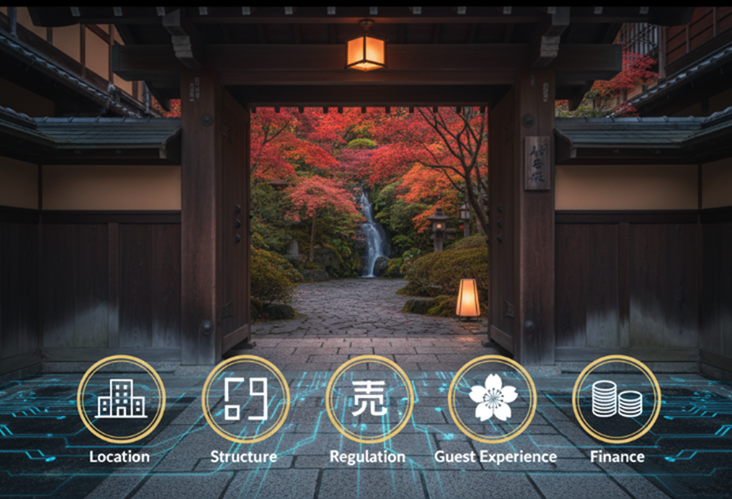
In this article, we—professionals in Osaka minpaku management—will share “5 Essential Secrets” to property selection that will help you avoid wasting precious time and investment.
Why “Hotel Business Act” in Osaka? The Fundamental Premise for Business Success
You might wonder, “Why not just use the 180-day Minpaku Business Act instead?” In the Osaka market, that path proves extremely challenging.
- Osaka City’s strict supplementary ordinances: Osaka City imposes its own particularly strict conditions on top of the national Minpaku Business Act (Private Lodging Business Act), such as restricting weekday operations near schools—among the strictest regulations in the country. This makes it extremely difficult to even fully utilize the 180-day cap, let alone generate meaningful business profitability.
- Maximizing Expo demand: To avoid missing out on even a single day of the explosive surge in accommodation demand expected around 2025, a license enabling 365-day operation is essential.
- Business stability and asset value: The status of a “property with Hotel Business Act license” enhances financing evaluations from financial institutions and adds significant value when it comes time to sell the property in the future.
[The Professional’s Eye] 5 Secrets to Identifying Hotel-Business-Eligible Properties
Now let’s walk through 5 concrete checkpoints for truly identifying, among countless properties, those that “can obtain a hotel business license AND turn a profit.”
Secret 1: [Most Critical] Master the “Zoning District” and You Master Property Hunting
This is the first filter that will make your property search ten times more efficient.
- Explanation: Because hotels and ryokan (guest houses) are classified under Building Standards Act usage as “hotels/ryokan,” they cannot, in principle, operate in **”exclusively residential districts”—such as Category I/II Low-Rise Exclusive Residential Districts and Category I/II Medium-to-High-Rise Exclusive Residential Districts—**which are designated to protect residential living environments.
- Practical tip: Before moving forward with a contract or property viewing for any property you’re interested in, first access Osaka City’s urban planning information site, **”Map Navi Osaka” (Map Navi Osaka)**, and enter the property’s address. Then check the “zoning district” under “Urban Planning Decision Details.” If it falls under **”Commercial District,” “Neighborhood Commercial District,” “Quasi-Industrial District,” or “Quasi-Residential District,”** you’ve cleared the first hurdle. This single step alone can eliminate over 90% of properties not worth considering, right from the initial screening stage.
Secret 2: Confirm the Presence of Documents Proving the Building’s “Legal Compliance”
Next, verify whether the building itself was legally constructed.
- Explanation: When applying for a Hotel Business Act license, official documents proving the building was legally constructed in compliance with the Building Standards Act in effect at the time are mandatory.
- Practical tip: When contacting the real estate company, always confirm whether the owner has both the **”Building Confirmation Certificate” (Kenchiku Kakunin-zumi-sho)** and the **”Certificate of Completion Inspection” (Kensa-zumi-sho)** on hand. The “Certificate of Completion Inspection,” which proves the building passed post-construction inspection, is especially critical. If these documents have been lost for an older property, you must be prepared for a specialist (such as a licensed architect) to conduct a “legal compliance survey” and prepare alternative documentation—which can add hundreds of thousands of yen in extra costs and several additional months to the timeline.
Secret 3: Anticipate Additional Costs from a “Fire Service Act” Perspective
Beyond the property price itself, fire safety equipment installation costs are the single biggest factor influencing your initial investment amount.
- Explanation: Because hotel business facilities are entrusted with the lives of an unspecified number of people, the Fire Service Act imposes extremely strict safety standards. These standards vary significantly depending on the building’s size, structure, and occupancy capacity.
- Practical tip: As soon as you obtain floor plans for a candidate property, visit the **fire prevention division of the jurisdictional fire department** for a “preliminary consultation.” Ask directly: “I’m planning to start a hotel business at this property—what additional fire safety equipment would be required?” This will give you concrete guidance on whether an automatic fire alarm system is necessary (typically the most expensive item), and how many emergency exit lights or fire extinguishers are needed. Accurately grasping potential additional costs—which can run into the millions of yen—before purchase is the key to a failure-free investment.
Secret 4: Read “Occupancy Capacity” and “Business Viability” from the Floor Plan
A property’s profitability is determined by how many guests you can host and at what price.
- Explanation: Licensing for hotel businesses (simple lodging houses) includes floor area requirements for guest rooms (in principle, the total floor area of guest rooms must be at least 33㎡, with a relaxed provision of at least 3.3㎡ per person allowed when accommodating fewer than 10 guests). You need to assess whether a floor plan can maximize occupancy capacity while taking full advantage of this rule.
- Practical tip: Rather than simply looking for a spacious property, examine the floor plan while simulating concrete layout changes to maximize revenue—thinking things like “If I connect this Japanese-style room with the living room, I could create a large room ideal for group guests,” or “I could place a tablet for unmanned check-in in this dead space, as a substitute for a front desk.” You’ll also need to factor in Building Standards Act constraints, such as the fact that rooms without windows (windowless rooms) cannot be counted as guest rooms.
Secret 5: Simulate “True Profitability” Based on Data
Finally, prove with data whether a property will generate “profits that justify the investment.”
- Explanation: Intuitive judgments like “it’s a good location, so it should be profitable” are not investment decisions. You need to calmly evaluate business viability based on objective data.
- Practical tip: Using data analysis tools like AirDNA, along with detailed research on competing facilities, forecast a realistic **ADR (Average Daily Rate) and OCC (Occupancy Rate)**. From the annual revenue calculated based on these figures, subtract all operating expenses (property management fees, cleaning costs, utility bills, property taxes, etc.) to calculate the actual yield. Rigorously scrutinize whether the total initial investment—”property price + renovation costs + fire safety equipment costs”—will generate a return you find satisfactory.
Conclusion: “Hotel Business Property Hunting” Is a Team Effort with Specialists
Searching for a hotel-business-eligible property in Osaka City is now something entirely different from typical real estate hunting. It’s a highly specialized project requiring the mobilization of expertise in law, architecture, fire safety, and market analysis to find that single correct answer among countless candidates: a property that “can obtain a license AND turn a profit.”
And to bring a project like this to successful fruition, teaming up with trustworthy specialists is an absolutely essential condition.
Let Us—Osaka’s Professionals—Be Your Team for This “Property Search”
“I’ve hit my limit trying to research zoning districts and fire safety regulations on my own…”
“I want a professional assessment of whether this property can really obtain a hotel business license.”
“In the first place, where would I even go to find such a property?”
Please feel free to bring these concerns to us.
We at Stay Buddy Inc. are true **”Osaka professionals”** who have successfully guided **numerous hotel business (simple lodging house) license acquisitions—starting from the property search stage—in the fiercely competitive minpaku market of Osaka City.**
- We narrow down the optimal area and property type for your investment strategy, and instantly screen for legal requirements using “Map Navi Osaka” and direct inquiries with government authorities.
- Together with our partner licensed architects and administrative scriveners (gyoseishoshi), we thoroughly assess properties from a Fire Service Act and Building Standards Act perspective.
- And we provide highly accurate revenue simulations based on our extensive track record and data in the Osaka market.
We won’t let you waste a single second of your precious time on properties with no real potential.
Why not clear the most difficult and most critical first hurdle—obtaining a hotel business license—by the shortest possible path, together with us? Because we know the Osaka market inside and out, we can offer value you won’t find elsewhere. We look forward to hearing from you.