What If Osaka City’s Special Zone Minpaku Were Abolished? A Complete Guide to the Hotel Business Act You Need to Know
With the 2025 Osaka-Kansai Expo drawing travelers from around the world, Osaka City is booming. Against this backdrop, “Special Zone Minpaku” (Tokku Minpaku), which allows 365-day operation, has become a trump card that many operators rely on to maximize their revenue.
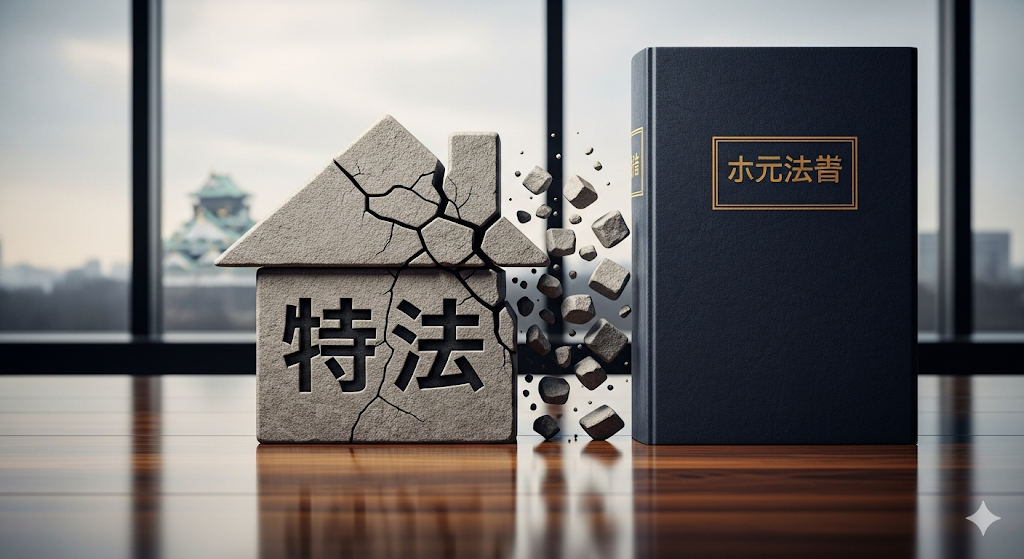
However, have you ever stopped to consider that this Special Zone Minpaku system could, depending on national policy direction, potentially be reviewed or even abolished in the future?
Let us share the conclusion of this article upfront.
If you are serious about the **”longevity” of your minpaku business, it is critically important to understand the risk of depending on Special Zone Minpaku—a “time-limited special measure”—and to start considering, as a safety net, transitioning to the “Hotel Business Act” (Ryokan Gyō Hō)**, a more permanent and stable legal framework.
In this article, to prepare for the future ahead, we thoroughly explain from a professional perspective the fundamentals of the “Hotel Business Act (Simple Lodging)” that you absolutely need to know now, along with its essential differences from Special Zone Minpaku.
Why Should You Consider the Possibility That Special Zone Minpaku Could Be Abolished?
You might think, “Why worry about that when things are going smoothly right now?” However, the wisest operators are always the ones who anticipate the worst-case scenario and act preemptively.
Special Zone Minpaku Is a “Special Exception,” Not a “Permanent Law”
The legal basis for Special Zone Minpaku, the National Strategic Special Zones Act, is a “special law” that temporarily and regionally relaxes the rules of an existing law (the Hotel Business Act) for a specific purpose—in this case, improving the environment for accepting inbound tourists. It’s essential to understand that this “exception” could be reviewed at any time should national policy shift or social conditions change.
The “Backlash” Risk After the 2025 Osaka-Kansai Expo
It is precisely because of this national-scale event, the Expo, that regulatory relaxation to increase accommodation capacity is currently progressing. However, once the Expo ends, if there is an oversupply of accommodation facilities or an increase in trouble with local residents, public opinion could swing sharply toward “stricter regulation.” In that scenario, Special Zone Minpaku, as the exceptional measure, would be the first target for reconsideration.
A Perspective on Business “Longevity”
If you view this business not as a short-term venture ending in a few years, but as a stable asset meant to last 10 or 20 years, its foundation cannot be a castle built on sand, easily swayed by shifting policy winds. Having a stronger, historically more stable legal basis—that is true risk management.
[In-Depth Comparison] What’s the Difference Between “Special Zone Minpaku” and “Hotel Business (Simple Lodging)”?
So, specifically, how does the Hotel Business Act—your safety net—differ from Special Zone Minpaku? Let’s compare five key points from the perspective of preparing for a transition.
1. Legal Stability: “Special Exception” vs. “Principal Law”
- Special Zone Minpaku: As mentioned above, this is based on the National Strategic Special Zones Act, a “special law.” It carries an inherent tendency toward change and instability.
- Hotel Business Act: Enacted in 1948, this “fundamental law” has continued to form the backbone of Japan’s accommodation industry ever since. Deeply rooted as part of the nation’s infrastructure, its stability is in a different league entirely.
2. Differences in Operating Rules: The “Minimum 2 Nights, 3 Days” Requirement
- Special Zone Minpaku: 365-day operation is permitted, but in Osaka City, a **minimum stay of “2 nights, 3 days”** is required.
- Hotel Business Act: 365-day operation is permitted with absolutely no restrictions on length of stay. This allows you to capture customer segments that Special Zone Minpaku misses entirely—single-night business travelers and domestic weekend short-trip travelers—significantly expanding your revenue opportunities.
3. Facility Requirement Hurdles: “Relaxed” vs. “Strict”
This represents the biggest physical hurdle in the transition process.
- Special Zone Minpaku: Some facility requirements are relaxed compared to the Hotel Business Act, such as no obligation to install a front desk.
- Hotel Business Act:
- Front desk installation: In principle required, but in Osaka City, alternative measures using ICT equipment (identity verification via video call plus smart locks, etc.) are widely permitted.
- Guest room floor area: There are standards such as a minimum total floor area of 33㎡ for guest rooms (relaxation measures apply for fewer than 10 guests).
- Fire safety equipment: Depending on the size and structure of the building, installing an automatic fire alarm system is often newly required, and this tends to be the largest additional investment.
4. Difficulty of Procedures: “Certification” vs. “Permit”
- Special Zone Minpaku: This involves a process of receiving “certification” from the local municipality.
- Hotel Business Act: This requires a “permit” from the government, subject to more rigorous screening criteria. The procedural difficulty is significantly higher with the Hotel Business Act.
What Special Zone Minpaku Owners Should Prepare Now for a Transition to Hotel Business Licensing
So, what should you start preparing now to guard against future risks?
1. Diagnose Whether Your Property Can Meet Hotel Business Act Requirements
First, confirm whether your property has the potential to transition to Hotel Business Act licensing.
- Check the zoning classification: As a rule, the Hotel Business Act does not permit operation in “exclusively residential zones.” Re-verify your property’s zoning classification via the city’s website or other resources.
- Identify additional required equipment: Consult with your local fire department and health center to list out what fire safety equipment or other renovations would be additionally required if you transition to Hotel Business Act licensing.
- Consider front desk alternatives: If you currently do face-to-face check-ins, consider introducing ICT equipment (tablets, smart locks, etc.) to switch to unmanned operations.
2. Create a Financial Plan for Additional Investment
Get quotes from specialized contractors on how much the identified additional equipment and renovation work would cost. It’s important to have a financial plan in place so you can act quickly when the time comes.
3. Consult with Experts
Switching your license from Special Zone Minpaku to a Hotel Business Act permit is an extremely specialized and complex procedure. We strongly recommend consulting early with an administrative scrivener (gyoseishoshi) well-versed in minpaku regulations, or with a property management company like us, to get support in creating a concrete roadmap for the transition.
In Summary: The Hotel Business Act Is an “Upgraded License” That Protects Your Business’s Future
Even if you’re currently generating solid revenue under Special Zone Minpaku, there’s no guarantee that stability will last forever.
Enjoy the benefits of the Special Zone Minpaku “exception” to the fullest, while always keeping an eye on the road ahead—staying prepared to transition at any time to the “Hotel Business Act,” an “upgraded license,” so to speak, that offers greater stability and fewer operational restrictions.
That, truly, is the risk management approach of a genuine business owner—one who can survive a rapidly changing market and protect the future of their valuable assets and business.
Ready to Start Preparing for the Future with Us, the Professionals?
“I want an accurate diagnosis of whether my property can meet Hotel Business Act requirements.”
“I have no idea how much the additional costs for a transition would come to.”
“I want an expert opinion on business strategy after the Expo.”
Bring us your concerns—we’re here to help.
Stay Buddy Inc. has been a specialist in this field since the dawn of Osaka City’s minpaku market, having handled numerous licensing acquisitions for both Special Zone Minpaku and Hotel Business Act permits.
We conduct a detailed analysis of your property’s current condition and clearly diagnose exactly what’s missing and how much additional investment is needed to transition to Hotel Business Act licensing. From proposing the most cost-effective renovation plans to handling the complex license-switching procedures on your behalf, we take full responsibility for mapping out a concrete roadmap to maximize the “sustainability” of your business.
A forward-looking business strategy for 2025 and beyond.
Why not take this crucial next step together with us, the professionals of Osaka? We wholeheartedly look forward to consulting with you on building a stronger future for your business.