
Leave Your Minpaku Management to Us
Completely Free Online Consultation5 Foolproof Tips for Choosing a Profitable Rural Minpaku Property
Leaving the hustle and bustle of the city behind to run a minpaku surrounded by nature in the countryside—for many people, this might be the ideal lifestyle. But turning that dream into a viable “business” that actually “makes money” requires a completely different set of success rules than what applies in urban areas.
Let’s start with this article’s conclusion.
If you choose a property based on urban values like “close to the station” or “convenient,” your rural minpaku business is almost guaranteed to fail. A truly profitable property in the countryside is one that becomes a **”stage set that maximizes the unique charm of the land, letting guests become the protagonist of their own story.”**
In this article, we’ll narrow things down to five key points for choosing a foolproof property—one that goes beyond a simple slow-life fantasy and becomes a sustainable business as a rural minpaku.
Why Applying Urban Standards to Property Selection Leads to Failure
To succeed with a rural minpaku, you first need to understand what guests are actually seeking, and then discard the urban yardstick you’d normally use to evaluate a property.
- Guests come seeking “inconvenience”: What guests want isn’t a 24-hour convenience store or a commercial complex near the station. They’re after silence, beautiful nature, and a sky full of stars—an “extraordinary experience” they could never get in the city. Poor accessibility and having nothing around actually becomes a value in itself: “the luxury of doing nothing.”
- The property itself becomes the “destination”: While an urban minpaku serves as a “base for sightseeing,” a rural minpaku often makes “the stay itself the purpose” of the trip. That’s why the property must have a compelling appeal in its own right—in other words, a “story” that makes people want to stay there.
- Guest acquisition is built on “empathy”: Simply listing your property on major booking sites (OTAs) will get it buried among countless other tourist listings. What matters is building a community of “fans” on social media who resonate with your property’s story and your way of life in the region—turning them into guests who book specifically because they chose you.
[Properties That Actually Make Money] 5 Points for Foolproof Selection
Building on the unique characteristics above, here are five concrete checkpoints for identifying a truly “profitable” property in the countryside.
Point 1: [Source of the Concept] Does It Have a One-of-a-Kind “View”?
The greatest weapon a rural property can have is its “scenery.” Whatever view you see from the windows or the veranda directly translates into the property’s value.
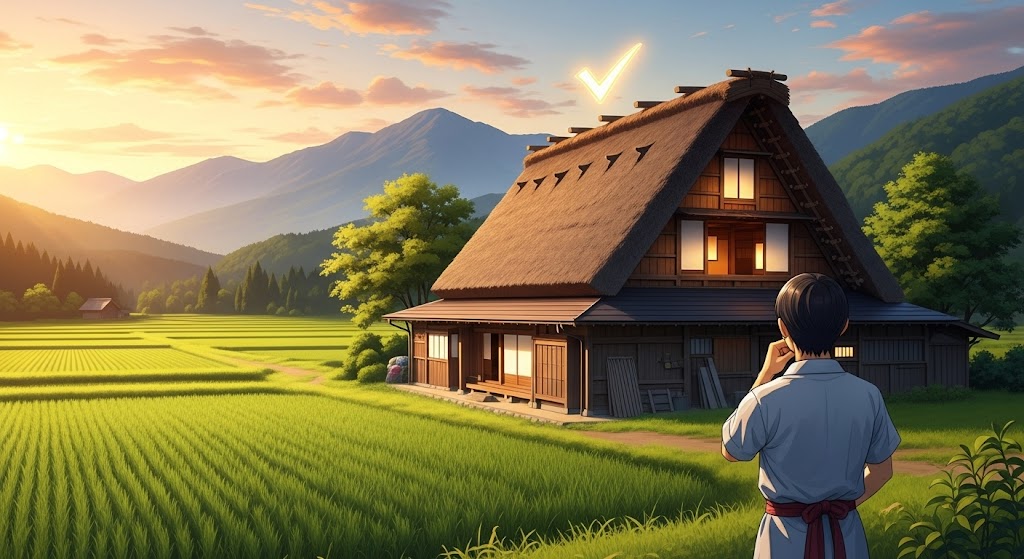
- Think in terms of “borrowed scenery”: Can a window frame the view like a picture frame—terraced rice fields, majestic mountains, a peaceful lakeside, or an endless horizon? This “borrowed scenery” outshines even the most expensive interior decor.
- Silence and darkness: Is the surrounding area free of artificial buildings and roads, with nothing but birdsong and the murmur of a stream to be heard? At night, can you see a sky full of stars, undisturbed by city lights? These are powerful selling points that can captivate guests with just a single photo.
Point 2: [A Vessel for Experience] Does the Building Itself—Such as a Traditional Farmhouse—Have a Story to Tell?
The question here is whether the building itself can become the purpose of the trip.
- The building’s individuality: A property with a unique story of its own—a farmhouse over 100 years old, a former elementary school, a historic storehouse—has tremendous competitive strength. Thick beams, a glossy blackened central pillar, a traditional sunken hearth, an earthen-floored entryway, tasteful fittings and doors—all these features, absent from modern homes, are compelling content in themselves.
- Prepare for renovation costs: That said, never forget that restoring a traditional farmhouse or similar building requires substantial renovation costs. Seismic reinforcement, improved insulation, and a complete overhaul of the plumbing (kitchen, bath, toilet) are essential, and you should be prepared to invest anywhere from several million to over ten million yen. It’s worth checking whether national or local government “vacant house renovation subsidies” are available to help offset these costs.
Point 3: [Expandability] Is There Space to Offer “Experiential Content”?
Rather than separating “stay” from “food,” a rural minpaku should boost its value through an integrated “stay-and-experience” model. Check whether the property has the space to make this possible.
- Garden or field: A kitchen garden space where guests can join in harvesting vegetables or picking herbs.
- Outdoor space: A wooden deck or open area for enjoying BBQs with friends, or a space for a campfire.
- Indoor space: A spacious kitchen or earthen-floored area where guests can cook local dishes together, or a large tatami-free living room where yoga or workshops can be held even on rainy days.
Point 4: [Accessibility] Can You Secure Access That Isn’t “Hopelessly” Remote?
Even a sense of being “off the beaten path” becomes a liability if taken too far—no one will be able to reach the property at all. While creating an extraordinary atmosphere, you need to secure a baseline of practical convenience.
- Access by car: A good benchmark is being within 30–40 minutes by car from a major highway interchange.
- Everyday infrastructure: Being within a 15–20 minute drive of the nearest supermarket or convenience store for grocery shopping and other errands will give guests greater peace of mind.
- Parking space: Check whether you can comfortably secure parking for at least two vehicles for guests.
- Utility and communications infrastructure: Don’t overlook checking whether the area has access to fiber-optic internet, whether the water supply is municipal or well water, and whether sewage is handled by a public system or a septic tank.
Point 5: [Coexisting with the Community] Is the Location One Where You Can Build Good Relationships with Neighbors?
This is the most important—and most delicate—point for succeeding in a rural business.
- A comfortable distance: A property right in the middle of a village, sitting too close to neighboring houses, tends to lead to noise complaints from guests’ voices or car traffic. On the other hand, a completely isolated, standalone house also raises concerns around security and coordination in emergencies. A location at the edge of a village—maintaining a comfortable distance from neighbors—is ideal.
- Laying the groundwork in advance: Before finalizing the purchase or contract for a property, be sure to greet the local district head or other key figures in the community and explain that you intend to operate a minpaku. Gauging whether the community is generally welcoming toward outsiders and new businesses is more important than anything else for avoiding trouble down the road.
Consider the Possibility of Obtaining a Hotel Business Act License
If you’re serious about “making money,” the Minpaku Business Act’s 180-day annual operating limit will cause too much lost opportunity during peak seasons. Many rural properties are located in areas without designated use zoning, which can make it easier to obtain a “Hotel Business Act (simple lodging)” license—allowing 365-day operation—than it typically is in the city. From the property-search stage onward, it’s essential to keep the Hotel Business Act license in mind and evaluate whether the requirements (building structure, road access obligations, etc.) can be met. This perspective is critical for maximizing revenue.
Conclusion: Making Money in the Countryside Means Owning a “Stage for Storytelling”
Choosing a property for a rural minpaku isn’t just a real estate search. It’s the work of unearthing the story dormant in the land and producing the ultimate “stage” where guests can become the protagonist of that story.
Scenery, the building, the experience, and connection with the community—when you combine these elements to create a stage that’s truly one of a kind, you’ll have a “profitable” minpaku facility that’s beloved by guests and free from price competition.
Will That “Rural Property” Really Become a “Profitable Stage”?
“I can sense the property’s potential, but I want an objective evaluation of whether it can actually work as a business.”
“I have no idea how much it will cost to restore this traditional farmhouse.”
“I want to obtain a Hotel Business Act license, but I don’t know where to start.”
Turning the dream of running a rural minpaku into a sustainable “business” requires more than passion—it demands a level-headed business plan and specialized expertise.
We at Stay Buddy Inc., a minpaku management company, have built our business-development capabilities on data gathered from managing numerous properties day in and day out—capabilities that let us identify **”what kind of property will generate revenue, and how.”** That know-how holds true whether the property is located in the city or out in the countryside.
We provide an objective, third-party professional diagnosis of whether the property you’re considering can truly become a “profitable property.” From building highly accurate revenue simulations to researching the feasibility of obtaining licenses, and developing a web strategy to attract your first guests, we offer practical support to ensure your dream of “making money in the countryside” doesn’t remain just a fantasy.
Before taking that big step forward, please make use of our expertise. We look forward to hearing from you.