Trust Us With Your Vacation Rental Management
100% Free Online ConsultationThe Complete Journey: Turning an Old Vacant Property into a Vacation Rental
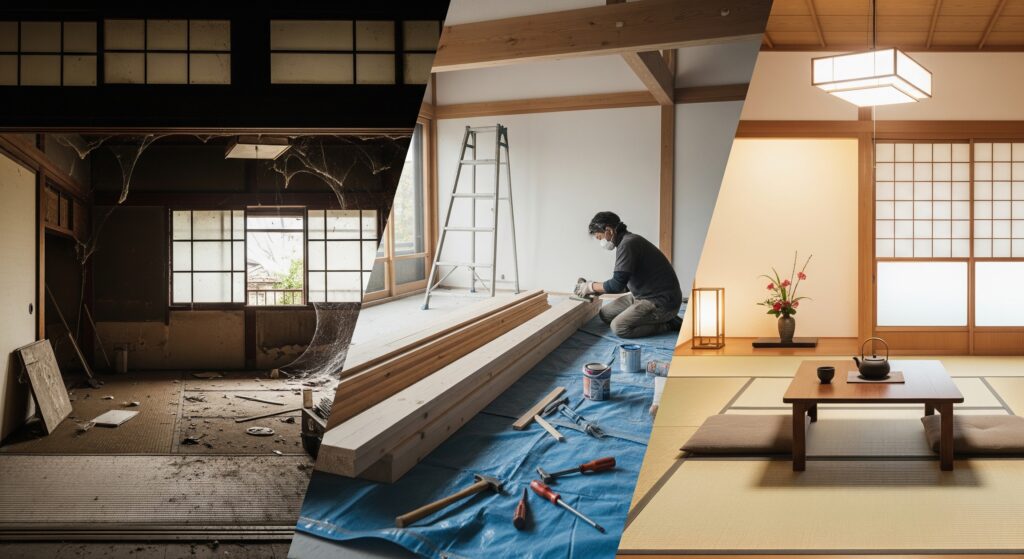
An old family home inherited from your parents, or a house that’s sat empty for years. Demolition is costly, yet leaving it as-is means mounting property taxes with no return—these “old vacant houses” are a genuine headache for many owners.
However, the distinctive character and history held within that old house carry enormous potential. With the right approach, it can be transformed into a truly one-of-a-kind accommodation that captivates travelers from Japan and abroad.
In this article, we’ll walk through the concrete “journey” of reviving an aging property into a thriving vacation rental that generates real revenue—presenting it as a complete roadmap, along with the challenges you’ll need to overcome and how to tackle them.
Why “Old” Properties Are So Appealing for Vacation Rentals Right Now
Older properties offer a unique value that new or nearly-new buildings simply can’t replicate.
- A Unique Spatial Experience: The warmth and depth created by weathered beams, pillars, and fittings that have aged gracefully over the years is something you’ll never find in a standardized hotel. For overseas travelers especially, experiencing traditional Japanese living is an incredibly compelling draw.
- Higher Added Value Through Renovation: By renovating with a concept that embraces the building’s age—such as “wa-modern” (Japanese-modern) or “vintage kominka” (traditional farmhouse) styles—you can dramatically increase the property’s value. This “storytelling” element becomes a powerful differentiator against other properties.
【The Complete Roadmap】Practical Steps to Turn an Old Property into a Popular Vacation Rental
Converting an aging property into a vacation rental isn’t something you can pull off on a whim. Success hinges on taking a long-term view and methodically clearing each challenge, phase by phase.
Phase 1: Concept & Research Phase (First 1–3 Months)
This is the most critical period, laying the foundation for everything that follows. The precision of your planning here will determine whether the entire project succeeds.
STEP 1: Build Your Business Plan and Financial Plan
First, confront the real numbers. For older properties in particular, you’ll need to budget generously for renovation costs.
- Funding Plan: List out anticipated renovation costs (including seismic reinforcement and insulation work), fire safety equipment installation, furnishing purchases, and licensing/permit application fees. If your own capital falls short, consider financing options such as loans from the Japan Finance Corporation or vacant-house renovation subsidies offered by local municipalities.
- Revenue Plan: Forecast your sales based on the rates and occupancy of nearby competing properties, then subtract monthly operating costs (cleaning, utilities, OTA commissions, etc.) to simulate your expected profit.
STEP 2: Thoroughly Investigate the Property’s Potential and Legal Constraints
Confirm whether your dream plan is even feasible in the first place.
- Regulatory Check: Verify the property’s “zoning classification” at your local city office to confirm whether vacation rental operation is permitted. Also, always check whether the municipality has any additional local ordinances that impose extra restrictions.
- Building Condition Check: Review the property registry to confirm ownership and identify the building’s construction confirmation date. Buildings constructed under the **”old seismic standards” (before May 31, 1981)** are a top priority checkpoint—a seismic diagnosis is mandatory, and depending on the results, major reinforcement work may be required.
- Choosing Your Operating Style: Decide whether to operate under the “Minpaku Business Act” (capped at 180 days per year) or pursue a “Hotel Business Act” license (simple lodging, no day limit), based on your business plan.
Phase 2: Renovation & Application Phase (3–6 Months)
This is the execution period, where your concept takes physical shape.
STEP 3: Finalize Your Concept and Select a Renovation Company
Determine a concept that draws out the property’s charm to the fullest. Craft a story that resonates with your target guests—whether that’s “a stay where you can experience the beauty of old Japanese living” or “a retro space surrounded by antique furniture.” To bring that concept to life, it’s absolutely essential to choose a renovation company or design firm with a strong track record in vacation rentals and kominka (traditional house) restoration.
STEP 4: Design and Renovation Work
Work with your chosen partner to finalize the detailed design, then begin construction. When renovating an older property, the following points deserve special attention:
- Ensuring Safety: Prioritize seismic reinforcement work above all else.
- Improving Comfort: Cold winters and hot summers are the classic weak points of older buildings. Adding insulation and upgrading to double-glazed windows will ensure year-round comfort.
- Complete Bathroom and Kitchen Renovation: The toilet, bathroom, and kitchen directly impact guest satisfaction. Prioritize functionality as well as design, and upgrade to modern fixtures.
- Fire Code Compliance: Install automatic fire alarms, emergency exit lights, fire extinguishers, and other equipment appropriately, following fire department guidance.
STEP 5: Licensing Applications and Fire Department Inspection
Alongside your construction planning, begin preliminary consultations with the public health center and prepare the necessary documentation. Submit your formal application to align with your construction completion timeline, and undergo the health center’s on-site inspection. Once fire safety equipment installation is complete, you’ll also need to pass a fire department inspection and obtain a “Fire Code Compliance Certificate.” Because these procedures are highly complex, it’s common practice to engage a licensed administrative scrivener (gyoseishoshi) to handle them.
Trust Us With Your Vacation Rental Management
100% Free Online ConsultationPhase 3: Preparation & Launch Phase (1–2 Months)
This is the final stage, where the hardware (the building) is complete and you’re putting the software (the operations) in place.
STEP 6: Bring the Space to Life with Furniture and Furnishings
This is where you breathe life into the space transformed by renovation. Select furniture, appliances, lighting, curtains, tableware, and more to match the property’s concept. Incorporating tables made from reclaimed wood or antique chairs can further enhance the distinctive atmosphere that only an older property can offer.
STEP 7: Register with OTAs and Create a Compelling Listing
Register your property’s information with OTAs (booking platforms) like Airbnb and Booking.com. To convey the property’s appeal to the fullest, always hire a professional photographer for your photos. In your listing description, highlight the story that only an older property can tell—phrases like “fully renovated traditional house, built over XX years ago” or “a stay where you can experience the beauty of traditional Japanese architecture” work well.
STEP 8: Build Your Operating System
Decide concretely how day-to-day operations will run. Maintaining consistently high-quality cleaning, in particular, is the lifeline of a successful vacation rental. Secure a reliable cleaning company or staff, and establish a system for changing linens. Outsourcing everything—including guest communication and reservation management—to a specialized management company is also a strong option worth considering.
STEP 9: Greet Your Neighbors and Build Relationships
Before you launch, visit your neighbors to introduce yourself and thank them for their patience with the construction noise. Take the time to explain what kind of property you’re operating and what measures you’ve put in place (such as noise prevention). Building a good relationship with your neighbors is the single greatest secret to long-term, stable operations.
STEP 10: Test Stay and Launch
Before opening, have friends or acquaintances stay overnight and give you feedback from a guest’s perspective. Once you’ve fixed any small issues—Wi-Fi connectivity, hot water, how easy the amenities are to use—you’re finally ready to launch.
Three “Walls” to Watch Out for With Older Vacation Rental Properties
Throughout this journey, there are three major hurdles unique to older properties that you’ll need to overcome.
Wall 1: Building Code and Fire Code Requirements
Some properties can’t clear the fundamental legal requirements—for example, old seismic standard issues, or “non-rebuildable” status due to failing to meet road access requirements (at least 2 meters of frontage on a legally recognized road under the Building Standards Act). Construction costs to meet fire code requirements also tend to run higher than for new builds.
Wall 2: Renovation Costs Exceeding Expectations
Problems invisible during the planning stage often surface only once walls and flooring are demolished. Rotted support beams, termite damage, water leaks—the additional costs to repair these issues are far from trivial. It’s essential to set aside a contingency reserve of roughly 10–20% on top of your initial construction budget.
Wall 3: The Effort of Operations and Ongoing Maintenance
Older buildings often require more day-to-day maintenance effort compared to newer ones. Unexpected equipment failures are also more common, so you’ll need a system in place to respond quickly when emergencies arise.
The Right Process Turns an Old Property Into a “Treasure”
Turning an old property into a vacation rental is a complex and challenging project, entirely different from working with a new build. But precisely because of that, the joy of completion—and the emotion of hearing a guest say, “This was such a wonderful experience”—is immeasurable.
By steadily clearing each step of the journey outlined in this article, your vacant house will transform from a mere old building into a beloved “treasure” that generates real revenue.
Let Stay Buddy Turn That “Vision” Into Reality
“After reading this, I understand the process. But I’m not confident I can pull off such a complex project on my own…”
“I want an expert opinion on whether my old house could really become an appealing vacation rental.”
It’s completely natural to feel this way. Reviving an aging property requires deep, wide-ranging expertise and experience spanning construction, law, fire safety, marketing, and operations.
We at Stay Buddy Inc., a vacation rental management company, are professionals in vacant house revival and vacation rental operations, having produced numerous older properties into highly profitable, popular accommodations.
From that very first question—”Can this old house become a vacation rental?”—all the way through business planning, financing consultations, concept development, selecting a trustworthy renovation company, support with complex licensing applications, and guest acquisition after launch, we walk alongside you through every phase as a true one-stop partner.
We’ll help transform your desire to “make use of that vacant house” into a truly achievable project. We’d love to hear about the possibilities for your property—please don’t hesitate to reach out. We look forward to hearing from you.