Leave Your Minpaku Management to Us
Free Online ConsultationFor anyone thinking about starting a minpaku (private lodging) or ryokan business, finding the right property is an absolutely critical step.
However, simply moving forward with a contract just because “the location looks good” or “there’s a vacant property available” can actually be quite risky. That’s because Japan’s urban planning system establishes what are known as zoning districts (yōto chiiki), which strictly regulate the types of buildings and businesses permitted in each area.
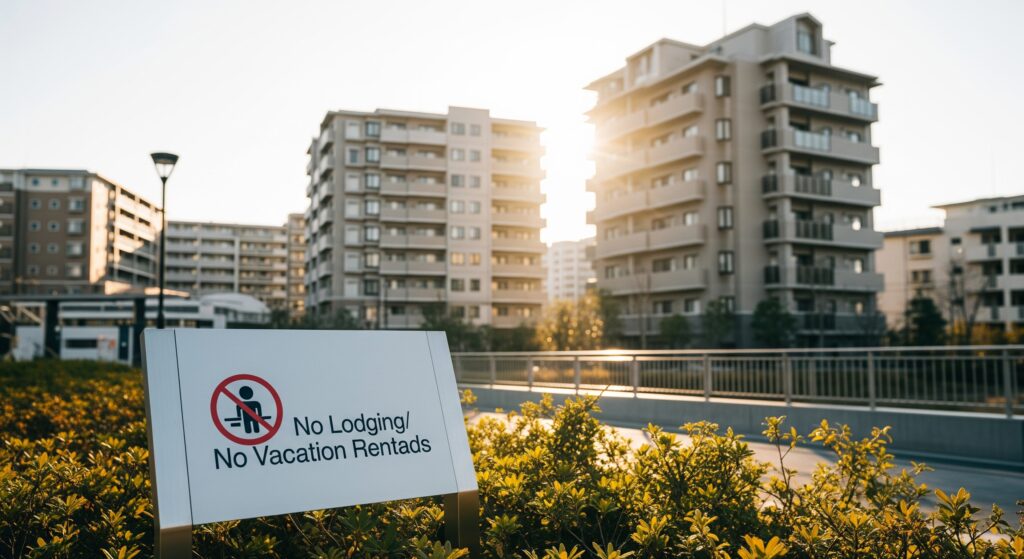
You may have come across the term “Category I Medium-to-High-Rise Exclusive Residential District” (第一種中高層住居専用地域). As the name suggests, this zone is designated to protect a good residential environment for mid-to-high-rise housing, and to cut straight to the point: operating a ryokan business or Tokku Minpaku (National Strategic Special Zone Foreign Visitor Accommodation Business) is generally prohibited here.
“Wait, really? Do I need to start my property search all over again?”
“I have no idea which zoning district my property falls under…”
“Why can’t I run a ryokan business in a residential-only zone?”
You may have questions like these. If you proceed with a contract without knowing this information, you could end up being denied a permit later on, wasting significant time and money in the process. In this article, for those considering operating a ryokan business or Tokku Minpaku, we’ll explain the following points in detail:
- What are zoning districts? Understanding the basics
- Why ryokan businesses and Tokku Minpaku cannot operate in Category I Medium-to-High-Rise Exclusive Residential Districts
- Whether ryokan business and minpaku are permitted in other zoning districts
- How to check the zoning district of your property
- Other important points to watch out for beyond zoning districts when running a ryokan business or minpaku
Knowing this information in advance will help you avoid wasted effort and move your minpaku or ryokan business plan forward smoothly.
What Are Zoning Districts? Understanding the Basics
First, let’s understand the basic concept of “zoning districts” to see why they affect ryokan business and minpaku operations in the first place.
1. “Zoning” — The Foundation of Urban Planning
Zoning districts are designations established under the City Planning Act that restrict the types of buildings, building uses, and building heights permitted in each area. Urbanized areas throughout Japan (regions where people gather to live) are broadly divided into 13 types of zoning districts.
The purpose of this system is to prevent chaotic, unplanned development and to create a favorable urban environment by appropriately allocating residential, commercial, and industrial areas. For example, if a factory operating 24 hours a day or a commercial facility that’s noisy late into the night were built right next to a quiet residential neighborhood, the living environment would suffer. To prevent this kind of mismatch, the zoning district system assigns “suitable uses” to each area.
It’s easiest to think of it as **zoning**—dividing land into “areas for living,” “areas for commercial activity,” and “areas for industrial activity.”
2. What’s Restricted Is “Building Use”
What’s particularly important about zoning districts is the restriction on **”what kind of building use is permitted on that land.”** For example, you might be allowed to build a residential house but not a hotel or factory.
Within this classification of “building use” are the categories we’re focusing on here: “ryokan business (hotels, ryokan, etc.)” and “shared housing” (which includes registered lodging houses under the Minpaku New Law as well as Tokku Minpaku facilities). Therefore, before renting or purchasing a property, you must always check the zoning district in which that property is located.
Why Ryokan Business and Tokku Minpaku Cannot Operate in Category I Medium-to-High-Rise Exclusive Residential Districts
Now, let’s get to the main topic. Let’s take a specific look at why ryokan business and Tokku Minpaku operations aren’t permitted in “Category I Medium-to-High-Rise Exclusive Residential Districts.”
1. An Area Where “Residential-Only” Use Takes Top Priority
As the name suggests, the Category I Medium-to-High-Rise Exclusive Residential District is designated to “protect a favorable living environment for mid-to-high-rise housing.” The “mid-to-high-rise housing” referred to here means shared housing such as apartments and condominiums.
In this district, protecting the residential environment takes top priority so that nearby residents can enjoy a quiet, peaceful lifestyle. As a result, the following types of facilities are either restricted or not permitted at all:
- Large-scale commercial facilities (those with substantial floor space)
- Factories
- Entertainment facilities (pachinko parlors, karaoke boxes, etc.)
- Accommodation facilities such as hotels and ryokan
Since these types of facilities involve traffic from an unspecified number of people and can have a considerable impact on the surrounding residential environment—through noise, increased traffic, waste issues, and so on—they’re deemed incompatible with exclusive residential districts.
2. Restrictions Under the Building Standards Act
This principle is specifically codified in the Building Standards Act. Article 48 of the Building Standards Act sets out in detail the types of buildings permitted in each zoning district, and in Category I Medium-to-High-Rise Exclusive Residential Districts, the construction of “hotels or ryokan”—including ryokan, hotels, and simple lodging houses—is, in principle, not permitted.
[Excerpt from Building Standards Act, Article 48, Paragraph 7]
Within Category I Medium-to-High-Rise Exclusive Residential Districts, hotels, ryokan, and other similar facilities as specified by Cabinet Order shall not be constructed.
This “facilities specified by Cabinet Order” is clearly defined in Article 130-4 of the Enforcement Order of the Building Standards Act as ryokan, hotels, and simple lodging houses. Therefore, facilities operating under permits obtained pursuant to the Hotel and Ryokan Business Act—including hotels, ryokan, and simple lodging houses—can neither be built nor operated in this district.
3. Tokku Minpaku (National Strategic Special Zone Foreign Visitor Accommodation Business) Is Also Off-Limits
So what about Tokku Minpaku? Tokku Minpaku is the “National Strategic Special Zone Foreign Visitor Accommodation Business” established under the National Strategic Special Zone Act—a special system under which certain provisions of the Hotel and Ryokan Business Act are relaxed. However, even Tokku Minpaku cannot be operated in Category I Medium-to-High-Rise Exclusive Residential Districts.
The laws and cabinet orders governing the Tokku Minpaku system (such as the Enforcement Order of the National Strategic Special Zone Act) separately specify which zoning districts permit this type of business, and exclusive residential districts are generally excluded. This is because, as Tokku Minpaku is also a form of accommodation facility, its impact on the residential environment must be taken into consideration.
Notably, unlike registered lodging houses under the Minpaku New Law (Private Lodging Business Act), Tokku Minpaku has no limit on the number of operating days per year and functions more like a traditional ryokan business. As a result, zoning restrictions are applied more strictly to it as well.
Leave Your Minpaku Management to Us
Free Online ConsultationWhether Ryokan Business and Minpaku Are Permitted in Other Zoning Districts
Can you operate a ryokan business or minpaku in zoning districts other than the Category I Medium-to-High-Rise Exclusive Residential District? Let’s look at what’s permitted in other major zoning districts.
1. Ryokan Business (Hotels, Ryokan, Simple Lodging Houses, etc.)
Facilities governed by the Hotel and Ryokan Business Act (hotels, ryokan, simple lodging houses) can generally be built and operated in the following zoning districts:
- Neighborhood Commercial District, Commercial District: These are the hubs of commercial activity, and the construction of hotels and ryokan is generally permitted. These areas thrive on bustling activity and high accommodation demand.
- Quasi-Industrial District: This area primarily mixes light industrial factories with service facilities, but the construction of hotels and ryokan may also be permitted here.
- Category I Residential District, Category II Residential District: These residential districts have more relaxed restrictions than medium-to-high-rise exclusive residential districts, and hotels and ryokan may be permitted alongside shops and offices below a certain size. That said, conditions vary depending on municipal ordinances and the scale of the building, so verification is always necessary. For example, in a Category II Residential District, shops, offices, and even bowling alleys of a certain size can be built, so hotels tend to be relatively easier to approve here as well.
- Quasi-Residential District: This district, typically found along major roads, mixes automobile-related facilities with residential housing, and the construction of hotels and ryokan is permitted.
Conversely, in even more strictly protected low-rise residential areas—such as the Category I Low-Rise Exclusive Residential District and Category II Low-Rise Exclusive Residential District—ryokan business facilities are, in principle, not permitted under any circumstances.
2. Tokku Minpaku (National Strategic Special Zone Foreign Visitor Accommodation Business)
The zoning districts where Tokku Minpaku is permitted vary by municipality, but the following districts tend to be designated most often:
- Neighborhood Commercial District, Commercial District: Given their high convenience for tourists and strong accommodation demand, many municipalities designate these areas as eligible for Tokku Minpaku.
- Quasi-Industrial District, Industrial District (partial): In some municipalities such as Osaka City, Tokku Minpaku may be permitted in quasi-industrial districts or in industrial districts that meet certain conditions.
- Quasi-Residential District, Category I Residential District, Category II Residential District (partial): Depending on the municipality’s judgment, Tokku Minpaku may be permitted even in these residential districts, but strict conditions regarding location and scale are typically imposed out of consideration for the residential environment.
While Tokku Minpaku is a system established at the national level, the specific areas where it can actually be implemented are governed in detail by each municipality’s own ordinances (area plans). Therefore, if you’re considering Tokku Minpaku, you must always check the **”Area Plan for the National Strategic Special Zone Foreign Visitor Accommodation Business”** or similar documentation on the website of the municipality in question.
3. Registered Lodging Houses Under the Minpaku New Law (Private Lodging Business Act)
Finally, let’s look at registered lodging houses under the **Minpaku New Law (Private Lodging Business Act)**. Because this system limits operations to 180 days per year, it can be operated in a relatively wide range of zoning districts.
- All residential zoning districts, including the Category I Medium-to-High-Rise Exclusive Residential District: Even in exclusive residential districts, operation is possible if the property is registered as a lodging house under the Minpaku New Law. This is because the nature of the business is essentially “renting out a portion of a residential home,” and since the number of operating days is limited, the impact on the residential environment is judged to be relatively minor.
That said, even under the Minpaku New Law, some municipalities have established their own additional ordinances (stricter or supplementary local regulations). For example, additional restrictions are common, such as prohibiting operation near schools or hospitals, or limiting operation to specific periods of the year. So even when filing a notification under the Minpaku New Law, it’s essential to check the ordinances of each municipality.
How to Check the Zoning District of Your Property
Some of you may be wondering, “I have no idea what zoning district the property I’m considering falls under…” There are a few ways to find out.
1. Municipal “City Planning Information” or “Zoning District Maps”
The most reliable and convenient method is to check the **”City Planning Information”** or **”Zoning District Map”** published on each city, ward, town, or village’s website. Many municipalities offer online GIS (Geographic Information System) tools where you can simply enter an address to find out the zoning district.
Example search terms: “[City Name] zoning district map” or “[City Name] city planning information”
The map is color-coded, allowing you to see at a glance which zoning district your property falls under.
2. Ask a Real Estate Agent
The real estate agent handling the property listing should know the zoning district. Be sure to confirm this before signing a contract—it’s also listed in the Important Matters Explanation Document (juyō jikō setsumeisho).
3. Contact the City Planning Division or Building Guidance Division at City Hall
If you can’t find the information online, or if you have questions, the most reliable option is to contact the City Planning Division or Building Guidance Division of the municipality where the property is located directly. You can reach out by phone or visit the counter in person for a consultation.
Other Important Points to Watch Out for Beyond Zoning Districts When Running a Ryokan Business or Minpaku
While zoning is extremely important, there are various other regulations and requirements to check when operating a ryokan business or minpaku.
1. Fire Service Act
The Fire Service Act is a law designed to protect lives and property from fire, and it applies strictly to ryokan and minpaku facilities. Depending on the size and structure of the building, installation of automatic fire alarm systems, sprinklers, emergency exit signs, fire extinguishers, and other equipment may be mandatory. When converting an existing building, the cost of newly installing or renovating these fire safety systems can turn out to be substantial in many cases.
2. Building Standards Act (Structure, Evacuation Routes, etc.)
Beyond zoning, the Building Standards Act also sets out a wide range of standards covering building structure, earthquake resistance, natural lighting and ventilation, and the critical matter of evacuation route requirements. Particularly for facilities used as accommodations, requirements such as the width of evacuation routes, the number of exits, and the display of emergency exit signage are strictly checked to ensure that an unspecified number of guests can evacuate safely.
3. The Hotel and Ryokan Business Act, the Private Lodging Business Act, and the National Strategic Special Zone Act
Naturally, you’ll need a thorough understanding of the specific law governing your chosen business format.
- Hotel and Ryokan Business Act: Hotels, ryokan, simple lodging houses, and boarding houses each have their own permit criteria, with detailed requirements covering mandatory front desk staffing (except for simple lodging houses), guest room size, and structural equipment standards.
- Private Lodging Business Act (Minpaku New Law): This requires checking the 180-day annual operating day limit, the distinction between owner-occupied and owner-absent operations, housing requirements, the mandatory notification process, and each municipality’s supplementary or stricter local ordinances.
- National Strategic Special Zone Act (Tokku Minpaku): This requires checking stay length restrictions (generally a minimum of 2 nights/3 days, though this varies by municipality), facility requirements (such as minimum size), the fact that eligibility is limited to specific designated areas, and the content of each municipality’s area plan.
4. Other Considerations (Disputes with Neighbors, Building Management Bylaws, etc.)
- Disputes with Neighbors: Noise, garbage, illegal dumping, and suspicious visitors are unavoidable issues in minpaku and ryokan operations. Advance explanations to neighbors, strict enforcement of house rules, and a solid complaint-response system are all essential.
- Condominium Management Bylaws: If you plan to use a condominium unit for a minpaku or ryokan business, be aware that condominium management bylaws very often prohibit commercial use. Failing to check the management bylaws can lead to contract termination or even litigation.
These factors can’t simply be addressed one at a time in isolation—only a property that comprehensively clears all of these requirements together can legally operate a ryokan business or minpaku.
Summary
When operating a minpaku or ryokan business, property selection is an extremely important process, and checking the zoning district in particular is an unavoidable first step.
The “Category I Medium-to-High-Rise Exclusive Residential District” exists to protect a favorable residential environment, and ryokan business and Tokku Minpaku operations are, in principle, not permitted here. This is strictly regulated by the Building Standards Act and by the laws and cabinet orders governing each respective business format. Keep in mind that if you sign a property contract without knowing this, you risk being denied a permit later and wasting significant time and money.
You can easily check your property’s zoning district through the “City Planning Information” or “Zoning District Map” published on your municipality’s website. You can also inquire with a real estate agent or the relevant department at city hall.
It’s not just zoning that matters—legal operation is only possible for a property that comprehensively clears a wide range of regulations and requirements, including the Fire Service Act, the Building Standards Act, the specific laws governing each business format, local municipal ordinances, and even condominium management bylaws.
Thorough research in advance, along with seeking expert advice when needed, is the key to making your minpaku or ryokan business a success.
Contact Stay Buddy for Support with Property Selection and Permit Applications for Your Ryokan Business or Minpaku
“I want to know whether my property is in an area where I can operate a ryokan business or minpaku.”
“I’m uneasy about interpreting complex laws and ordinances.”
“I’d like comprehensive support, from property search all the way through to permit application.”
Do you have concerns like these about starting or operating a ryokan business or minpaku?
At Stay Buddy Co., Ltd., our specialist team provides consistent, end-to-end support—from checking zoning districts, to clearing regulations under the Building Standards Act, Fire Service Act, Hotel and Ryokan Business Act, the Private Lodging Business Act, and Tokku Minpaku rules, all the way through to the permit application process.
With our extensive experience and expertise, we’ll help ensure your property search and business launch go smoothly, so you can achieve safe, reliable accommodation operations with peace of mind. Feel free to reach out to us anytime.